- Animals
- ›Flatworms
- ›Rhabditophora
- ›Planarians
- ›Continenticola
- ›Geoplanoidea
- ›Land Planarians
- ›Hammerhead Worms
- ›Bipalium
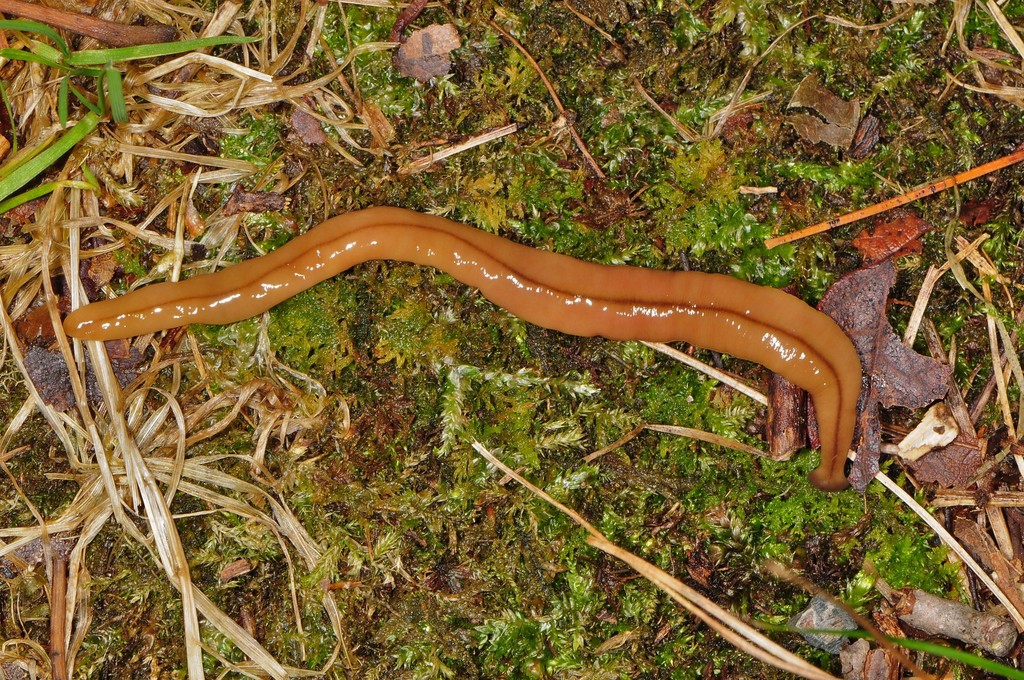
Wandering Broadhead Planarian
Bipalium adventitium
Bipalium adventitium, the wandering broadhead planarian, is a land planarian in the subfamily Bipaliinae. Native to Asia, it has been accidentally introduced in the United States, where it is considered invasive.
From the article Bipalium adventitium on Wikipedia (CC BY-SA), quoted section by section
Description
Most adult individuals of B. adventitium are 5–8 cm (2.0–3.1 in) in length. The head is expanded and fan-shaped, being easily distinguishable from other common species of Bipalium, such as Bipalium kewense and Bipalium pennsylvanicum, because these have a head in the shape of a half moon. The body has a yellow to tan color and has one dark dorsal stripe that does not extend over the head.
Wikipedia: “Appearance”
What it does
Differently from Bipalium kewense, which usually reproduces asexually by fission, Bipalium adventitium more commonly reproduces sexually. It is suggested that it has only one breeding season per year. As in most land planarians, mating occurs by internal fertilization when two individuals meet. The eggs are deposited in egg capsules and after about 3 weeks they release 1–6 juveniles.
Wikipedia: “Reproduction”
Where it lives
Recorded sightings
—
geo-referenced records in GBIF, from museums, herbaria and field observers.
Drag the globe to turn it. Dots are where records exist, not a range map; darker means more records.
In the stacks
Searching the stacks…
Every page naming Bipalium adventitium in the Biodiversity Heritage Library →
This page is assembled live from iNaturalist, GBIF, Wikipedia, the Source Library and the Internet Archive. It is not yet part of the hand-edited codex. iNaturalist taxon 82290.