On eBird ↗
Stubble Quail
Live sightings near you, the range map, bar charts of when it is seen, and Macaulay Library photos and recordings.
Stubble Quail
Coturnix pectoralis
The stubble quail (Coturnix pectoralis), whose other common names include grey quail and pectoral quail, is a species of Old World quail native to Australia. The species is widespread in mainland Australia and is listed as least concern by the IUCN, and can be found throughout all states and territories of Australia except Tasmania. It is the only native upland game bird that can be legally hunted in Australia, though with strict game law restrictions.
From the article Stubble quail on Wikipedia (CC BY-SA), quoted section by section
Description
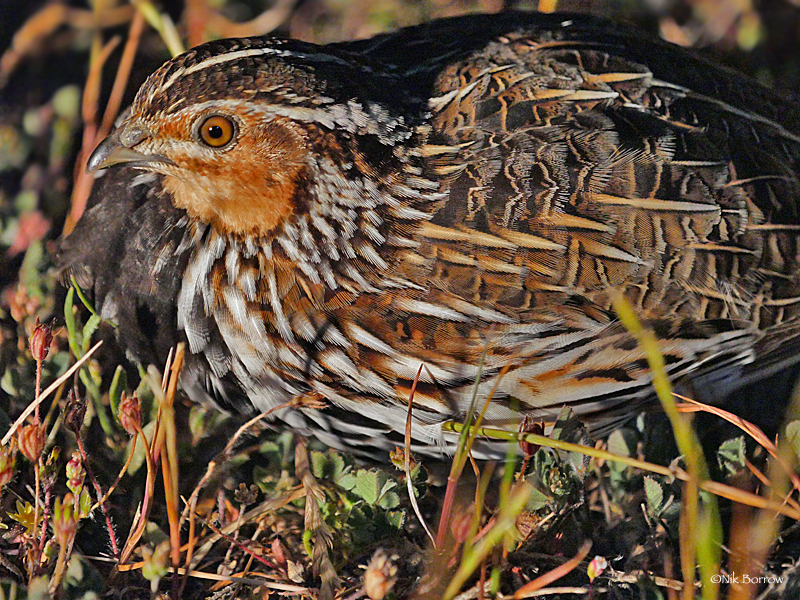
The stubble quail is a ground dwelling bird that is characterised by its dark brown feathers with a cream coloured strip down the centre of each feather giving rise to stripes down the length of the bird. It is a plump species that is larger than other native quails. Male birds will mature at about 18.0–18.5 cm long and females are generally slightly larger. Adult males weigh around 100g and the females around 110g with all birds having a wingspan of between 25–33 cm. The stubble quail can also be identified by the loud whirring noise made by their wings during take-off into flight once disturbed from on the ground.
Similar species. The brown quail is also a member of the family Phasianidae that looks similar to the stubble quail; however, the brown quail appears darker in colour. The white streaks that are obvious on the back of the stubble quail are thinner and less obvious on the brown quail. The brown quail does not have white streaks underneath its body like the stubble quail, but has black horizontal bars instead. This makes the brown quail look much darker than the stubble quail in flight. The brown quail's wings produce a whistling noise when flushed, which is different from the whirring sound produced by the stubble quail's wings. …
Range & habitat
Stubble quail are found in a diverse range of habitats from very dry parts of Australia to alpine grasslands. Stubble quail are more common in the high rainfall areas of southeastern and western Australia though are often found in the arid zone after above average rainfall. The species was found in all Australian states including Tasmania up until the 1940s to 1960s when they became extinct in Tasmania. On the mainland stubble quail are found in a variety of biomes but tend to avoid wooded areas as the canopy obstructs the growth of thick grassy undergrowth that they prefer. They prefer a habitat of tall grassland made up of native or introduced grasses, and crops. The density of the ground cover is highly important for stubble quail habitat as the birds prefer very dense vegetation. A high density of kangaroos and rabbits (or any grazing animal) in an area can decrease the height and density of grassland vegetation and make the habitat unsuitable for stubble quail. They are frequently found in agricultural areas after the harvest of cereal crops, where they feed on grain and insects.
Wikipedia: “Distribution and habitat”
Listen
Looking for field recordings…
Where it lives
Recorded sightings
—
geo-referenced records in GBIF, from museums, herbaria and field observers.
Drag the globe to turn it. Dots are where records exist, not a range map; darker means more records.
In the stacks
Searching the stacks…
Every page naming Coturnix pectoralis in the Biodiversity Heritage Library →
This page is assembled live from iNaturalist, GBIF, Wikipedia, the Source Library and the Internet Archive. It is not yet part of the hand-edited codex. iNaturalist taxon 825.