- Animals
- ›Chordates
- ›Vertebrates
- ›Birds
- ›Swifts and Hummingbirds
- ›Hummingbirds
- ›Bee Hummingbirds, Emeralds, Mountain-gems, and Allies
- ›Emerald Hummingbirds and Allies
- ›Campylopterus
On eBird ↗
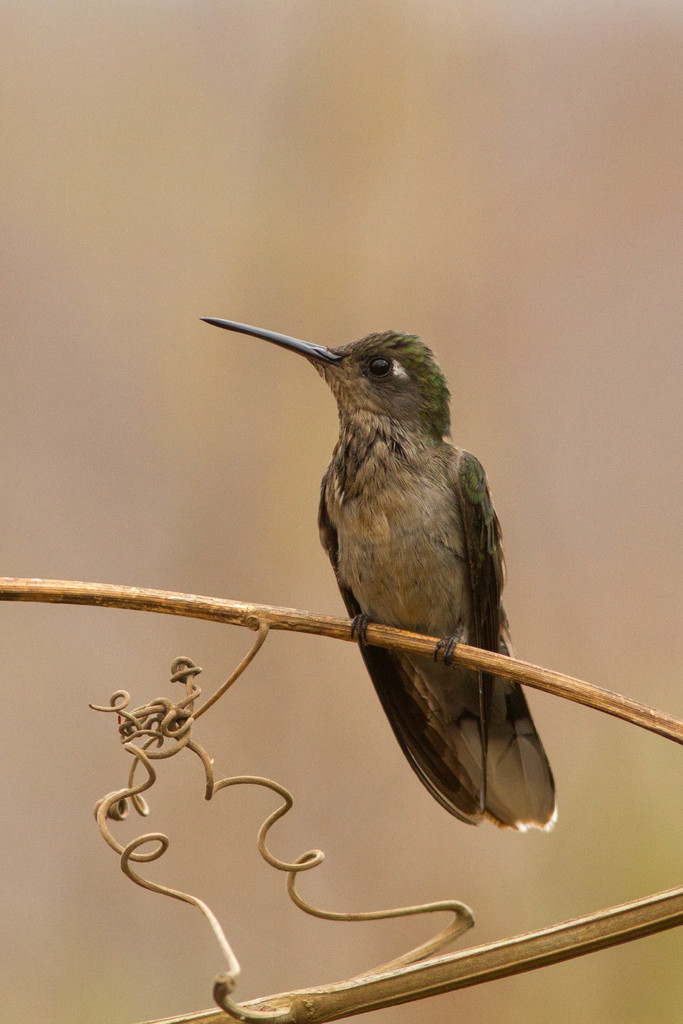
Outcrop Sabrewing
Live sightings near you, the range map, bar charts of when it is seen, and Macaulay Library photos and recordings.
Dry-forest Sabrewing
Campylopterus calcirupicola
The dry-forest sabrewing (Campylopterus calcirupicola) is a species of hummingbird found only in Brazil. It is endemic to the Atlantic dry forests of the country's eastern portion, especially the states of Minas Gerais, Bahia, and Goiás.
From the article Outcrop sabrewing on Wikipedia (CC BY-SA), quoted section by section
Description
The outcrop sabrewing is very similar to its "parents", the grey-breasted and especially the Diamantina sabrewings. Males weigh about 7.0 g (0.25 oz) and females 5.9 g (0.21 oz). The sexes have almost identical plumage. Their bill is long and slightly decurved. Their upperparts are bright bronze green with coppery reflections on the darker crown. They have a white spot behind the eye. Their underparts are pale gray that lightens to whitish on the abdomen and light gray on the undertail coverts. Their central pair of tail feathers is bright bronze green, the next pair bright bronze green with a dark olive gray spot at the end, and the rest have bright bronze green bases, narrow dark olive gray bands near the tip, and white tips.
Range & habitat
The outcrop sabrewing is found only in a small part of eastern Brazil. It is known from northeastern Goiás, southwestern Bahia, and northern Minas Gerais, and suspected to also be found in southeastern Tocantins and southern Piauí. Though exact details of its habitat requirements have not been determined, it is known mostly from dry forests on limestone outcrops and calcareous soils derived from them. It is known only in a very limited elevational range between 460 and 880 m (1,500 and 2,900 ft).
Wikipedia: “Distribution and habitat”
What it does
The outcrop sabrewing's foraging strategy and diet are poorly known, but it does take nectar from a variety of native and introduced plant species.
Wikipedia: “Feeding”
Listen
Looking for field recordings…
Where it lives
Recorded sightings
—
geo-referenced records in GBIF, from museums, herbaria and field observers.
Drag the globe to turn it. Dots are where records exist, not a range map; darker means more records.
In the stacks
Searching the stacks…
Every page naming Campylopterus calcirupicola in the Biodiversity Heritage Library →
This page is assembled live from iNaturalist, GBIF, Wikipedia, the Source Library and the Internet Archive. It is not yet part of the hand-edited codex. iNaturalist taxon 827379.