On eBird ↗
Purple-backed Fairywren
Live sightings near you, the range map, bar charts of when it is seen, and Macaulay Library photos and recordings.
Purple-backed Fairywren
Malurus assimilis
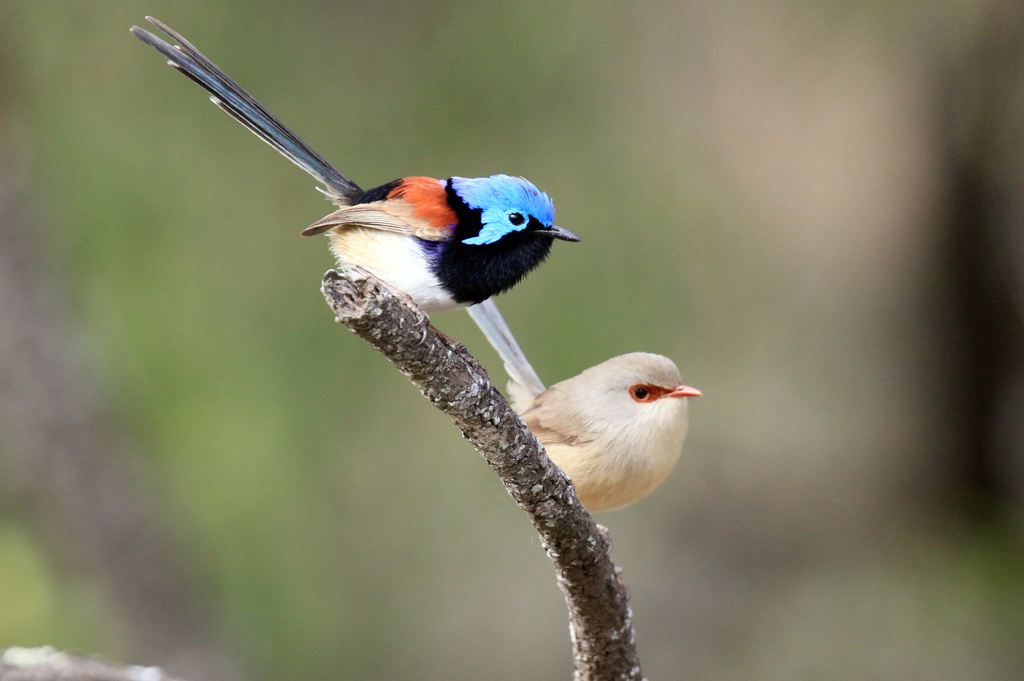
The purple-backed fairywren (Malurus assimilis) is a fairywren that is native to Australia. Described by Alfred John North in 1901, it has four recognised subspecies. In a species that exhibits sexual dimorphism, the brightly coloured breeding male has chestnut shoulders and azure crown and ear coverts, while non-breeding males, females and juveniles have predominantly grey-brown plumage, although females of two subspecies have mainly blue-grey plumage. Distributed over much of the Australian continent, the purple-backed fairywren is found in scrubland with plenty of vegetation providing dense cover.
From the article Purple-backed fairywren on Wikipedia (CC BY-SA), quoted section by section
Description
The purple-backed fairywren is on average 14.5 cm (5.5 in) long. Like other fairywrens, it is notable for its marked sexual dimorphism, males adopting a highly visible breeding plumage of brilliant iridescent blue and chestnut contrasting with black and grey-brown. The brightly coloured crown and ear tufts are prominently featured in breeding displays. The male in breeding plumage has striking bright blue ear coverts and blue-purple crown and forehead, a black throat and nape, a blue-purple upper back, chestnut shoulders and a bluish-grey tail. The wings are drab brown and the belly white. Within subspecies assimilis, the plumage of both sexes is becomes paler from east to west across its range, with those of northwestern Australia paler still. Non-breeding males, females and juveniles of subspecies assimilis are predominantly grey-brown in colour, while those of subspecies rogersi and dulcis are mainly blue-grey. Males of all subspecies have a black bill and lores (eye-ring and bare skin between eyes and bill), while females of subspecies assimilis and rogersi have a red-brown bill and bright rufous lores, and those of subspecies dulcis have white lores. …
Range & habitat
The purple-backed fairywren is widely distributed over much of the Australian continent. It is replaced in southwestern Western Australia by the red-winged and blue-breasted fairywrens, and by the lovely fairywren north of a line between Normanton and Townsville in north Queensland. Some early evidence suggested subspecies assimilis may be nomadic, but later more detailed fieldwork indicated it was generally sedentary, with pairs of purple-backed fairywrens maintaining territories year-round. There is little information on the other subspecies. It is found in scrubland with plenty of vegetation providing dense cover. It prefers rocky outcrops and patches of Acacia, Eremophila or lignum in inland and northern Australia. Fieldwork in the Northern Territory showed that the species preferred open woodland dominated by thickets of lancewood (Acacia shirleyi) and bullwaddy (Macropteranthes kekwickii) than eucalyptus. Chenopod scrubland with plants such as saltbush, bluebush, black rolypoly (Sclerolaena muricata), nitre goosefoot (Chenopodium nitrariaceum), grass tussocks, and overstory plants such as black box (Eucalyptus largiflorens) and native cypress (Callitris). Clearing of native vegetation for agriculture in the Western Australian wheatbelt and Murray-Mallee region of Victoria had a negative impact on the species, as does the consumption of saltbush by cattle.
Wikipedia: “Distribution and habitat”
In human culture
In his 1982 monograph, ornithologist Richard Schodde proposed a northern origin for the chestnut-shouldered fairywren group due to the variety of forms in north and their absence in the southeast of the continent. Ancestral birds spread south and colonised the southwest during a warm wetter period around 2 million years ago at the end of the Pliocene or beginning of the Pleistocene. Subsequent cooler and drier conditions resulted in loss of habitat and fragmentation of populations. South-western birds gave rise to what is now the red-winged fairywren, while those in the northwest of the continent became the variegated fairywren and yet another isolated in the northeast became the lovely fairywren. Further warmer, humid conditions again allowed birds to spread southwards, this group occupying central southern Australia east to the Eyre Peninsula became the blue-breasted fairywren. Cooler climate after this resulted in this being isolated as well and evolving into a separate species. Finally, after the end of the last glacial period 12,000–13,000 years ago, the northern variegated forms have again spread southwards, resulting in the purple-backed fairywren. This has resulted in the variegated fairywren's range to overlap with all four other species. …
Wikipedia: “Evolutionary history”
Listen
Looking for field recordings…
Where it lives
Recorded sightings
—
geo-referenced records in GBIF, from museums, herbaria and field observers.
Drag the globe to turn it. Dots are where records exist, not a range map; darker means more records.
In the stacks
Searching the stacks…
Every page naming Malurus assimilis in the Biodiversity Heritage Library →
This page is assembled live from iNaturalist, GBIF, Wikipedia, the Source Library and the Internet Archive. It is not yet part of the hand-edited codex. iNaturalist taxon 827392.