On eBird ↗
Madeira Firecrest
Live sightings near you, the range map, bar charts of when it is seen, and Macaulay Library photos and recordings.
Madeira Firecrest
Regulus madeirensis
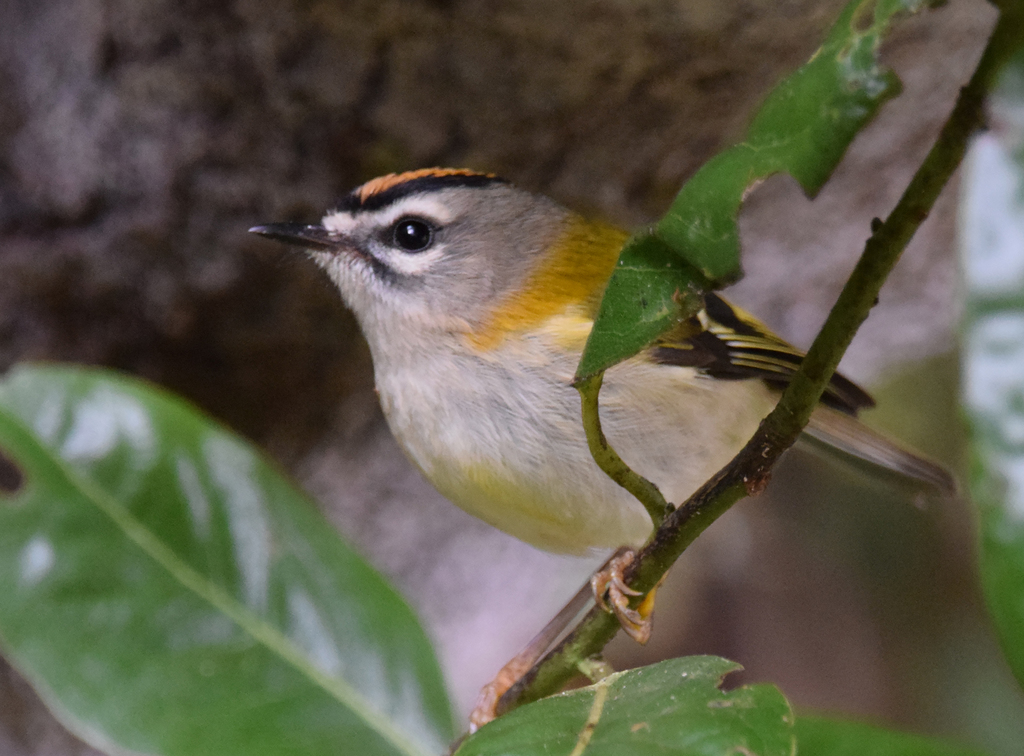
The Madeira firecrest, Madeira kinglet, or Madeiracrest (Regulus madeirensis) is a very small passerine bird endemic to the island of Madeira. It is a member of the kinglet family. Before it was recognised as a separate species in 2003, it was classified as a subspecies of the common firecrest. It differs in appearance and vocalisations from its relative, and genetic analysis has confirmed it as a different species. The Madeiran bird has green upperparts, whitish underparts and two white wingbars, and a distinctive head pattern with a black eye stripe, short white supercilium, and a crest that is mainly orange in the male and yellow in the female.
The female Madeira firecrest builds a spherical nest from cobwebs, moss and small twigs, and she incubates the eggs and broods the chicks on her own. Both parents feed the young. This species forages for insects and other small invertebrates in tree heath, laurisilva and other woodland. It is common within its restricted range, and is not considered to be threatened.
From the article Madeira firecrest on Wikipedia (CC BY-SA), quoted section by section
Description
The Madeira firecrest is a small plump bird, of 9–10 cm (3.5–3.9 in) length and weighing about 5 g (0.18 oz). It has bright olive-green upperparts with a bronze-coloured patch on each shoulder, and whitish underparts washed with brownish grey on the breast and flanks. It has two white wingbars, a tiny black bill and brownish-black legs. The head pattern is striking, with a black eye stripe, white supercilium and a crest which is yellow in the female and mainly orange in the male. Juveniles have a grey tinge to the duller upperparts, and lack the crown and eye stripes and supercilium; by their first winter, only the flight and tail feathers remain unmoulted, and the young birds are virtually indistinguishable from the adults in the field. This kinglet usually hops with its body held horizontally, and its flight is weak and whirring, with occasional jinking. Compared to the common firecrest, the Madeiran firecrest has a longer bill and legs, a shorter white supercilium, more black on the wings and a deeper golden-bronze shoulder patch; the male's crest is duller orange. …
Range & habitat
The Madeira firecrest is endemic to the main island of Madeira. It occurs mainly at higher levels from 600 to 1,550m (1,950–4,900ft) in all types of forests and scrub, but with a preference for tree heaths. It can also descend to lower areas after breeding. Although it is strongly adapted to endemic tree heaths, it also breeds in broom, Vaccinium, relict laurel forest, oak-dominated deciduous forest and stands of the introduced Japanese cedar, Cryptomeria japonica. It is absent from the alien eucalyptus and acacia plantations which have replaced much of the endemic Madeiran laurel forest.
Wikipedia: “Distribution and habitat”
What it does
All Regulus species are almost exclusively insectivorous, preying on small arthropods with soft cuticles, such as springtails, aphids and spiders. They also feed on the cocoons and eggs of spiders and insects, and occasionally take pollen. Regulus madeirensis favours large-sized prey such as moths and caterpillars (Lepidoptera). The Madeira firecrest feeds in trees, exploiting mainly the upper surface of branches in coniferous habitat and of leaves in deciduous trees. This is in contrast to the goldcrest, which frequently feeds on the undersides of branches and leaves. The Madeira firecrest also forages in the moss and lichen which often covers the branches and trunks of laurel and oak trees.
Wikipedia: “Feeding”
Listen
Looking for field recordings…
Where it lives
Recorded sightings
—
geo-referenced records in GBIF, from museums, herbaria and field observers.
Drag the globe to turn it. Dots are where records exist, not a range map; darker means more records.
In the stacks
Searching the stacks…
Every page naming Regulus madeirensis in the Biodiversity Heritage Library →
This page is assembled live from iNaturalist, GBIF, Wikipedia, the Source Library and the Internet Archive. It is not yet part of the hand-edited codex. iNaturalist taxon 827402.