On eBird ↗
Peruvian Pipit
Live sightings near you, the range map, bar charts of when it is seen, and Macaulay Library photos and recordings.
Peruvian Pipit
Anthus peruvianus
The Peruvian pipit (Anthus peruvianus) is a species of bird in the family Motacillidae, the wagtails and pipits. It is found in Chile and Peru.
From the article Peruvian pipit on Wikipedia (CC BY-SA), quoted section by section
Description
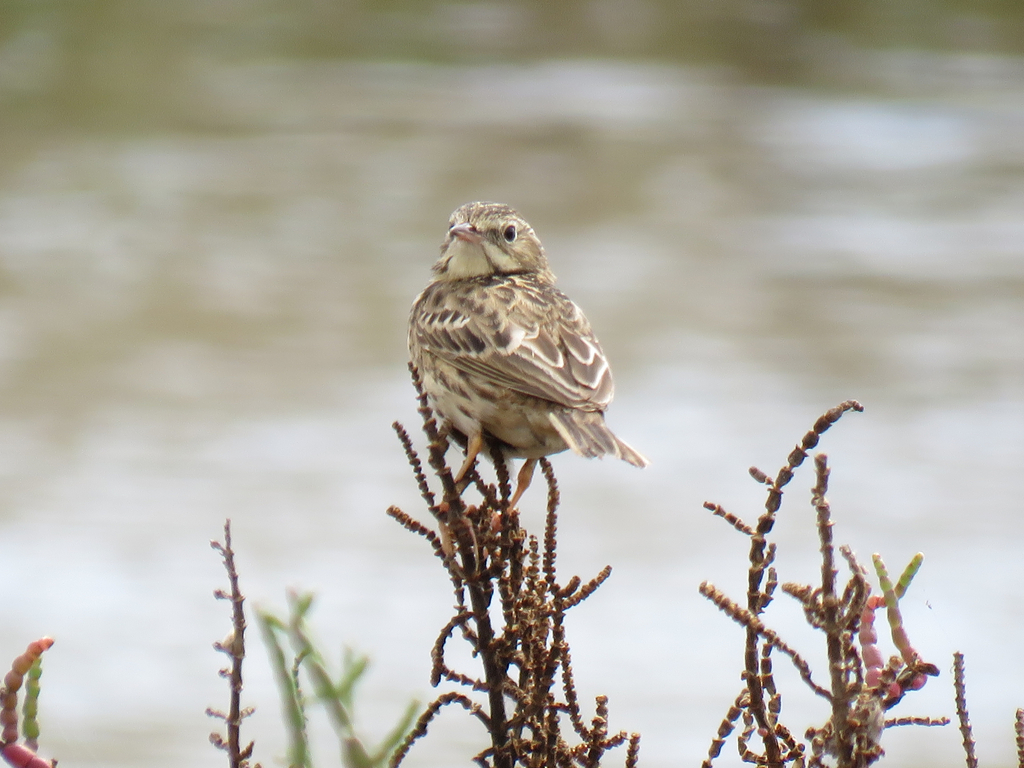
The Peruvian pipit is one of the smallest members of genus Anthus. It is 13 to 14 cm (5.1 to 5.5 in) long. The sexes have the same plumage. Adults have a brown head with a weak whitish supercilium and a thin white eye-ring. Their upperparts are brown with dark streaks and white "braces" on the shoulders. Their wing coverts have pale tips that show as two wing bars. Their flight feathers are blackish brown with buff edges. Their tail is mostly blackish brown with much white on the outer two pairs of feathers. Their throat and underparts are whitish with dark brown streaks in a band across the breast. They have a dark iris, a dark maxilla, a pale pinkish mandible, and pale pinkish legs and feet.
Range & habitat
The Peruvian pipit is found in a thin coastal band from Piura Department in far northwestern Peru south into extreme northwestern Chile's Arica Province. In Peru it inhabits marshes, pastures, and agricultural fields at elevations from sea level up to about 450 m (1,500 ft). In Chile it is found mostly in areas of short grass on sandy soils up to about 100 m (300 ft).
Wikipedia: “Distribution and habitat”
What it does
The Peruvian pipit's diet has not been studied but is known to include insects and thought to also include seeds. It forages while walking and running on the ground.
Wikipedia: “Feeding”
Listen
Looking for field recordings…
Where it lives
Recorded sightings
—
geo-referenced records in GBIF, from museums, herbaria and field observers.
Drag the globe to turn it. Dots are where records exist, not a range map; darker means more records.
In the stacks
Searching the stacks…
Every page naming Anthus peruvianus in the Biodiversity Heritage Library →
This page is assembled live from iNaturalist, GBIF, Wikipedia, the Source Library and the Internet Archive. It is not yet part of the hand-edited codex. iNaturalist taxon 827409.