On eBird ↗
Amazonian Grosbeak
Live sightings near you, the range map, bar charts of when it is seen, and Macaulay Library photos and recordings.
Amazonian Grosbeak
Cyanoloxia rothschildii
The Amazonian grosbeak or Rothschild's grosbeak (Cyanoloxia rothschildii) is a species of grosbeak in the family Cardinalidae, the cardinals or cardinal grosbeaks. It is found in much of the Amazon Basin, in Bolivia, Brazil, Colombia, French Guiana, Guyana, Peru, Suriname, and Venezuela.
From the article Amazonian grosbeak on Wikipedia (CC BY-SA), quoted section by section
Description
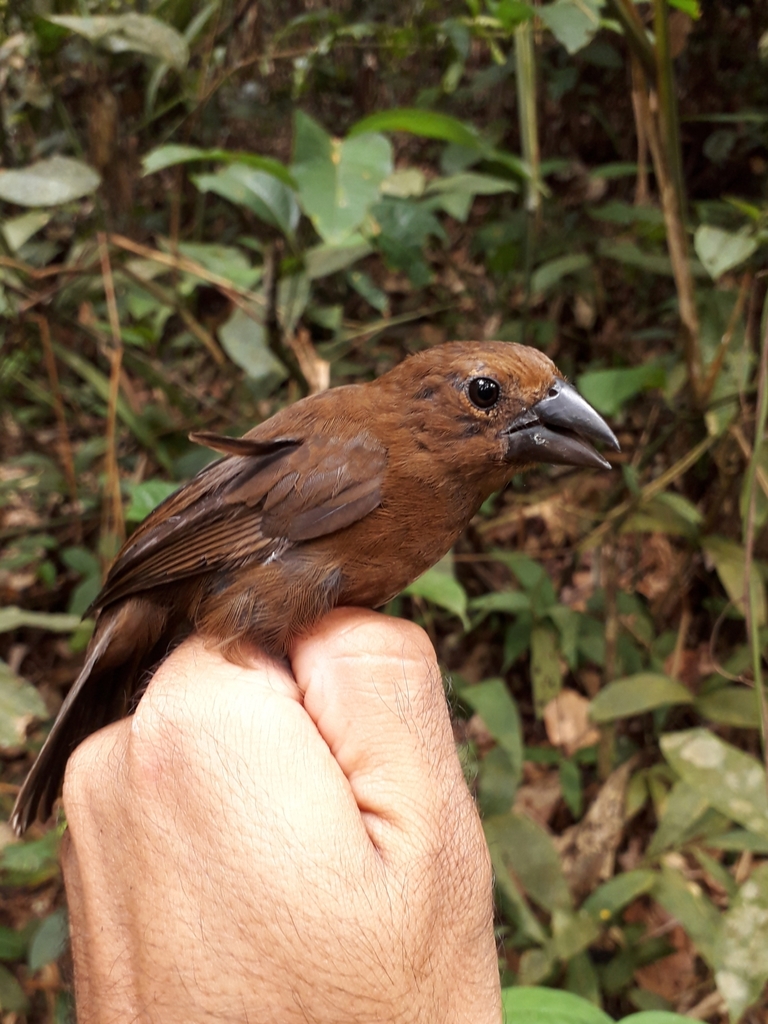
The Amazonian grosbeak is 14.5 to 15 cm (5.7 to 5.9 in) long and weighs 21.5 to 31 g (0.76 to 1.09 oz). The adult male is mostly dark blue. Its forecrown and part of the wings are light blue and the underparts are blackish on the belly. It has a bit of black on the face. The female's upperparts are dark brown and the underparts a paler brown. Juveniles are similar to the female.
Range & habitat
The Amazonian grosbeak is the most widely distributed grosbeak in the Amazon Basin. It is found from eastern Colombia south through eastern Ecuador and Peru to central Bolivia, from southern and eastern Venezuela east through the Guianas, and in all of Amazonian Brazil. In Venezuela it ranges in elevation from near sea level to 1,000 m (3,300 ft), in Peru to 1,400 m (4,600 ft), and in Bolivia mostly to 1,000 m (3,300 ft) and rarely to 1,200 m (3,900 ft). It inhabits the understory and edges of humid primary and tall secondary forests.
Wikipedia: “Distribution and habitat”
What it does
Little is known about the Amazonian grosbeak's feeding behavior and diet, though it appears to eat mostly seeds and fruit with some insects as well.
Wikipedia: “Feeding”
Listen
Looking for field recordings…
Where it lives
Recorded sightings
—
geo-referenced records in GBIF, from museums, herbaria and field observers.
Drag the globe to turn it. Dots are where records exist, not a range map; darker means more records.
In the stacks
Searching the stacks…
Every page naming Cyanoloxia rothschildii in the Biodiversity Heritage Library →
This page is assembled live from iNaturalist, GBIF, Wikipedia, the Source Library and the Internet Archive. It is not yet part of the hand-edited codex. iNaturalist taxon 827410.