On eBird ↗
White-bellied Treepie
Live sightings near you, the range map, bar charts of when it is seen, and Macaulay Library photos and recordings.
White-bellied Treepie
Dendrocitta leucogastra
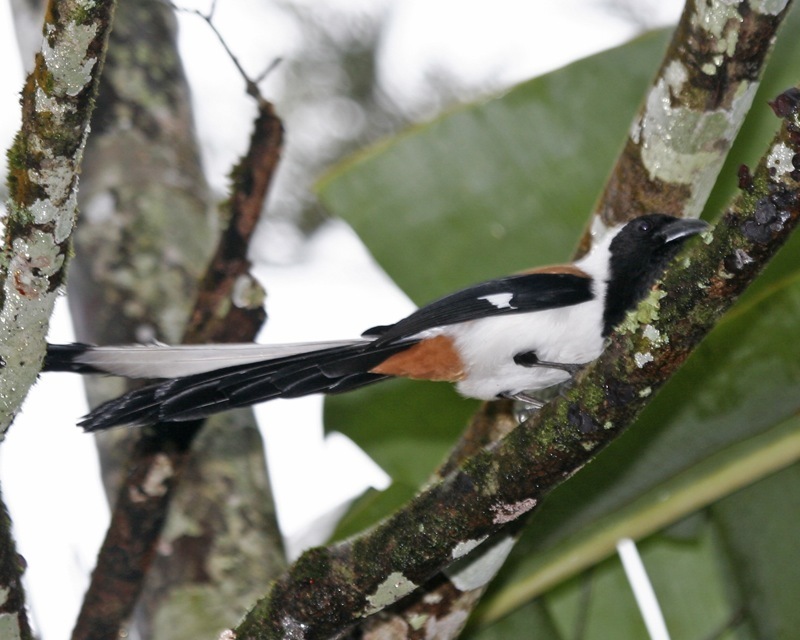
The white-bellied treepie (Dendrocitta leucogastra) is a bird of the crow family endemic to the forests of southern India. They overlap in distribution in some areas with the rufous treepie but are easily to tell apart both from appearance and call.
From the article White-bellied treepie on Wikipedia (CC BY-SA), quoted section by section
Description
The white of the head and body makes it easy to distinguish from the sympatric rufous treepie. This tends to be found in more dense forest and is less associated with human habitation than the rufous treepie. The white-bellied treepie is 48 cm (19 in) long. The back of the neck is white, and the throat and breast are black. The thighs are black, and the undertail coverts are chestnut. The rest of the underparts is white. The back is chestnut-brown. The wings are black and have a white patch. The rump is white. Two-thirds of the two central tail feathers are silver-grey, and the terminal third is black. The other tail feathers are black. The beak is black, and the legs are greyish-black.
Range & habitat
It is found in the forests of the Western Ghats mainly south of Goa. A record from Erimalai near Dharmapuri and reports from the Surat Dangs and the southeastern Ghats of Andhra Pradesh stand outside its main distribution range. A record from central India (Chikalda, Gawilgarh) has been questioned.
Wikipedia: “Distribution”
What it does
The white-bellied treepie eats fruits, seeds, nectar, invertebrates, reptiles, rodents, nestlings and eggs. When calling, the bird bows and droops its wings. Several birds may arrive at one tree and call repeatedly during the pre-monsoon breeding season (mainly April–May but some nests from February). The nest is a platform of twigs on a medium-sized tree. Three eggs are laid, ashy grey with green and grey blotches. It is associated with mixed-species foraging flocks and is often found along with greater racket-tailed drongos.
Wikipedia: “Behaviour and ecology”
Listen
Looking for field recordings…
Where it lives
Recorded sightings
—
geo-referenced records in GBIF, from museums, herbaria and field observers.
Drag the globe to turn it. Dots are where records exist, not a range map; darker means more records.
In the stacks
Searching the stacks…
Every page naming Dendrocitta leucogastra in the Biodiversity Heritage Library →
This page is assembled live from iNaturalist, GBIF, Wikipedia, the Source Library and the Internet Archive. It is not yet part of the hand-edited codex. iNaturalist taxon 8308.