On eBird ↗
Seychelles Paradise-Flycatcher
Live sightings near you, the range map, bar charts of when it is seen, and Macaulay Library photos and recordings.
Seychelles Paradise-Flycatcher
Terpsiphone corvina
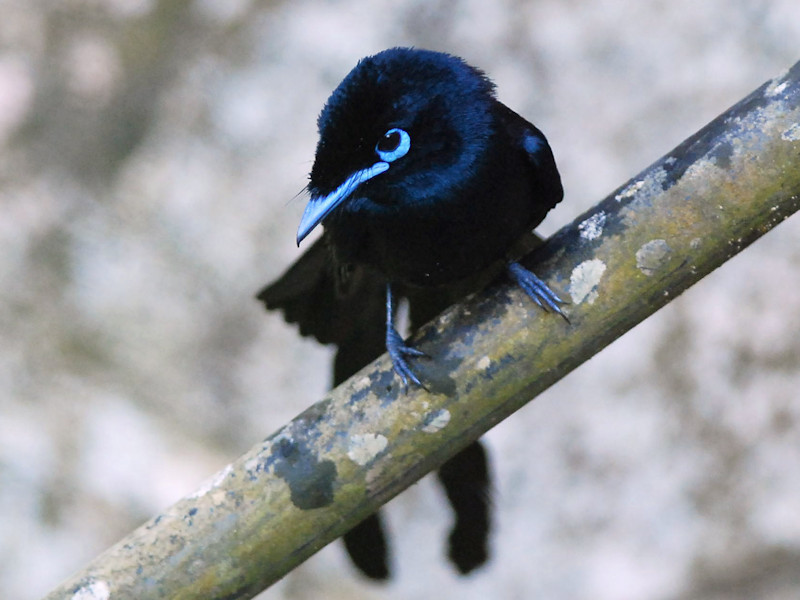
The Seychelles paradise flycatcher (Terpsiphone corvina) is a rare bird from the genus of paradise flycatchers (Terpsiphone) within the family Monarchidae. It is a forest-dwelling bird endemic to the Seychelles where it is native to the island of La Digue. Males have glossy black plumage with elongated tail feathers, while females are reddish-brown with pale underparts and no long tail feathers. The International Union for Conservation of Nature lists this bird as being "Vulnerable" and attempts have been made to increase its numbers by relocating some individuals to Denis Island, another island in the Seychelles archipelago.
From the article Seychelles paradise flycatcher on Wikipedia (CC BY-SA), quoted section by section
Description
The length of the males is about 20 cm. In addition there are two long black central tail feathers which can reach a length of 30 cm. The females can reach a length between 16 and 18 cm (including the tail). The males are entirely glossy black with a deep blue sheen. The upperparts of the females including wings and tail are reddish brown. The underparts are pale cream white. Facial skin, bill, and legs are blue.
Range & habitat
It lives in the Veuve Nature Reserve on La Digue, Seychelles, where it inhabits dense Calophyllum forests. Although a reservation was made especially for this bird, it is common to see it outside in the trees or even in the garden of the Seychellois people. Plans were made to get this bird back into the wild on other islands of the Seychelles.
Wikipedia: “Distribution”
What it does
It preys on insects in flight or from a perch. It also feeds on larvae and spiders. The oval bowl-shaped nest is built on branches and consists of twigs, palm fibre, and spider webs. Both parents, male and female, take care of the little bird until it grows up and each of them provides it with food, mainly in the form of flies for which it got its name.
Wikipedia: “Ecology”
Listen
Looking for field recordings…
Where it lives
Recorded sightings
—
geo-referenced records in GBIF, from museums, herbaria and field observers.
Drag the globe to turn it. Dots are where records exist, not a range map; darker means more records.
In the stacks
Searching the stacks…
Every page naming Terpsiphone corvina in the Biodiversity Heritage Library →
This page is assembled live from iNaturalist, GBIF, Wikipedia, the Source Library and the Internet Archive. It is not yet part of the hand-edited codex. iNaturalist taxon 8358.