On eBird ↗
King Bird-of-Paradise
Live sightings near you, the range map, bar charts of when it is seen, and Macaulay Library photos and recordings.
King Bird-of-Paradise
Cicinnurus regius
The king bird-of-paradise (Cicinnurus regius) is a passerine bird of the Paradisaeidae (bird-of-paradise) family. It is considered by the IOC checklist to be the only member of the genus Cicinnurus, although the genus Diphyllodes is closely related and is subsumed under Cicinnurus by many other authorities.
The king bird-of-paradise is a common and wide-ranging species, distributed throughout lowland forests of New Guinea and western satellite islands. Some populations range quite high into the hills and lower mountains, and these are poorly known as yet.
From the article King bird-of-paradise on Wikipedia (CC BY-SA), quoted section by section
Description
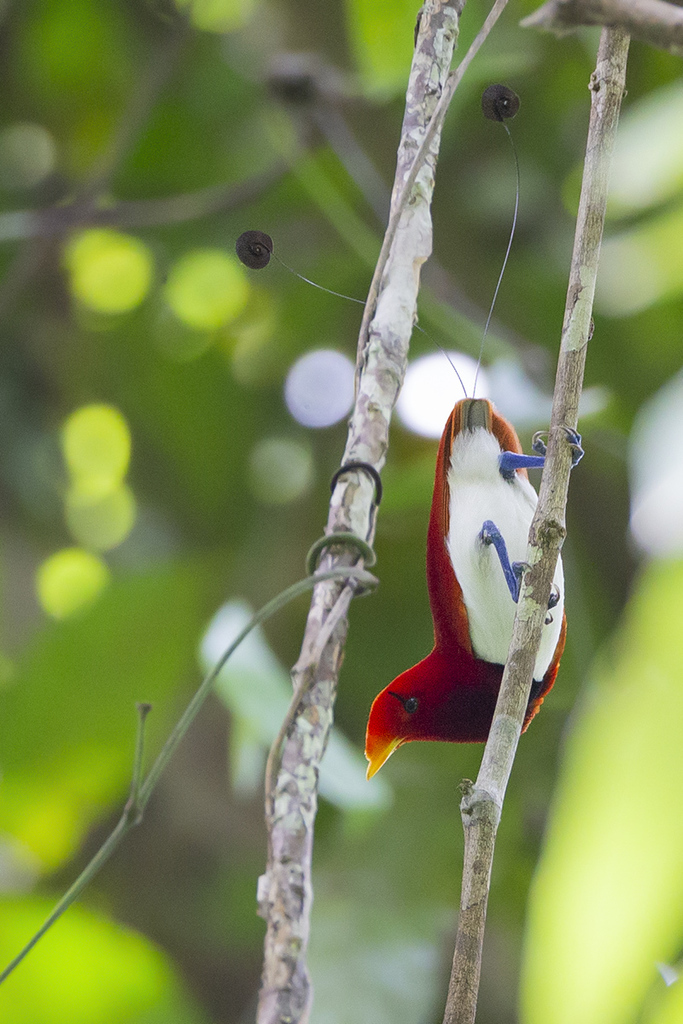
This so-called "living gem" is the smallest and most vividly colored among birds-of-paradise. The king bird-of-paradise is small, measuring approximately 6.3–7.5 inches (16–19 cm) long, but 12.2 inches (31 cm) if central rectrices of adult males included. Females weigh about 0.08–0.13 pounds (36–59 g), males 0.10–0.14 pounds (45–64 g). The adult male has an overall metallic crimson color, slightly orange under certain lights, and more particularly so in the crown. They have a narrow, dark green iridescent breast band with whitish lower breast, and green-tipped fan-like plumes on the shoulder. The feathers of the undertail and mantle are olive-brown, with iridescent green tips, and violet legs. Bills are ivory-yellow. Females have dull olive heads and upperparts with yellowish underparts and violet legs.
Range & habitat
The king bird-of-paradise is distributed throughout the majority of lowland New Guinea mainland, and on the surrounding islands, including Aru, Salawati, Missol, and Yapen, inhabiting mostly lowland rainforests, gallery forests, forest edges, and disturbed and tall secondary forests.
Wikipedia: “Distribution and habitat”
What it does
There is little information available about this species' behavior. They are inconspicuous and may be hard to locate, except for males at their display trees.
Courtship and breeding. The species is polygynous, with the promiscuous adult males displaying in isolation at exploded leks and in groups at traditional arboreal courts. They are perhaps more persistent callers than any other birds of paradise. Courtship involves complex vocalizations, feather manipulations, and a variety of body posturing and movements, including hanging fully inverted and pendulum-like swinging. An extraordinary courtship display is performed by the male with a series of tail swinging, fluffing of the white abdominal feathers that makes the bird look like a cotton ball, and acrobatic movements of their elongated tail wires. Breeding occurs at least during March through October. The open cup nest is built into a tree cavity (unique within the family), within which two eggs are laid. The female builds the nest and cares for the young without male assistance. In captivity, incubation lasted 17 days and the nestling period was 14 days.
Feeding and diet. The diet consists mainly of fruits and arthropods. Foraging occurs at all forest levels, where birds often join mixed-species foraging flocks to seek arthropods in the lower forest.
Wikipedia: “Ecology and behaviour”
Listen
Looking for field recordings…
Where it lives
Recorded sightings
—
geo-referenced records in GBIF, from museums, herbaria and field observers.
Drag the globe to turn it. Dots are where records exist, not a range map; darker means more records.
In the old herbals & bestiaries


In the stacks
Searching the stacks…
Every page naming Cicinnurus regius in the Biodiversity Heritage Library →
This page is assembled live from iNaturalist, GBIF, Wikipedia, the Source Library and the Internet Archive. It is not yet part of the hand-edited codex. iNaturalist taxon 8365.