- Animals
- ›Chordates
- ›Vertebrates
- ›Ray-finned Fishes
- ›Carps, Characins, Catfishes and Allies
- ›Characins
- ›Characoidei
- ›Toothed Headstanders
- ›Leporininae
- ›Abramites
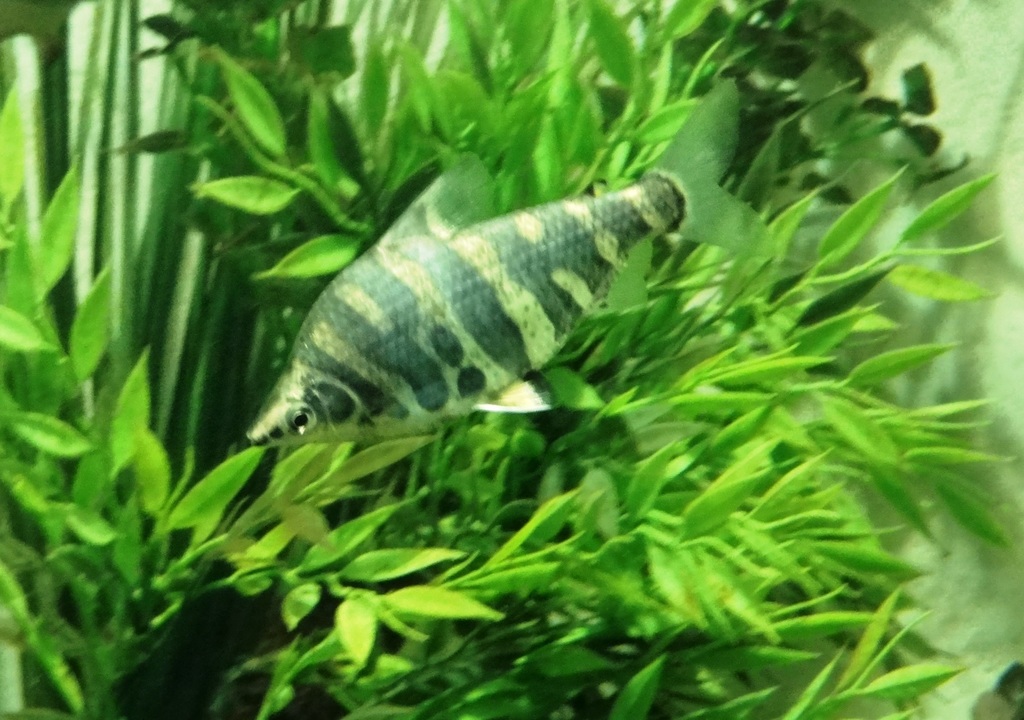
Marbled Headstander
Abramites hypselonotus
Abramites hypselonotus, also called the marbled headstander or the high-backed headstander, is a member of the family Anostomidae of the order Characiformes. Under normal fish classifying rules you would gather from its upturned mouth and long streamlined body that the marbled headstander is a surface dweller. In reality marbled headstanders, like all headstanders, inhabit the middle and lower portions of the aquarium. In the wild, head standers are often found face down, tail up in narrow...
From the article Abramites hypselonotus on Wikipedia (CC BY-SA), quoted section by section
Description
Marble headstanders are generally identified by their high backs, pointed snout, diamond-shaped body, brown markings on pelvic fin, wavy dark brown bands, and a dark line at the base of the caudal peduncle. The marble headstander's full adult size is roughly 5 in (13 cm), on both sides. They are among the rarely introduced representatives of the Anostomidae and the males are more contrasted than the females.
Range & habitat
The marbled headstander generally inhabits streams and rivers of the Orinoco and Amazon river systems. Headstanders most commonly inhabit very fast flowing waters in rocky stretches of river.
Wikipedia: “Distribution and habitat”
What it does
The marble headstander is a predominantly herbivorous fish and as such should be given a high vegetation diet. In addition to processed food, it will readily accept (and probably enjoy) lettuce leaves, and peas. They will also accept mosquito larvae and bloodworms.
Wikipedia: “Diet and feeding behaviour”
Where it lives
Recorded sightings
—
geo-referenced records in GBIF, from museums, herbaria and field observers.
Drag the globe to turn it. Dots are where records exist, not a range map; darker means more records.
In the stacks
Searching the stacks…
Every page naming Abramites hypselonotus in the Biodiversity Heritage Library →
This page is assembled live from iNaturalist, GBIF, Wikipedia, the Source Library and the Internet Archive. It is not yet part of the hand-edited codex. iNaturalist taxon 84411.