- Animals
- ›Chordates
- ›Vertebrates
- ›Mammals
- ›Therians
- ›Placental Mammals
- ›Ungulates, Carnivorans, and Allies
- ›Shrews, Moles, Hedgehogs, and Allies
- ›Shrews, Moles, and Hedgehogs
- ›Moles and Desmans
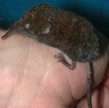
Indochinese Shrewmoles
Uropsilinae
The shrew moles or shrew-like moles (Uropsilus) are shrew-like members of the mole family of mammals endemic to the forested, high-alpine region bordering China, Myanmar, and Vietnam. They possess a long snout, a long slender tail, external ears, and small forefeet unspecialized for burrowing. Although they are similar to shrews in size, external appearance, and, presumably, ecological habits, they are nevertheless talpids and considered true moles, as they share a full zygomatic arch with all other moles, while this arch is completely absent in shrews.
The genus is the only one of the subfamily Uropsilinae, which is one of the three main subfamilies of Talpidae, the other two being Talpinae, or Old World moles and relatives; and the Scalopinae, or New World moles. Although little is currently known regarding any aspect of their natural history, the Uropsilinae are thought to be the most ancestral group of moles, and as such, very similar to the primitive talpid from which all Talpidae have evolved. Uropsilus is thought to be a relict genus; despite the small distribution of the modern-day species, the subfamily once had a much wider range throughout Eurasia.
1 branches of this subfamily, most-observed first · about 10 known species
See this branch on the Wheel of Life →
Where it lives
Recorded sightings
—
geo-referenced records in GBIF, from museums, herbaria and field observers.
Drag the globe to turn it. Dots are where records exist, not a range map; darker means more records.
In the stacks
Searching the stacks…
Every page naming Uropsilinae in the Biodiversity Heritage Library →
This page is assembled live from iNaturalist, GBIF, Wikipedia, the Source Library and the Internet Archive. It is not yet part of the hand-edited codex. iNaturalist taxon 846292.