On eBird ↗
Malaysian Rail-babbler
Live sightings near you, the range map, bar charts of when it is seen, and Macaulay Library photos and recordings.
Malaysian Rail-babbler
Eupetes macrocerus
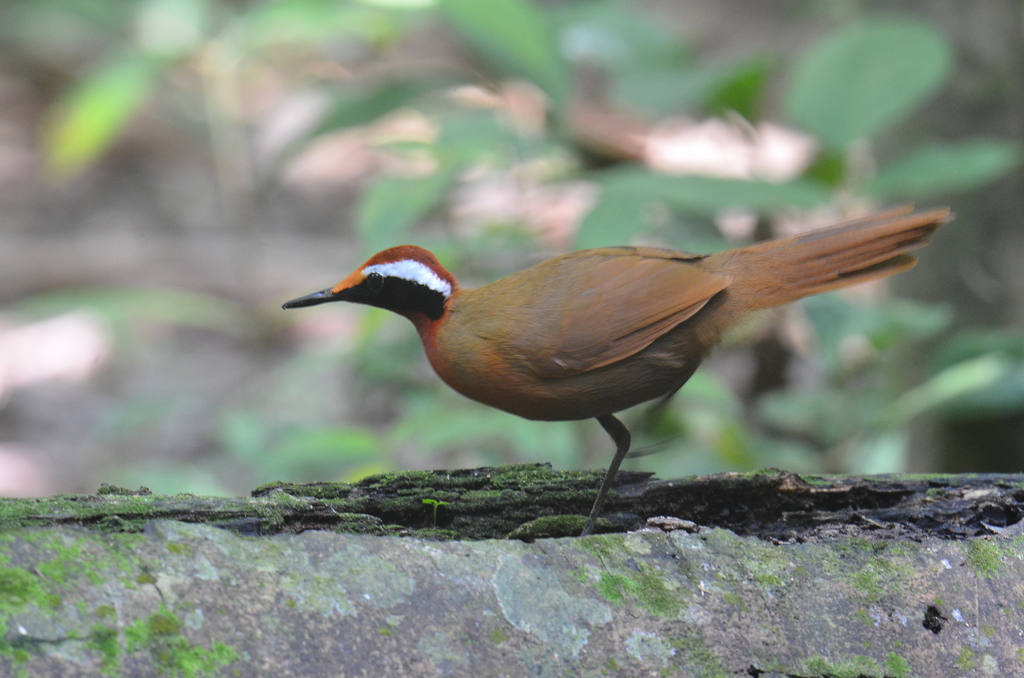
The rail-babbler or Malaysian rail-babbler (Eupetes macrocerus) is a brown and pied rail-like ground-living bird. It is the only species in the genus Eupetes and family Eupetidae. It lives on the floor of primary forests in the Malay Peninsula and Sumatra (the nominate subspecies macrocerus), as well as Borneo (ssp. borneensis). It is distantly related to African rockfowl. Its population has greatly decreased because much of the lowland primary forest has been cut, and secondary forests usually have too dense a bottom vegetation or do not offer enough shade to be favourable for the species. However, it is locally still common in logged forest or on hill-forest on slopes, and probably not in immediate danger of extinction. The species is poorly known and rarely seen, in no small part due to its shyness.
From the article Rail-babbler on Wikipedia (CC BY-SA), quoted section by section
Description
It is a medium-sized, fairly slender songbird, about 28 to 30 cm (11–12 in) in length, and weighing 66 to 72 g (2.3–2.5 oz). It has a long thin neck, long black bill, long legs and a long tail. The plumage is mainly brown with a more reddish forehead and crown, and the foreneck, chin and throat are a rich chestnut. It has a long, black eyestripe extending from the bill to the side of the neck and a broad, white supercilium above it. There is a strip of bare, blue skin on the side of the neck which can be seen when the bird calls and displays, and probably has signalling significance in a dark species living in low light on the forest floor. The two sexes are the same. Juvenile birds are similar to the adult but are overall duller in colour, have a whitish throat and dark grey-brown belly. The subspecies borneensis is similar to the nominate race except that the head is a richer brown colour, the upperparts, including the tail, are much more red and the underparts more rufous. It has a long, monotonous whistling call. When agitated, it gives a series of frog-like notes.
Range & habitat
It is found on the Malay Peninsula in southern Thailand and Peninsular Malaysia and in the Greater Sundas on Sumatra, Borneo and the Natuna Islands. It mainly occurs in tall, lowland forests and also in swamps and heath forest. It sometimes occurs in lower montane forests up to about 1,060 m (3,480 ft) in Peninsular Malaysia and 900 m (3,000 ft) in Sumatra and Borneo. It is believed to be declining due to loss and degradation of the forest and is classed as near threatened.
Wikipedia: “Distribution and habitat”
What it does
It is a shy and secretive bird, which lives on the forest floor. It walks like a rail, jerking its head in the manner of a chicken, and it prefers to run rather than fly when disturbed. It feeds mainly on insects, including cicadas, and beetles; spiders and worms. When feeding it will dash after prey items. Little is known about its breeding habits. The eggs are laid around January and February and fledglings have been seen in June. The nest has been described as being placed near the ground on a pile of dead leaves among the stalks of a plant around 30 cm (12 in) from the ground. It is made of plant fibres and is a cup shape. The clutch is two white unmarked eggs; nothing else is known.
Wikipedia: “Behaviour”
Listen
Looking for field recordings…
Where it lives
Recorded sightings
—
geo-referenced records in GBIF, from museums, herbaria and field observers.
Drag the globe to turn it. Dots are where records exist, not a range map; darker means more records.
In the stacks
Searching the stacks…
Every page naming Eupetes macrocerus in the Biodiversity Heritage Library →
This page is assembled live from iNaturalist, GBIF, Wikipedia, the Source Library and the Internet Archive. It is not yet part of the hand-edited codex. iNaturalist taxon 8491.