On eBird ↗
Chabert Vanga
Live sightings near you, the range map, bar charts of when it is seen, and Macaulay Library photos and recordings.
Chabert Vanga
Leptopterus chabert
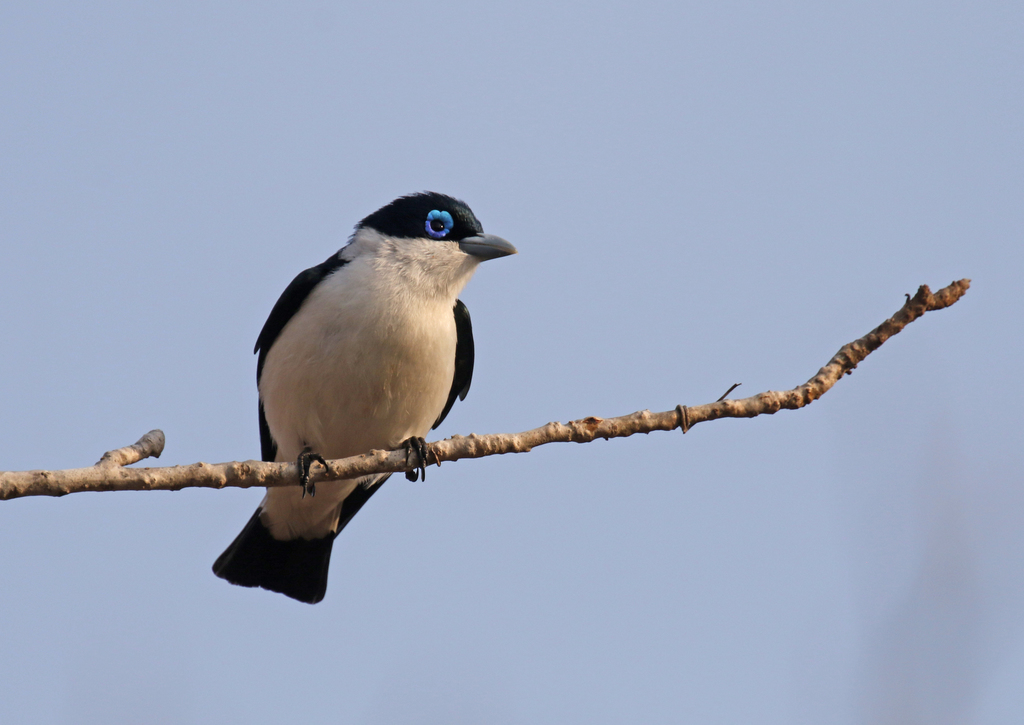
The chabert vanga (Leptopterus chabert), also erroneously called "Chabert's vanga", is a species of bird in the family Vangidae. It is monotypic within the genus Leptopterus. It is endemic to Madagascar. Its natural habitats are subtropical or tropical dry forests, subtropical or tropical moist lowland forests, and subtropical or tropical moist montane forests. Its name comes from a rendition of its call.
From the article Chabert vanga on Wikipedia (CC BY-SA), quoted section by section
Description
The cabaret vanga only possess two colors, black and white. Their head and wings are a dark black. However, due to the sun, this black can often be seen as having a shiny blue tint to it. Their underparts are white like their chin and belly. The color of their tails differ from where they originate. If they are located in the southwest, the tail of the chabert vanga has a white patch at the base of the tail. If they are from anywhere else in the world, the whole entire tail of the chabert vanga is known to be black. The bill is a light blue color and their eyes also resemble a turquoise or cobalt blue. The juvenile of the cabaret vanga resembles the adult however, it lacks the blue eyes. The juveniles tend to look a shade paler due to the white streaks and white fingers on their back and wing feathers. The white streaks tend to fade as they grow older. There is little physical difference between the male and female chabert vanga.
Range & habitat
The chabert vanga is endemic to Madagascar. Its natural habitats are subtropical or tropical dry forest, subtropical or tropical moist lowland forest, and subtropical or tropical moist montane forest. They tend to reside on sea level and up to 1000m. Very occasionally they are found higher than 1000m above sea level.
Wikipedia: “Habitat”
What it does
They feed on insects such as; beetles, cockroaches, and worms. Also, they have been found to eat small vertebrates such as chameleons and some small berries.
Wikipedia: “Diet”
Listen
Looking for field recordings…
Where it lives
Recorded sightings
—
geo-referenced records in GBIF, from museums, herbaria and field observers.
Drag the globe to turn it. Dots are where records exist, not a range map; darker means more records.
In the stacks
Searching the stacks…
Every page naming Leptopterus chabert in the Biodiversity Heritage Library →
This page is assembled live from iNaturalist, GBIF, Wikipedia, the Source Library and the Internet Archive. It is not yet part of the hand-edited codex. iNaturalist taxon 8522.