On eBird ↗
Huon Astrapia
Live sightings near you, the range map, bar charts of when it is seen, and Macaulay Library photos and recordings.
Huon Astrapia
Astrapia rothschildi
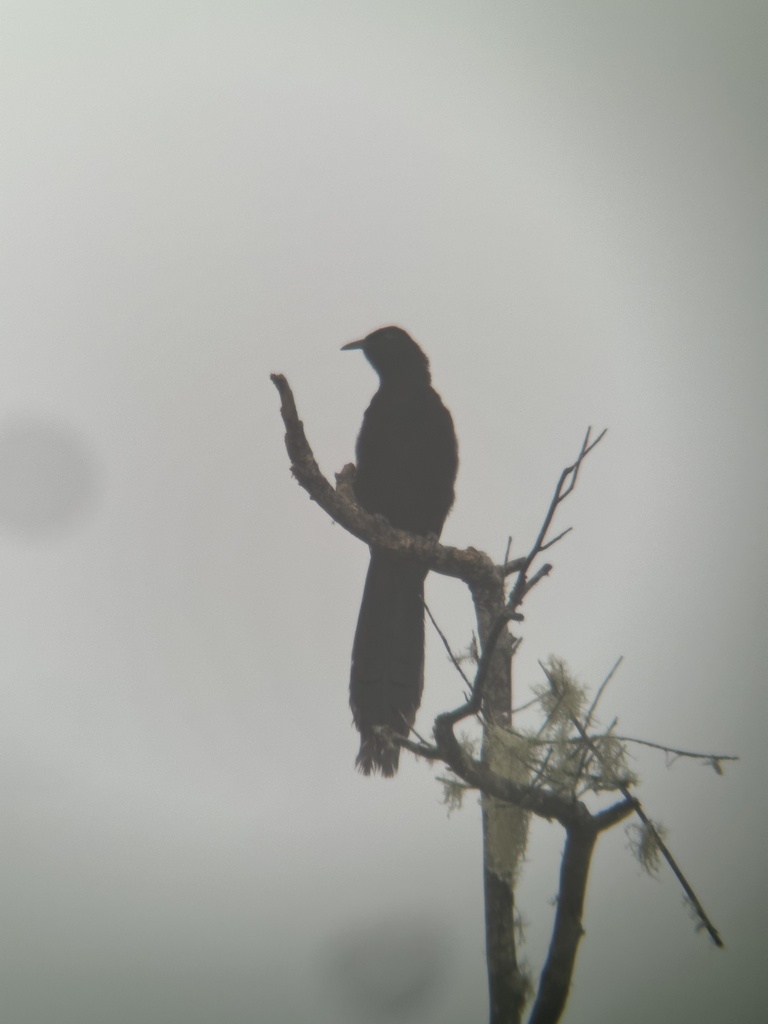
The Huon astrapia (Astrapia rothschildi), also known as Rothschild's astrapia, Huon bird-of-paradise, or Lord Rothschild's bird-of-paradise, is a species of bird-of-paradise belonging to the genus Astrapia. Like most of its congeners, A. rothschildi is a rather elusive member of its genus and family.
From the article Huon astrapia on Wikipedia (CC BY-SA), quoted section by section
Description
This little-known astrapia is a medium-sized bird-of-paradise species, excluding the tail. The males reach up to around 69 cm (27 in) long and weigh up to 205g, including the tail, while the smaller female is around 47 cm (18.5 in) long and weighs slightly less at 200g. The males' head to the breast are black with a velvety-blue iridescence, bordered by a characteristic iridescent, coppery-orange gorget-band; the hindneck is an elongated erectile cape with iridescent blue-green plate-like feathers, tipped pinkish-violet (cape may appear fully violet in some views.); upperparts, including wings, are black with a slight bronze-green sheen, underparts are a deep oily green, with larger, scale-like feathers down the sides a shiny lime-green; the impressively long tail feathers are purplish-black with a bluish sheen. The less-impressive females are mainly a dull brownish black, with slight, narrow pale barring ventrally; the upperparts are a lighter brown compared to the blackish head; and the tail is greatly shorter than the males' and generally similar in color, though drabbier and browner. It takes around 5–6 years to reach full adult plumage, like its congeners.
Vocalization. …
Range & habitat
A. rothschildi is restricted to the Huon Peninsula of Papua New Guinea, in montane and subalpine forests from 1,460 to 3,500 m. Their display sites are found in ridge crests and forest edges. It is assumed to be sedentary.
Wikipedia: “Range and distribution”
What it does
A. rothschildi is known to feed on Pittosporum seeds and the fruits of the genera Heptapleurum and Freycinetia, as well as some animal matter, like skinks and possibly insects and arachnids, like nearly all of the Astrapia species. It tends to probe knotholes, pecking and tearing among moss and epiphytes while foraging. They spend most of their time in all levels of the forest, excluding the highest canopy, though they mainly feed in the lower levels.
Wikipedia: “Diet”
In human culture
The generic name, Astrapia, is derived from the Greek word Astrapaios, which means "flash of lightning", referring to the iridescent plumage of the genus. Its specific name, rothschildi, is for Lord Walter Rothschild, a famous collector who kept the first specimen in his private museum sent to him by German naturalist Carl Wahnes.
Wikipedia: “Etymology”
Listen
Looking for field recordings…
Where it lives
Recorded sightings
—
geo-referenced records in GBIF, from museums, herbaria and field observers.
Drag the globe to turn it. Dots are where records exist, not a range map; darker means more records.
In the stacks
Searching the stacks…
Every page naming Astrapia rothschildi in the Biodiversity Heritage Library →
This page is assembled live from iNaturalist, GBIF, Wikipedia, the Source Library and the Internet Archive. It is not yet part of the hand-edited codex. iNaturalist taxon 8552.