- Animals
- ›Chordates
- ›Vertebrates
- ›Mammals
- ›Therians
- ›Placental Mammals
- ›Ungulates, Carnivorans, and Allies
- ›Carnivorans
- ›Mustelids
- ›Eurasian and Hog Badgers
- ›Meles
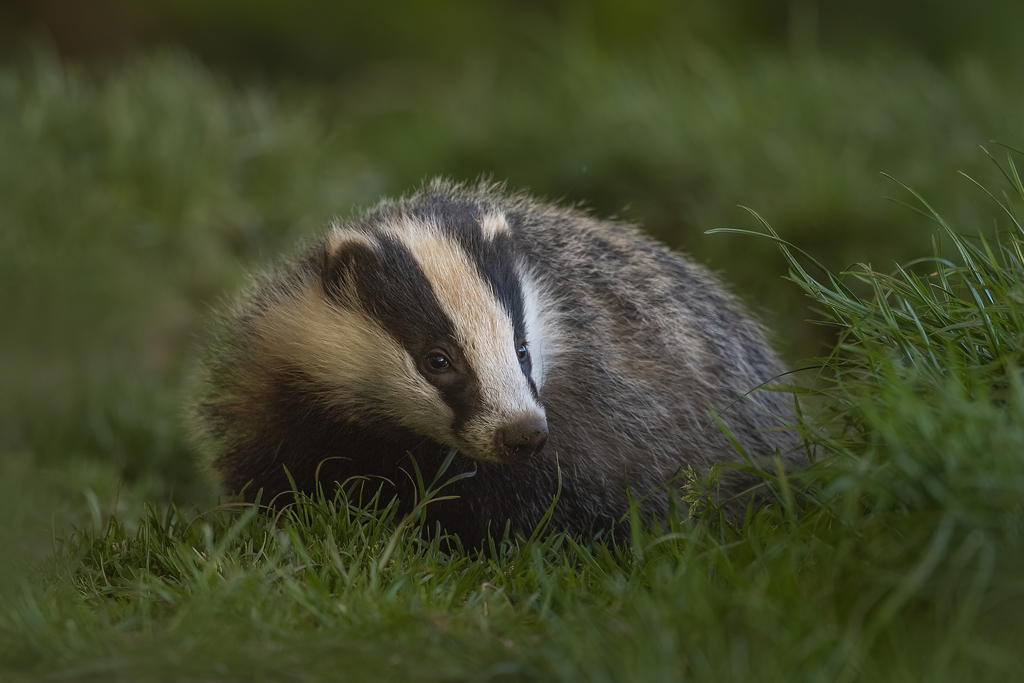
European Badger
Meles meles
The European badger (Meles meles), also known as the Eurasian badger, is a species of badger in the family Mustelidae native to Europe and West Asia and parts of Central Asia. It is classified as least concern on the IUCN Red List due to its wide range and large, stable population size which is thought to be increasing in some regions. Several subspecies are recognised, with the nominate subspecies (M. m. meles) predominating in most of Europe. In the UK it is the only extant species, and is simply known as the "badger".
The European badger is a powerfully built animal with a small head, stocky body, small black eyes and short tail, and a coat of black, white, brown, and grey fur. Its weight varies, ranging from 7–13 kg (15–29 lb) in spring to 15–17 kg (33–37 lb) in autumn before the winter sleep period. It is nocturnal and social, living in burrows and sleeping during the day in one of several setts within its territory. These burrows have multiple chambers and entrances and comprise extensive systems of underground passages measuring 35–81 m (115–266 ft) in length. Several badger families use these setts for decades. Badgers are particular about the cleanliness of their burrows, carrying in fresh bedding and removing soiled material. They defecate in latrines situated strategically outside their setts or en route to others.
From the article European badger on Wikipedia (CC BY-SA), quoted section by section
Description
European badgers are powerfully built animals with small heads, thick, short necks, stocky, wedge-shaped bodies and short tails. Their feet are either plantigrade or semi-digitigrade and short, with five toes on each foot. The limbs are short and massive, with bare lower surfaces on the feet. The claws are strong and elongated with an obtuse end to facilitate digging. The claws are not retractable, and the hind claws wear with age. Old badgers sometimes have their hind claws almost completely worn away from constant use. Their snouts, which are used for digging and probing, are muscular and flexible. Their eyes are small, and their ears are short and tipped with white. Whiskers are present on the snout and above the eyes. Boars typically have broader heads, thicker necks and narrower tails than sows. Sows have sleeker bodies, narrower, less domed heads and fluffier tails. Badgers have longer guts than red foxes, reflecting their omnivorous diet. The small intestine has an average length of 5.36 m (17.6 ft) and lacks a cecum. Both sexes have three pairs of nipples, though these are more developed in females. European badgers cannot flex their backs like martens, polecats and wolverines, nor can they stand fully erect like honey badgers. …
Range & habitat
The European badger is native to most of Europe. It is found in Albania, Armenia, Austria, Belarus, Belgium, Bosnia and Herzegovina, Bulgaria, Crete, Croatia, Czechia, Denmark, Estonia, Finland, France, Georgia, Germany, Great Britain, Greece, Hungary, Ireland, Italy, Latvia, Lithuania, Luxembourg, Macedonia, Moldova, Montenegro, the Netherlands, Norway, Poland, Portugal, Romania, Russia, Serbia, Slovakia, Slovenia, Spain, Sweden, Switzerland and Ukraine. The distributional boundary between the ranges of European and Asian badgers is the Volga River; the European species inhabits the western bank. The boundary between the ranges of the European and Caucasian badgers is in the North Caucasus. However, a clear boundary has not been defined, and the two species are sympatric in some regions, potentially forming a hybrid zone. They are common in European Russia, where 30,000 individuals were recorded in 1990. They are abundant and increasing throughout their range, partly due to a reduction in rabies in Central Europe. In the UK, the badger population increased by 77% during the 1980s and 1990s. The badger population in Great Britain in 2012 was estimated to be 300,000. The European badger inhabits deciduous and mixed woodlands, clearings, spinneys, pastureland and scrub, including Mediterranean maquis shrubland. …
Wikipedia: “Distribution and habitat”
What it does
European badgers are the most sociable of all badger species, forming groups of six adults on average, though larger groups of up to 23 individuals have been recorded. Group size may be related to habitat composition. Under optimal conditions, badger territories can be as small as 30 ha (74 acres), but may be as large as 150 ha (370 acres) in marginal areas. Badger territories can be identified by the presence of communal latrines and well-worn paths. It is mainly males that are involved in territorial aggression. A hierarchical social system is thought to exist among badgers and large powerful boars seem to assert dominance over smaller males. Large boars sometimes intrude into neighbouring territories during the main mating season in early spring. Sparring and more vicious fights generally result from territorial defence during the breeding season. However, animals within and outside a group generally show considerable tolerance towards each other. Boars tend to mark their territories more actively than sows, with their territorial activity increasing during the mating season in early spring. Badgers groom each other thoroughly using their claws and teeth. This grooming may have a social function. They are crepuscular and nocturnal by nature. Aggression among badgers is largely associated with territorial defence and mating. …
Wikipedia: “Social and territorial behaviour”
At the table
Badger meat is eaten in some districts of the former Soviet Union, though in most cases it is discarded. Smoked hams made from badgers were once highly esteemed in England, Wales and Ireland. Some badger products have been used for medical purposes; badger expert Ernest Neal, quoting from an 1810 edition of The Sporting Magazine, wrote;
The flesh, blood and grease of the badger are very useful for oils, ointments, salves and powders, for shortness of breath, the cough of the lungs, for the stone, sprained sinews, collachs etc. The skin being well dressed is very warm and comfortable for ancient people who are troubled with paralytic disorders. The hair of the European badger has been used for centuries for making sporrans and shaving brushes. Sporrans are traditionally worn as part of male Scottish highland dress. They form a bag or pocket made from a pelt and a badger or other animal's mask may be used as a flap. The pelt was also formerly used for pistol furniture.
Wikipedia: “Uses”
In human culture
Badgers play a part in European folklore and are featured in modern literature. In Irish mythology, badgers are portrayed as shape-shifters and kinsmen to Tadg, the king of Tara and foster father of Cormac mac Airt. In one story, Tadg berates his adopted son for having killed and prepared some badgers for dinner. In German folklore, the badger is portrayed as a cautious, peace-loving Philistine, who loves more than anything his home, family and comfort, though he can become aggressive if surprised. He is a cousin of Reynard the Fox, whom he uselessly tries to convince to return to the path of righteousness. In Kenneth Grahame's The Wind in the Willows, Mr. Badger is depicted as a gruff, solitary figure who "simply hates society", yet he is a good friend to Mole and Ratty. As a friend of Toad's late father, he is often firm and serious with Toad, yet generally patient and well-meaning towards him. He can be seen as a wise hermit and a good leader, embodying common sense and gentlemanly behaviour. He is also brave and a skilled fighter, and helps rid Toad Hall of invaders from the wild wood. The "Frances" series of children's books by Russell and Lillian Hoban depicts an anthropomorphic badger family. In T. H. White's Arthurian series The Once and Future King, the young King Arthur is transformed into a badger by Merlin as part of his education. …
Wikipedia: “Cultural significance”
Listen
Looking for field recordings…
Where it lives
Recorded sightings
—
geo-referenced records in GBIF, from museums, herbaria and field observers.
Drag the globe to turn it. Dots are where records exist, not a range map; darker means more records.
In the stacks
Searching the stacks…
Every page naming Meles meles in the Biodiversity Heritage Library →
This page is assembled live from iNaturalist, GBIF, Wikipedia, the Source Library and the Internet Archive. It is not yet part of the hand-edited codex. iNaturalist taxon 855297.