Jewel-babblers
Ptilorrhoa
The jewel-babblers are members of the bird genus Ptilorrhoa in the family Cinclosomatidae. The genus contains five species that are endemic to New Guinea. The genus was once considered to contain the rail-babbler, but that species is now considered to belong to its own family. The genus is closely related to the better known quail-thrushes (Cinclosoma) of New Guinea and Australia. Together with a number of other genera they comprise the family Cinclosomatidae, although the validity of this family as a whole has been questioned.
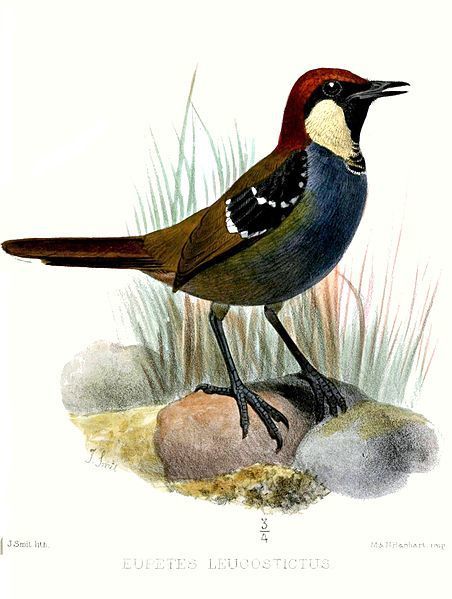
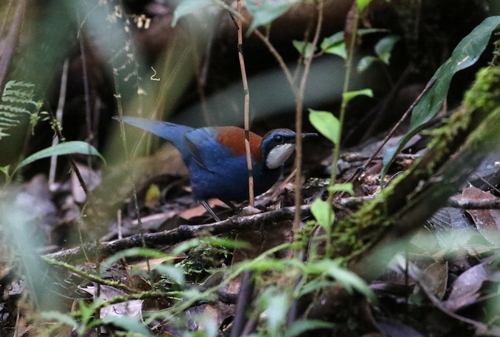
The jewel-babblers resemble the quail-thrushes in shape, being plump, long-tailed and short winged. They are adapted to life on the forest floor. The plumage of this genus is the most striking divergence from the quail-thrushes, having large amounts of blue and often with chestnut on the back. The throats of all species are white and the patch is mostly surrounded by a black edge. There is moderate levels of sexual dimorphism in the plumage, except in the brown-headed jewel-babbler where the female has no blue and is all chestnut coloured. When moving they hold the body horizontally to the ground, and bob their heads back and forth in a similar fashion to pigeons, and move their tail in a fashion similar to wagtails.
4 branches of this genus, most-observed first · about 4 known species

Blue Jewel-babbler
speciesPtilorrhoa caerulescens

Spotted Jewel-babbler
speciesPtilorrhoa leucosticta
Chestnut-backed Jewel-babbler
speciesPtilorrhoa castanonota

Dimorphic Jewel-babbler
speciesPtilorrhoa geislerorum
Where it lives
Recorded sightings
—
geo-referenced records in GBIF, from museums, herbaria and field observers.
Drag the globe to turn it. Dots are where records exist, not a range map; darker means more records.
In the stacks
Searching the stacks…
Every page naming Ptilorrhoa in the Biodiversity Heritage Library →
This page is assembled live from iNaturalist, GBIF, Wikipedia, the Source Library and the Internet Archive. It is not yet part of the hand-edited codex. iNaturalist taxon 8566.