On eBird ↗
Rose-throated Becard
Live sightings near you, the range map, bar charts of when it is seen, and Macaulay Library photos and recordings.
Rose-throated Becard
Pachyramphus aglaiae
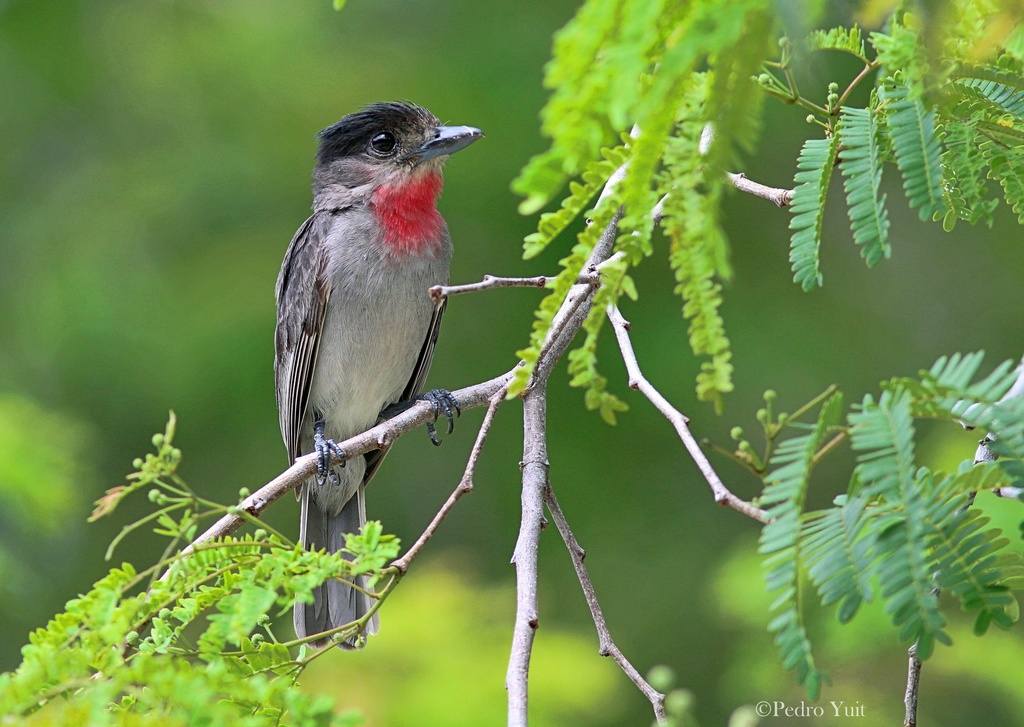
The rose-throated becard (Pachyramphus aglaiae) is a medium-sized passerine bird in the family Tityridae. It breeds from southeasternmost Arizona and extreme southern Texas in the United States and across Central America to western Panama. Males are mostly gray with a dark crest and have a characteristic rose-colored neck bib, which is absent in certain rainforest populations. Females also have a dark crest but are otherwise browner, with rusty-brown upperparts and pale buffy underparts.
The rose-throated becard is an omnivore, consuming fruit, berries, seeds, and (primarily) insects, either on the wing or by gleaning. Its typical habitat is riparian woodland and other semi-arid or subtropical open habitats with scattered trees. Breeding typically begins in May, with three to six eggs being laid in a domed nest suspended from a high tree branch.
From the article Rose-throated becard on Wikipedia (CC BY-SA), quoted section by section
Description
Rose-throated becards appear large-headed and show a dark gray to black crown or crest. Males tend to be pale gray in drier areas and significantly darker in rainforests, though always remaining countershaded gray. The diagnostic rose-colored throat patch is variable and not present across all populations, with the darkest males in rainforests having none at all. Males also have a hidden white shoulder patch which can be used during courtship, as well as a truncated ninth primary feather, the function of which is unknown. Females are mostly brown in color, with rusty brown upperparts and pale buffy underparts. Younger males are similar to the females but show a variable pink patch on the throat depending on the subspecies. The song of the rose-throated becard is described as short, sliding, and two-noted. One of its calls is a unique piercing cry.
Range & habitat
The rose-throated becard is a widespread year-round resident in tropical and subtropical regions across Central America from Mexico to western Panama. It is the only member of its family to occur regularly in the United States. Its breeding range extends into southeasternmost Arizona and extreme southern Texas, but these areas are generally abandoned for the winter. Becards were first discovered nesting in Arizona in the Santa Cruz River in the late 1940s and have since become established. After a period of sporadic breeding in places such as Arivaca Creek and near Sonoita Creek, they are successfully breeding again in the Santa Cruz River. Breeding in southern Texas has been particularly sporadic, with nesting occurring in small numbers in the Lower Rio Grande Valley from the 1940s to the 1990s. Breeding in southern Texas may become more regular in the future, as there has been a recent increase in becard observations in that region in the 2020s. Four active nests were discovered in Starr County, Texas, in March 2024, all in riparian forest. Rose-throated becards occur in riparian woodland, forest edges, and generally most habitats that are scattered with larger trees. The northernmost populations favor riparian woodlands dominated by cottonwoods. …
Wikipedia: “Distribution and habitat”
What it does
Rose-throated becards feed primarily on insects, which they will glean from the vegetation, but hawking is also employed. Fruit, berries, and seeds will be taken as well. While feeding, becards tend to move their heads back and forth in a slow and deliberate manner.
Wikipedia: “Feeding”
Listen
Looking for field recordings…
Where it lives
Recorded sightings
—
geo-referenced records in GBIF, from museums, herbaria and field observers.
Drag the globe to turn it. Dots are where records exist, not a range map; darker means more records.
In the stacks
Searching the stacks…
Every page naming Pachyramphus aglaiae in the Biodiversity Heritage Library →
This page is assembled live from iNaturalist, GBIF, Wikipedia, the Source Library and the Internet Archive. It is not yet part of the hand-edited codex. iNaturalist taxon 8671.