On eBird ↗
Green-backed Becard
Live sightings near you, the range map, bar charts of when it is seen, and Macaulay Library photos and recordings.
Green-backed Becard
Pachyramphus viridis
The green-backed becard (Pachyramphus viridis) is a species of bird in the family Tityridae. It has traditionally been placed in Cotingidae or Tyrannidae, but evidence strongly suggest it is better placed in Tityridae, where now placed by SACC. It often includes the Andean yellow-cheeked becard (Pachyramphus xanthogenys) as a subspecies.
From the article Green-backed becard on Wikipedia (CC BY-SA), quoted section by section
Description
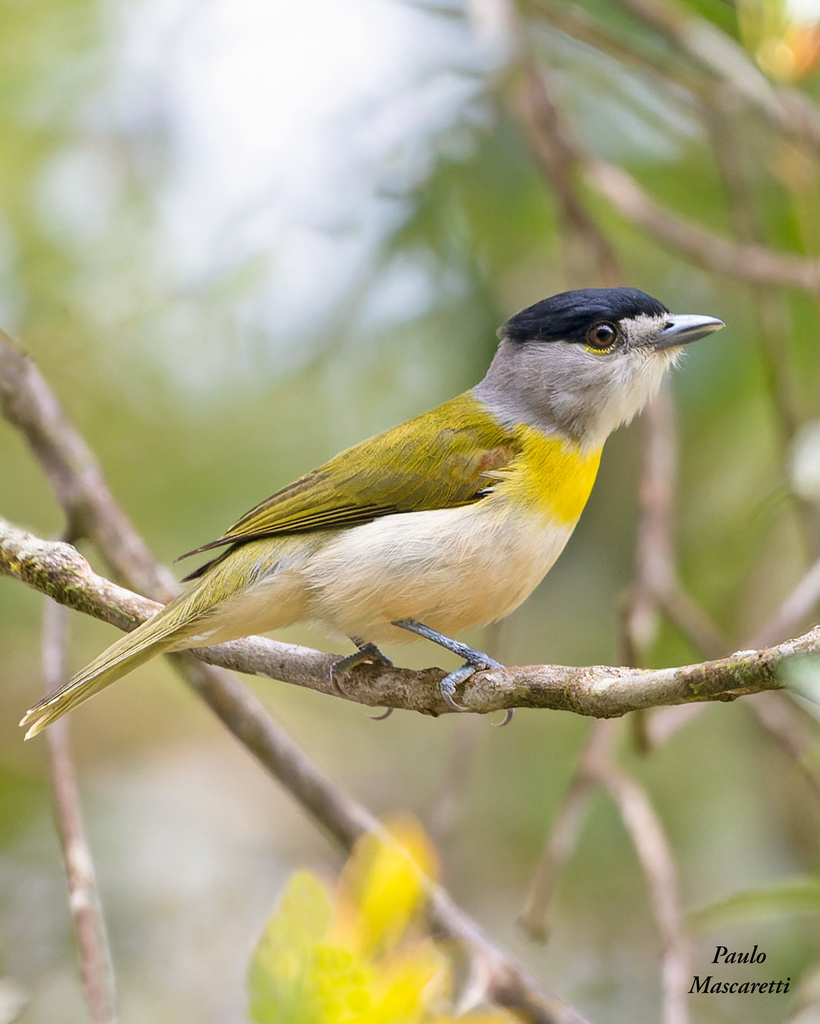
The green-backed becard is about 14.5 to 16 cm (5.7 to 6.3 in) long; two individuals of the nominate subspecies weighed 18 and 21 g (0.63 and 0.74 oz). Adult males of the nominate subspecies have a glossy black crown, whitish lores, and a thin yellowish eye-ring. The lower part of their face and their nape are pale gray. Their upperparts are mostly bright olive with dusky olive flight feathers and tail. Their throat is whitish, their breast bright yellow to olive yellow, and the rest of their underparts grayish white with a buffy tinge. Adult females have a similar pattern to males. However, their crown is dull olive, their lores grayish, and their face grayer. Their upperparts are pale olive and their wing coverts rufous-chestnut. Their breast is a more muted yellow and their underparts overall somewhat more dusky than the male's. The male of subspecies P. v. griseigularis has a grayish olive face and nape. It has blackish flight feathers with olive edges. The underparts are mostly grayish white with grayer sides and flanks than the nominate's. The male of the subspecies P. v. xanthogenys has bright yellow cheeks, sides of neck and throat. The male of subspecies peruanus is very simililar to xanthogenys but has a slightly brighter yellow face and breast. Both sexes have a dark iris, a pale bluish horn bill, and dusky or grayish legs and feet.
Range & habitat
The green-backed becard has a disjunct distribution. The nominate subspecies has by far the larger range. It is found in eastern and southern Brazil south from a line roughly southwest from Ceará and Rio Grande do Norte to west-central Mato Grosso. It is a year-round resident from Mato Grosso slightly into eastern Bolivia. It continues south through most of Paraguay into northeastern Argentina as far as Santa Fe and Entre Ríos provinces and northern Uruguay, and loops north from Argentina into central Bolivia. Subspecies P. v. griseigularis is found in the eastern part of the eastern Venezuelan states of Delta Amacuro and Bolívar and slightly east into western Guyana and also in Brazil along the lower Amazon River from the lower Tapajós River to its mouth. Subspecies P. v. xanthogenys is along the eastern base of the Andes in Ecuador and northern Peru. The green-backed becard primarily inhabits humid to moist forest in the tropical and lower montane zones, and favors broken and somewhat open areas. It also is found in riparian forest, terra firme forest, and the ecotone between them. In Brazil it is found from sea level to 1,000 m (3,280 ft). It also reaches that elevation in Venezuela.
Wikipedia: “Distribution and habitat”
What it does
The green-backed becard's diet has not been studied but is believed to be mostly insects with some fruit. It has been observed in pairs accompanying mixed-species feeding flocks. It forages in any level of the forest, typically taking food by reaching from a perch, snatching it after a short flight, or while briefly hovering.
Wikipedia: “Feeding”
Listen
Looking for field recordings…
Where it lives
Recorded sightings
—
geo-referenced records in GBIF, from museums, herbaria and field observers.
Drag the globe to turn it. Dots are where records exist, not a range map; darker means more records.
In the stacks
Searching the stacks…
Every page naming Pachyramphus viridis in the Biodiversity Heritage Library →
This page is assembled live from iNaturalist, GBIF, Wikipedia, the Source Library and the Internet Archive. It is not yet part of the hand-edited codex. iNaturalist taxon 8711.