On eBird ↗
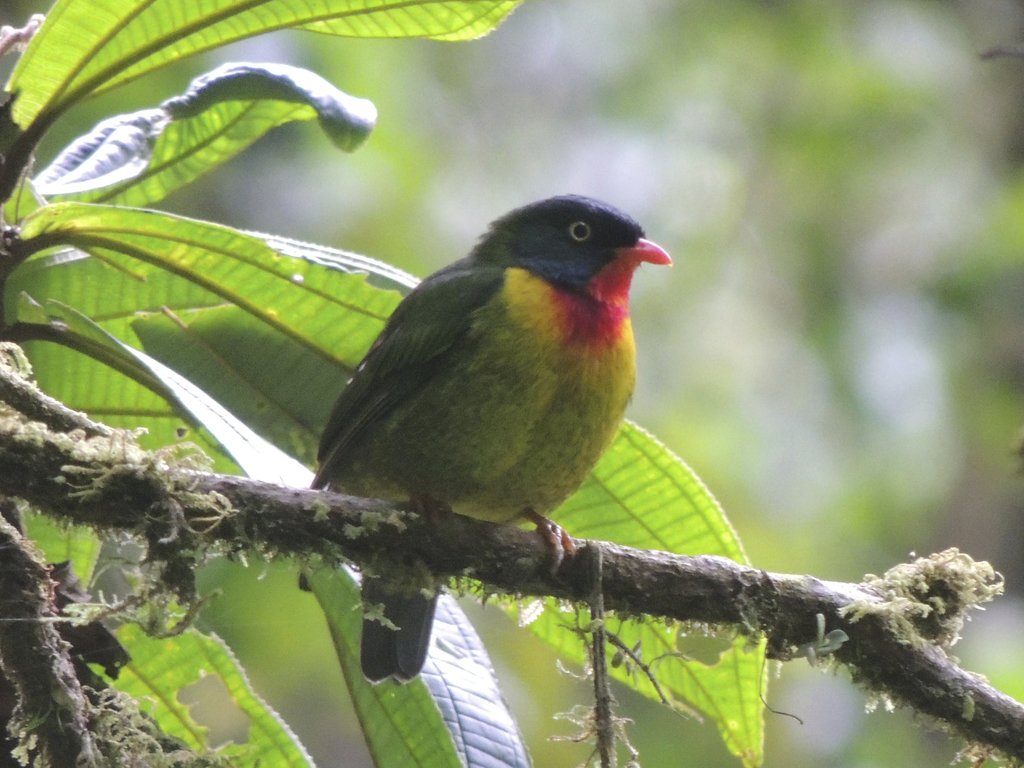
Scarlet-breasted Fruiteater
Live sightings near you, the range map, bar charts of when it is seen, and Macaulay Library photos and recordings.
Scarlet-breasted Fruiteater
Pipreola frontalis
The scarlet-breasted fruiteater (Pipreola frontalis) is a species of bird in the family Cotingidae.
It is found in Bolivia, Ecuador, and Peru where its natural habitat is subtropical and tropical moist montane forests. Two subspecies are recognised though some researchers consider these should be regarded as distinct species. It is a plump green bird with a black head, the males having red throats and the females yellow. It is a relatively common species with a wide range, and the International Union for Conservation of Nature has rated its conservation status as being "least concern".
From the article Scarlet-breasted fruiteater on Wikipedia (CC BY-SA), quoted section by section
Description
Like all Pipreola fruiteaters, the scarlet-breasted fruiteater is a plump, short-tailed cotinga. It is relatively small for a fruiteater, measuring 15.5–16.5 cm (6.1–6.5 in) in length; its mass ranges from 39.5 to 45.3 g (1.39 to 1.60 oz), with an average of 42.4 g (1.50 oz). The species is sexually dimorphic; the male is considerably more colorful than the female. Both sexes have bright green upperparts, with narrow yellow tips to the tertial feathers. The male's throat and upper breast are bright red (less extensively colored in P. f. squamipectus than in P. f. frontalis), while the female's underparts are yellow with green scaling or spots. Its legs and feet are pink or orange.
Range & habitat
The scarlet-breasted fruiteater is restricted to the eastern slope of the Andes from northeastern Ecuador through eastern Peru to central Bolivia. It is found in montane forests at elevations ranging from 900–2,000 m (3,000–6,600 ft) above sea level.
Wikipedia: “Distribution and habitat”
What it does
The scarlet-breasted fruiteater is arboreal and often occurs higher up, from mid-levels to sub-canopy, than many other members of its genus. Like other fruiteaters, it tends to be rather lethargic.
Feeding. As its name suggests, the scarlet-breasted fruiteater eats primarily fruit, which it picks while hover-gleaning or, less frequently, while perched.
Voice. The scarlet-breasted fruiteater's vocalizations are generally short, high-pitched and infrequent. The song of the P. f. squamipectus male is sharp and ascending, variously transcribed as "psii" or "tsweeet", while the song of the P. f. frontalis male is longer and more complex—a thin, rising trill that becomes a descending whistle, transcribed as "ti'ti'ti'ti'ti'ti'tseeeeeeeeer". Its call is a very high-pitched pseet.
Wikipedia: “Behavior”
Listen
Looking for field recordings…
Where it lives
Recorded sightings
—
geo-referenced records in GBIF, from museums, herbaria and field observers.
Drag the globe to turn it. Dots are where records exist, not a range map; darker means more records.
In the stacks
Searching the stacks…
Every page naming Pipreola frontalis in the Biodiversity Heritage Library →
This page is assembled live from iNaturalist, GBIF, Wikipedia, the Source Library and the Internet Archive. It is not yet part of the hand-edited codex. iNaturalist taxon 8759.