On eBird ↗
Handsome Fruiteater
Live sightings near you, the range map, bar charts of when it is seen, and Macaulay Library photos and recordings.
Handsome Fruiteater
Pipreola formosa
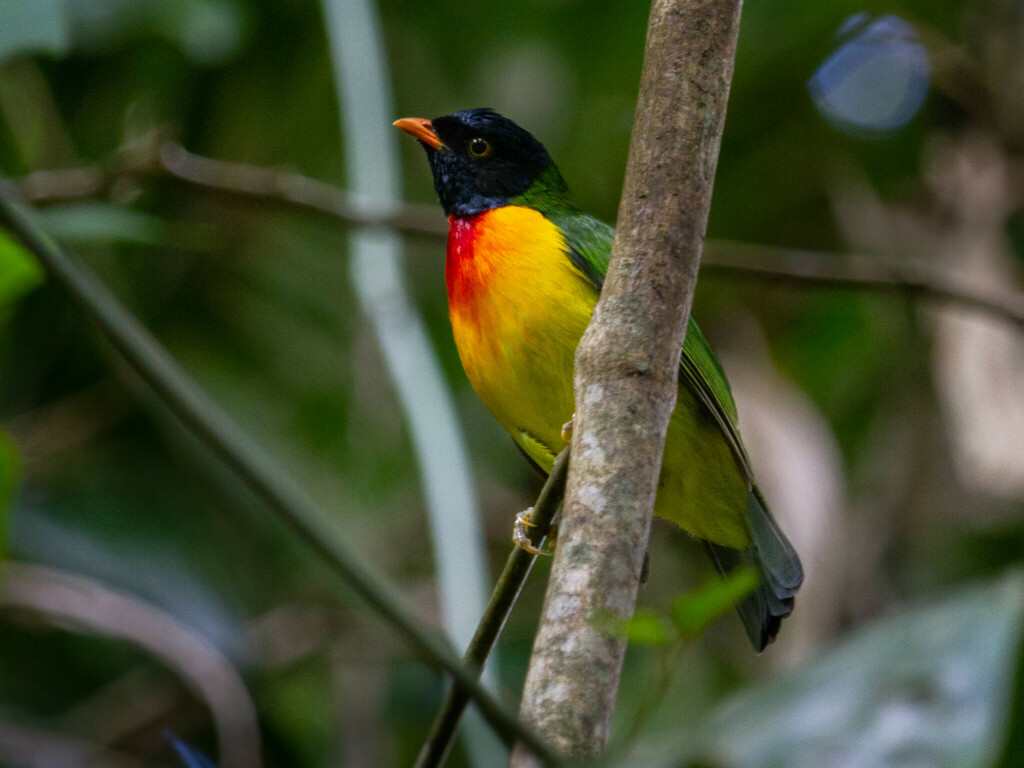
The handsome fruiteater (Pipreola formosa) is a species of bird in the family Cotingidae. It is endemic to coastal mountains of northern Venezuela. Two populations of the species live in the northern mountainous regions, separated by 400 km (250 mi). Its natural habitat is subtropical or tropical moist montane forests.
From the article Handsome fruiteater on Wikipedia (CC BY-SA), quoted section by section
Description
The handsome fruiteater is 16 to 18 cm (6.3 to 7.1 in) long and weighs 32.5 to 49 g (1.1 to 1.7 oz). The sexes have very different plumage. Adult males of the nominate subspecies have a glossy bluish black head including the chin and throat. Their nape, upperparts, and tail are bright grass green. Their wings are mostly bright grass green with blackish outer webs on the flight feathers and white tips on the tertials. Their upper breast has a deep orange triangular patch in otherwise mostly bright yellow underparts. Their lower flanks are mottled with bright green and their undertail coverts tinged bright greenish. Adult nominate females have a green to greenish yellow forehead and forecrown and a yellowish green throat on an otherwise green to greenish yellow head. Their upperparts are bright grass green. Their tail is mostly bright grass green with blackish or dusky outer feathers. Their wings' primaries and primary coverts are dusky to blackish with green outer webs and their innermost tertials have rounded or crescent-shaped white tips. Their wings are otherwise bright grass green. Their upper breast has an orange-yellow crescent. Their lower breast is green, their belly and flanks yellow barred with green, and their undertail coverts yellowish. Juveniles of both sexes are overall green. …
Range & habitat
The handsome fruiteater has a disjunct distribution; the three subspecies are found in different parts of the Venezuelan Coastal Range. The nominate subspecies is the westernmost; it is found from Yaracuy and Carabobo east to the Federal District and Miranda with a sight record further west in Falcón. Subspecies P. f. rubidior is found in northeastern Anzoátegui, western Sucre, and northern Monagas. P. f. pariae is found on the Paria Peninsula. The handsome fruiteater inhabits somewhat humid to wet premontane forest and cloudforest. In elevation it ranges between 800 and 2,200 m (2,600 and 7,200 ft).
Wikipedia: “Distribution and habitat”
What it does
The handsome fruiteater feeds primarily on fruit, with known items being Gonzalagunia dicocca, Anthurium cartilagineum, and Melastomataceae fruits. It also includes small insects in its diet. It typically feeds singly, in pairs, or in small family groups. It sometimes joins mixed-species feeding flocks as they pass through its territory but seldom accompanies them further. It typically perches quietly between about 2 and 10 m (7 and 33 ft) above the ground. It picks fruit while perched and while briefly hovering after a short upward sally.
Wikipedia: “Feeding”
Listen
Looking for field recordings…
Where it lives
Recorded sightings
—
geo-referenced records in GBIF, from museums, herbaria and field observers.
Drag the globe to turn it. Dots are where records exist, not a range map; darker means more records.
In the stacks
Searching the stacks…
Every page naming Pipreola formosa in the Biodiversity Heritage Library →
This page is assembled live from iNaturalist, GBIF, Wikipedia, the Source Library and the Internet Archive. It is not yet part of the hand-edited codex. iNaturalist taxon 8772.