On eBird ↗
Golden-breasted Fruiteater
Live sightings near you, the range map, bar charts of when it is seen, and Macaulay Library photos and recordings.
Golden-breasted Fruiteater
Pipreola aureopectus
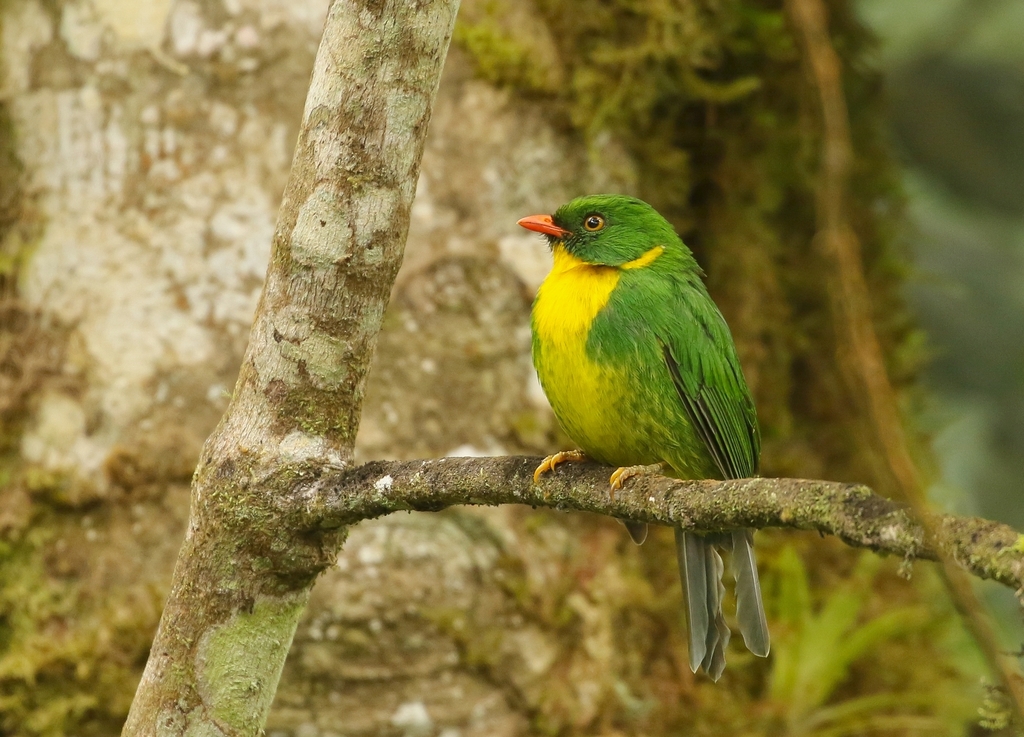
The golden-breasted fruiteater (Pipreola aureopectus) is a species of bird in the family Cotingidae. It is found in Colombia, and Venezuela, where its natural habitat is subtropical or tropical moist montane forests. Considering range and population size, this species is not considered vulnerable
From the article Golden-breasted fruiteater on Wikipedia (CC BY-SA), quoted section by section
Description
The golden-breasted fruiteater is 16.5 to 17.5 cm (6.5 to 6.9 in) long; three individuals weighed 46 to 50 g (1.6 to 1.8 oz). The sexes have very different plumage. Adult males of the nominate subspecies have dusky lores and chin on an otherwise grass-green head. Their upperparts and tail are also grass-green. Their wings have small white tips on the tertials. Their throat and the middle of their breast are bright yellow. Their lower breast is lemon-yellow that blends to green on the sides and flanks. Adult nominate females have the same head, upperparts, tail, and wings as males. Their underparts are green with yellow streaks. Both sexes have an orange-yellow iris, an orange or orange-red bill, and greenish gray legs and feet. Subspecies P. a. decora is smaller than the nominate and has a yellow band on the sides of its neck. Males of P. a. festiva have more yellow on their underparts than the nominate.
Range & habitat
The golden-breasted fruiteater has a disjunct distribution. The nominate subspecies is the most widespread, though found in three discrete populations. It is found on the west slope of Colombia's western Andes, from the northern central Andes of Colombia into the Andes of Venezuela east to Lara, and in the Serranía del Perijá that straddles the Colombia-Venezuela border. Subspecies P. a. decora is found in the isolated Sierra Nevada de Santa Marta of northern Colombia. P. a. festiva is found in the western Venezuelan Coastal Range of Carabobo and Aragua. The species inhabits humid, though not extremely wet, forest in the pre-montane and montane zones. In elevation it is found between 600 and 2,500 m (2,000 and 8,200 ft) in Colombia, between 800 and 2,050 m (2,600 and 6,700 ft) in the Venezuelan Andes, between 1,700 and 3,100 m (5,600 and 10,200 ft) on the Venezuelan side of the Serranía del Perijá, and between 800 and 2,050 m (2,600 and 6,700 ft) in the Venezuelan coastal mountains.
Wikipedia: “Distribution and habitat”
What it does
The golden-breasted fruiteater is believed to feed only on fruit but details are lacking. It typically forages in pairs, mostly in the forest's mid-levels, and often joins mixed-species feeding flocks.
Wikipedia: “Feeding”
Listen
Looking for field recordings…
Where it lives
Recorded sightings
—
geo-referenced records in GBIF, from museums, herbaria and field observers.
Drag the globe to turn it. Dots are where records exist, not a range map; darker means more records.
In the stacks
Searching the stacks…
Every page naming Pipreola aureopectus in the Biodiversity Heritage Library →
This page is assembled live from iNaturalist, GBIF, Wikipedia, the Source Library and the Internet Archive. It is not yet part of the hand-edited codex. iNaturalist taxon 8777.