On eBird ↗
Barred Fruiteater
Live sightings near you, the range map, bar charts of when it is seen, and Macaulay Library photos and recordings.
Barred Fruiteater
Pipreola arcuata
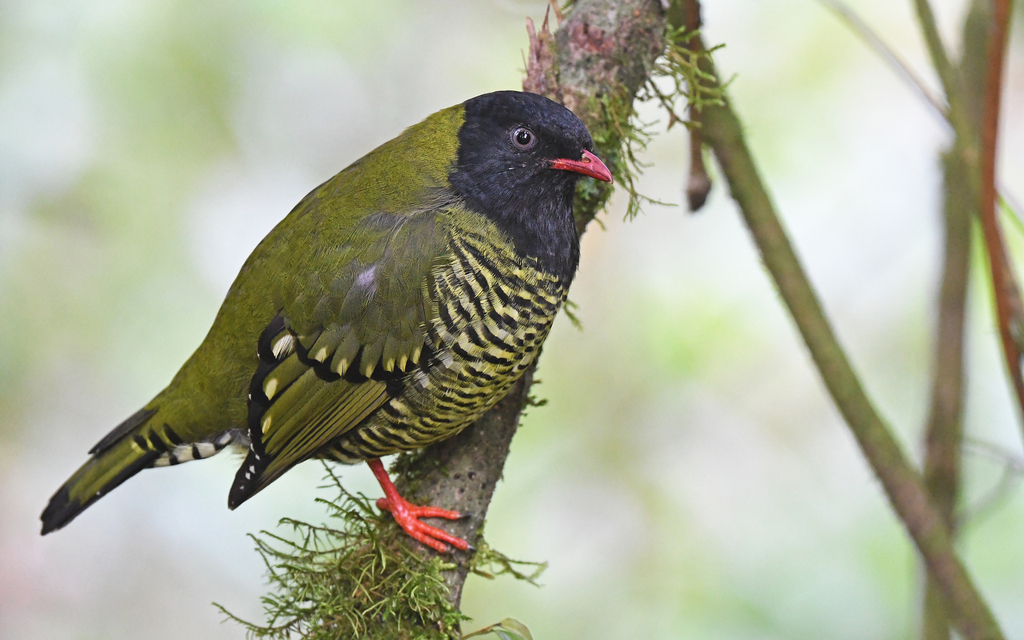
The barred fruiteater (Pipreola arcuata) is a species of bird in the family Cotingidae, found in Bolivia, Colombia, Ecuador, Peru, and Venezuela. Its natural habitat is subtropical or tropical moist montane forests. The population is stable, and they are considered common.
From the article Barred fruiteater on Wikipedia (CC BY-SA), quoted section by section
Description
The barred fruiteater is among the largest of its genus at 22 to 23 cm (8.7 to 9.1 in) long and weighing 112 to 128 g (4.0 to 4.5 oz). The sexes have different plumage, though uniquely among the fruiteaters both have barred breasts. Adult males of the nominate subspecies have an entirely black head, neck, and upper breast. Their upperparts are olive-green and the wings and tail mostly that color. The wing's greater coverts and tertials have large yellow spots. The tail has a black bar near the end and whitish tips on the feathers. Their underparts are yellow with crisp black bars. Females have an olive-green head instead of the male's black and the black-barred yellow of the underparts includes the throat and upper breast. Both sexes have a red, orange, yellow, or chestnut iris, a crimson bill with sometimes a black tip, and scarlet legs and feet. Subspecies P. a. viridicauda has pale yellow to creamy eyes and less black and white on its outer tail feathers than the nominate.
Range & habitat
The barred fruiteater has a disjunct distribution. The nominate subspecies has the much larger range, though it is discontinuous. It is found in the Serranía del Perijá that straddles the Colombia-Venezuela border, in the Andes of Venezuela from Lara west into Colombia's eastern Andes, from Colombia's central and western Andes south through the Andes of Ecuador into far northern Peru's Piura Department, and on the eastern slope of the Andes of Peru from Amazonas south to Pasco Department. Subspecies P. a. viridicauda is found on the eastern slope of the Andes from Junín Department in Peru south into Bolivia's La Paz and Cochabamba departments. The barred fruiteater inhabits the interior and edges of montane forest, including cloudforest, in the temperate zone. In elevation it ranges between 1,800 and 3,100 m (5,900 and 10,200 ft) in Venezuela, between 2,000 and 3,400 m (6,600 and 11,200 ft) in Colombia, mostly between 2,500 and 3,300 m (8,200 and 10,800 ft) in Ecuador, and between 2,100 and 3,500 m (6,900 and 11,500 ft) in Peru.
Wikipedia: “Distribution and habitat”
What it does
The barred fruiteater is believed to feed only on fruit but details are lacking. It forages singly, in pairs, or in small groups, mostly in the forest's mid-levels and up, and seldom joins mixed-species feeding flocks. It tends to sit sluggishly for long periods.
Wikipedia: “Feeding”
Listen
Looking for field recordings…
Where it lives
Recorded sightings
—
geo-referenced records in GBIF, from museums, herbaria and field observers.
Drag the globe to turn it. Dots are where records exist, not a range map; darker means more records.
In the stacks
Searching the stacks…
Every page naming Pipreola arcuata in the Biodiversity Heritage Library →
This page is assembled live from iNaturalist, GBIF, Wikipedia, the Source Library and the Internet Archive. It is not yet part of the hand-edited codex. iNaturalist taxon 8781.