On eBird ↗
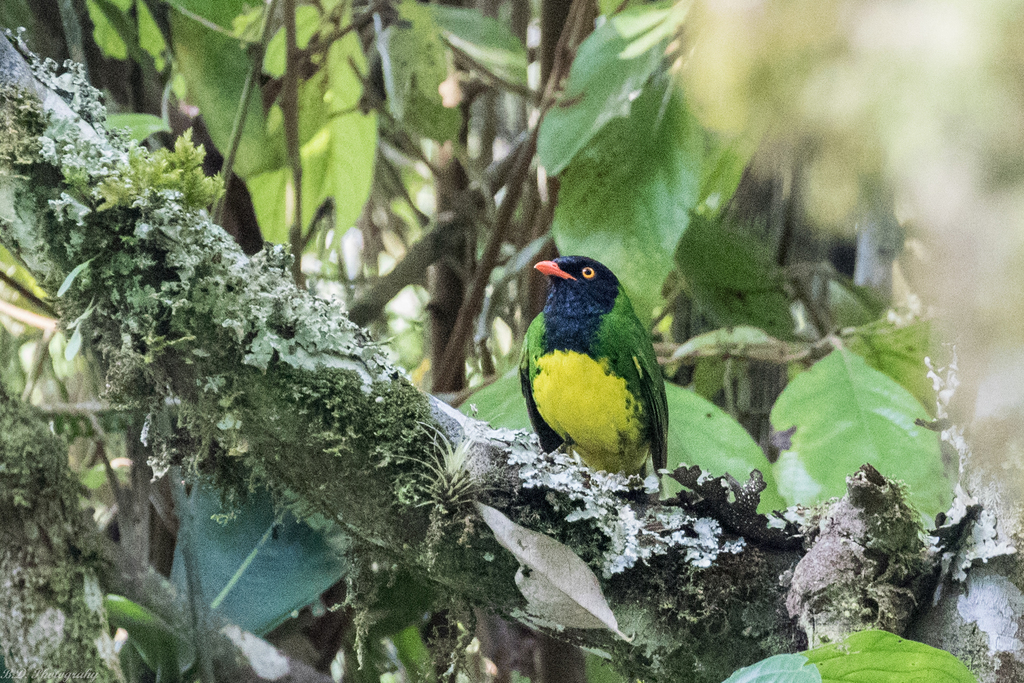
Black-chested Fruiteater
Live sightings near you, the range map, bar charts of when it is seen, and Macaulay Library photos and recordings.
Black-chested Fruiteater
Pipreola lubomirskii
The black-chested fruiteater (Pipreola lubomirskii) is a species of bird in the family Cotingidae found in Colombia, Ecuador, and Peru, mostly on the eastern side of the Andes. Its natural habitat is subtropical and tropical moist montane forests and the IUCN lists its status as being of "least concern".
From the article Black-chested fruiteater on Wikipedia (CC BY-SA), quoted section by section
Description
Fruiteaters are stocky birds with short tails and short tarsi (lower legs). The black-chested fruiteater is a medium-size fruiteater with a length of 18 cm (7.1 in). The male has a black head, throat and upper breast. The upper parts of the body are bright green and the underparts yellowish-green with mottling on the flanks. The female lacks the black head region and has a bright green back, throat and cheat and underparts streaked with yellow and green. The iris is yellow in both sexes, the beak pinkish-orange and the legs greenish-grey. This species could be confused with the green-and-black fruiteater (Pipreola riefferii), but the latter species has pale barring on the tertial wing feathers, and a yellow border to the black chest in the male. The song is a faint, high-pitched ascending whistle "tseeeeeeweee", and there are further short, rising and falling, whistling calls.
Range & habitat
The black-chested fruiteater is native to the Andean region of South America. Its range extends on the eastern side of the Andes from southern Colombia, through Ecuador, to northern Peru; it is found in montane forests and its altitudinal range is 1,500 to 2,300 m (4,900 to 7,500 ft). It also occurs as separate populations locally on the western side of the Andes at Cajamarca and in the south of Marañón Province.
Wikipedia: “Distribution and habitat”
Listen
Looking for field recordings…
Where it lives
Recorded sightings
—
geo-referenced records in GBIF, from museums, herbaria and field observers.
Drag the globe to turn it. Dots are where records exist, not a range map; darker means more records.
In the stacks
Searching the stacks…
Every page naming Pipreola lubomirskii in the Biodiversity Heritage Library →
This page is assembled live from iNaturalist, GBIF, Wikipedia, the Source Library and the Internet Archive. It is not yet part of the hand-edited codex. iNaturalist taxon 8787.