On eBird ↗
Gray Junglefowl
Live sightings near you, the range map, bar charts of when it is seen, and Macaulay Library photos and recordings.
Grey Junglefowl
Gallus sonneratii
The grey junglefowl (Gallus sonneratii), also known as Sonnerat's junglefowl, is one of the wild ancestors of the domestic chicken together with the red junglefowl and other junglefowls.
The species epithet commemorates the French explorer Pierre Sonnerat. Local names include Komri in Rajasthan, Geera kur or Parda komri in Gondi, Jangli Murghi in Hindi, Raan kombdi in Marathi, Kattu Kozhi in Tamil and Malayalam, Kaadu koli in Kannada and Tella adavi kodi in Telugu.
From the article Grey junglefowl on Wikipedia (CC BY-SA), quoted section by section
Description
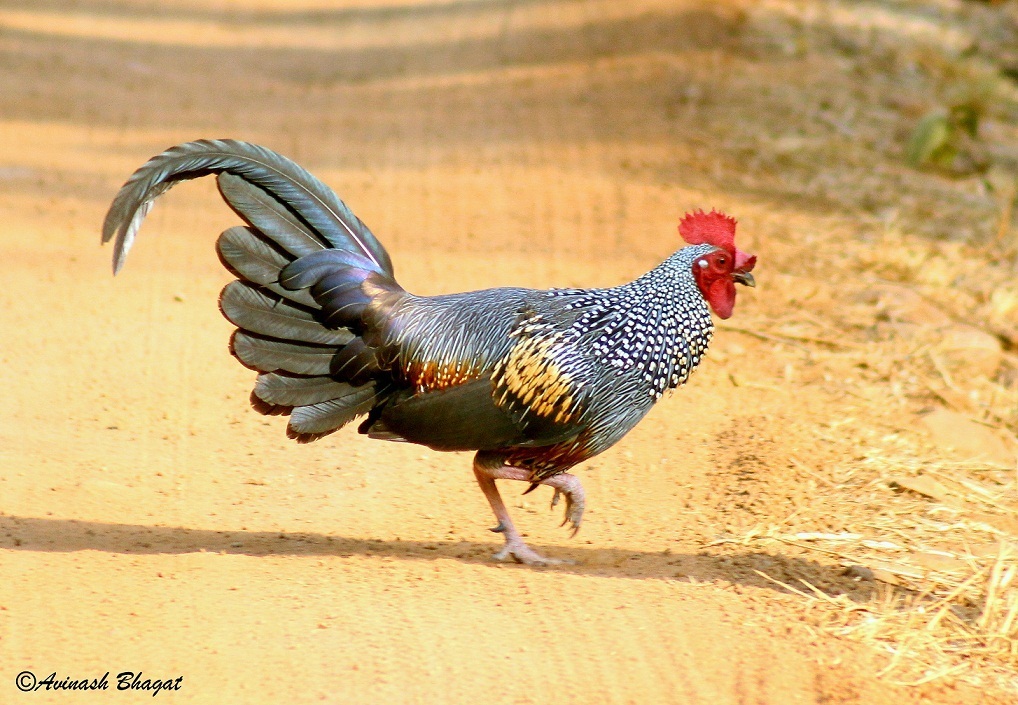
The male has a black cape with ochre spots and the body plumage on a grey ground colour is finely patterned. The elongated neck feathers are dark and end in a small, hard, yellowish plate; this peculiar structure making them popular for making high-grade artificial flies. The male has red wattles and combs but not as strongly developed as in the red junglefowl. Legs of males are red and have spurs while the yellow legs of females usually lack spurs. The central tail feathers are long and sickle shaped. Males have an eclipse plumage in which they moult their colourful neck feathers in summer during or after the breeding season. The female is duller and has black and white streaking on the underparts and yellow legs.
Range & habitat
This species is endemic to India, and even today it is found mainly in peninsular India and towards the northern boundary. They are found in thickets, on the forest floor and open scrub. The species occurs mainly in the Indian Peninsula, but extends into Gujarat, Madhya Pradesh and southern Rajasthan. The red junglefowl is found more along the foothills of the Himalayas; a region of overlap occurs in the Aravalli range. although the ranges are largely non-overlapping.
Disputed subspecies. The populations from the region of Mount Abu in Rajasthan named as the subspecies wangyeli is usually not recognized although it is said that the calls of the cock from this region differs from the call of birds from southern India and the plumage is much paler.
Wikipedia: “Distribution and habitat”
What it does
Their loud calls of Ku-kayak-kyuk-kyuk () are loud and distinctive, and can be heard in the early mornings and at dusk. Unlike the red junglefowl, the male does not flap its wings before uttering the call. They breed from February to May. They lay 4 to 7 eggs which are pale creamy in a scrape. Eggs hatch in about 21 days. Although mostly seen on the ground, grey junglefowl fly into trees to escape predators and to roost. They forage in small mixed or single sex groups. They feed on grains including bamboo seeds, berries, insects and termites, and are hunted for meat and for the long neck hackle feathers that are sought after for making fishing lures.
Wikipedia: “Behaviour”
Listen
Looking for field recordings…
Where it lives
Recorded sightings
—
geo-referenced records in GBIF, from museums, herbaria and field observers.
Drag the globe to turn it. Dots are where records exist, not a range map; darker means more records.
In the stacks
Searching the stacks…
Every page naming Gallus sonneratii in the Biodiversity Heritage Library →
This page is assembled live from iNaturalist, GBIF, Wikipedia, the Source Library and the Internet Archive. It is not yet part of the hand-edited codex. iNaturalist taxon 880.