- Animals
- ›Chordates
- ›Vertebrates
- ›Mammals
- ›Therians
- ›Placental Mammals
- ›Primates, Rodents, and Allies
- ›Primates
- ›Monkeys, Apes, and Tarsiers
- ›Monkeys and Apes
- ›Apes and Old World Monkeys
- ›Apes
- ›Gibbons
- ›Hoolock
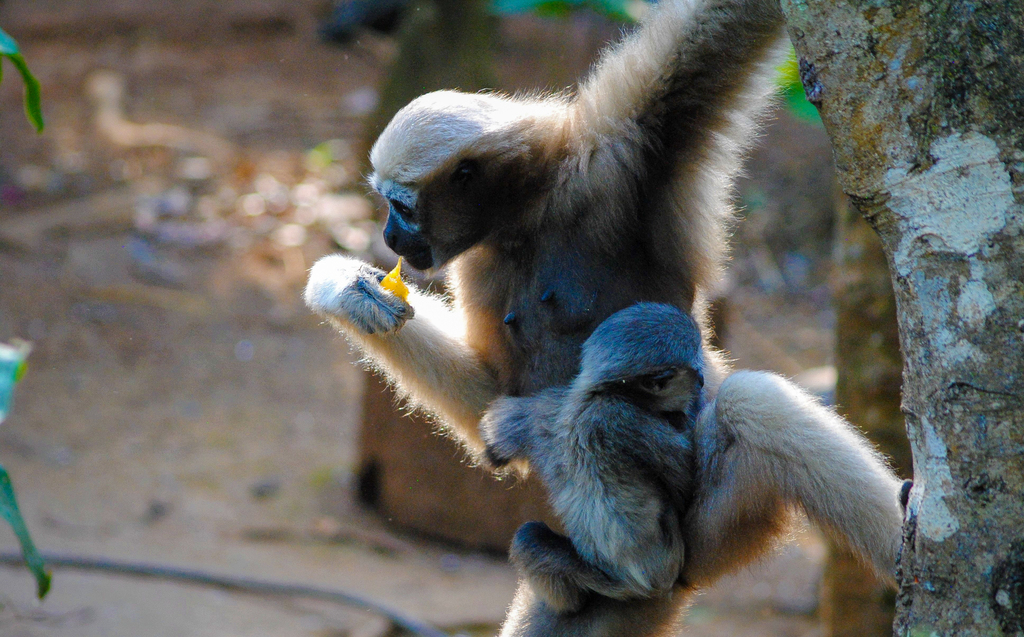
Eastern Hoolock Gibbon
Hoolock leuconedys
The eastern hoolock gibbon (Hoolock leuconedys) is a primate from the gibbon family, Hylobatidae. It is one of three species of hoolock gibbon. This species is found in extreme eastern corner of Assam and parts of Arunachal Pradesh, Myanmar east of the Chindwin River, such as the Mahamyaing Wildlife Sanctuary, and in south west Yunnan of China. The other hoolock gibbon, the western hoolock (H. hoolock), occurs farther to the west. Indian records for the eastern...
From the article Eastern hoolock gibbon on Wikipedia (CC BY-SA), quoted section by section
Range & habitat
The eastern hoolock gibbon is a forest-dwelling primate that prefers a continuous canopy, which makes them vulnerable to loss of habitat. They can be found in deciduous or evergreen forests. They also reside in partially deciduous hill forests as well as broadleaf pine forests, and can be found as high as 2,700 m in elevation in northeastern Myanmar. The eastern hoolock gibbon has been found in tropical environments that experience monsoon rains and have cool, dry winters. and lowland tropical environments. The eastern hoolock gibbon is an omnivorous animal, with fruits making up the majority of its diet at about 65%, with 60% of the fruits being figs. They also eat lichens, invertebrates, bird eggs, plant parts (buds, shoots, leaves, flowers), and insects. The majority of what they eat depends on their location and the density of the available resources, but fruits always show to be their most dominant food type. Gibbon groups sleep in trees that are close to each other, focusing on the tallest canopy trees, and tend to choose areas located either on hilltops or slopes. They also sleep in a fetal position with their arms hugging their knees into their chests. Gibbons are more active in the summer, awaking earlier in the day than in the winter, and socialize more with each other while being awake for about 8–10 hours a day, sleeping shortly before dusk arrives. …
Wikipedia: “Habitat and ecology”
Listen
Looking for field recordings…
Where it lives
Recorded sightings
—
geo-referenced records in GBIF, from museums, herbaria and field observers.
Drag the globe to turn it. Dots are where records exist, not a range map; darker means more records.
In the stacks
Searching the stacks…
Every page naming Hoolock leuconedys in the Biodiversity Heritage Library →
This page is assembled live from iNaturalist, GBIF, Wikipedia, the Source Library and the Internet Archive. It is not yet part of the hand-edited codex. iNaturalist taxon 883258.