On eBird ↗
Three-wattled Bellbird
Live sightings near you, the range map, bar charts of when it is seen, and Macaulay Library photos and recordings.
Three-wattled Bellbird
Procnias tricarunculatus
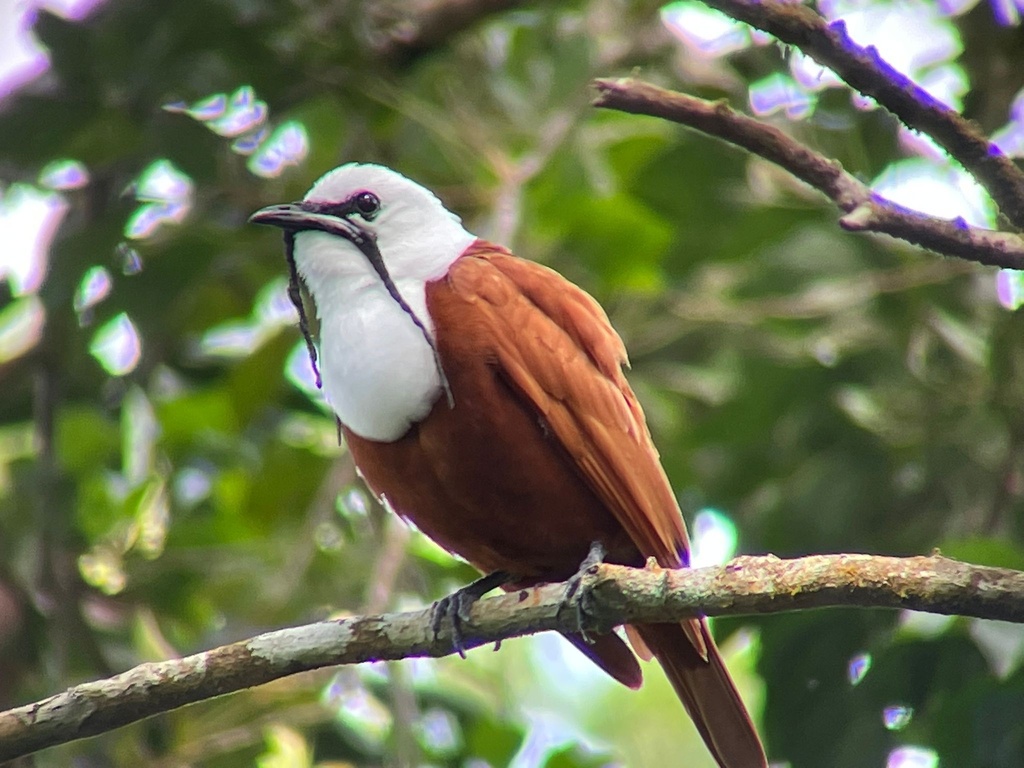
The three-wattled bellbird (Procnias tricarunculatus) is a Central American migratory bird of the cotinga family. The sexes are very dissimilar in appearance. The male has a white head and throat and the remaining plumage is chestnut brown. From the base of his beak dangle three long, slender, black wattles that he uses in display. The female has olive plumage with yellowish streaked underparts and a yellow vent area.
The three-wattled bellbird breeds in mountainous regions of Costa Rica and migrates to western Honduras, Nicaragua and Panama. The male bird has a loud, distinctive, bell-like call, and as these birds are secretive and shy, they are more often heard than seen. The International Union for Conservation of Nature has assessed their conservation status as "vulnerable".
From the article Three-wattled bellbird on Wikipedia (CC BY-SA), quoted section by section
Description
One of four species of bellbird that live in Central and South America, the three-wattled bellbird is between 25 cm (9.8 in) and 30 cm (12 in) long. The body, tail, and wings of the male are uniformly chestnut-brown; its head, neck, and upper breast are white; and it has a black eye-ring, eye-stripe, and bill. Its name comes from the three worm-like wattles of skin that hang from the base of the bill. These wattles can be as long as 10 cm (3.9 in) when extended during songs and interactions. The wattles remain flaccid even when extended. The male shakes the wattles, but otherwise they hang straight down; they are neither erectile nor under muscular control. The side wattles do not stick out to the sides and the central one is not extended directly skywards as shown on some old illustrations and specimens. The purpose of the wattles is unclear. The female bellbirds are smaller and less striking in appearance, being overall olive with yellowish streaking below, pure yellow vent and no wattles. The females blend into the surroundings of the forest, which helps them hide its nests from predators. The nests are very difficult to spot. As of January 2019, only six nests had been found in Monteverde, according to the council for the Bellbird Biological Corridor. …
Range & habitat
Famous for having one of the most unusual and distinct vocalizations of any bird in its range, the three-wattled bellbird exists from western Honduras south to eastern Panama. Bellbirds breed primarily in Costa Rican highlands in the cloud forest (March–September) and return to lower elevations in the mangroves for the interim months.
Wikipedia: “Distribution”
What it does
The species is completely frugivorous; it swallows the fruits from trees in the Lauraceae family, of which the avocado is a member. The bellbird performs an important role in seed dispersal. It regurgitates the seeds it cannot digest and deposits them in gap areas beneath song perches, which nearly doubles seedling survival rate.
Wikipedia: “Ecology”
Listen
Looking for field recordings…
Where it lives
Recorded sightings
—
geo-referenced records in GBIF, from museums, herbaria and field observers.
Drag the globe to turn it. Dots are where records exist, not a range map; darker means more records.
In the stacks
Searching the stacks…
Every page naming Procnias tricarunculatus in the Biodiversity Heritage Library →
This page is assembled live from iNaturalist, GBIF, Wikipedia, the Source Library and the Internet Archive. It is not yet part of the hand-edited codex. iNaturalist taxon 8847.