On eBird ↗
Buff-throated Purpletuft
Live sightings near you, the range map, bar charts of when it is seen, and Macaulay Library photos and recordings.
Buff-throated Purpletuft
Iodopleura pipra
The buff-throated purpletuft (Iodopleura pipra) is a small species of South American bird in the family Tityridae. It has traditionally been placed in the cotinga family, but evidence strongly suggest it is better placed in Tityridae, where now placed by SACC.
From the article Buff-throated purpletuft on Wikipedia (CC BY-SA), quoted section by section
Description
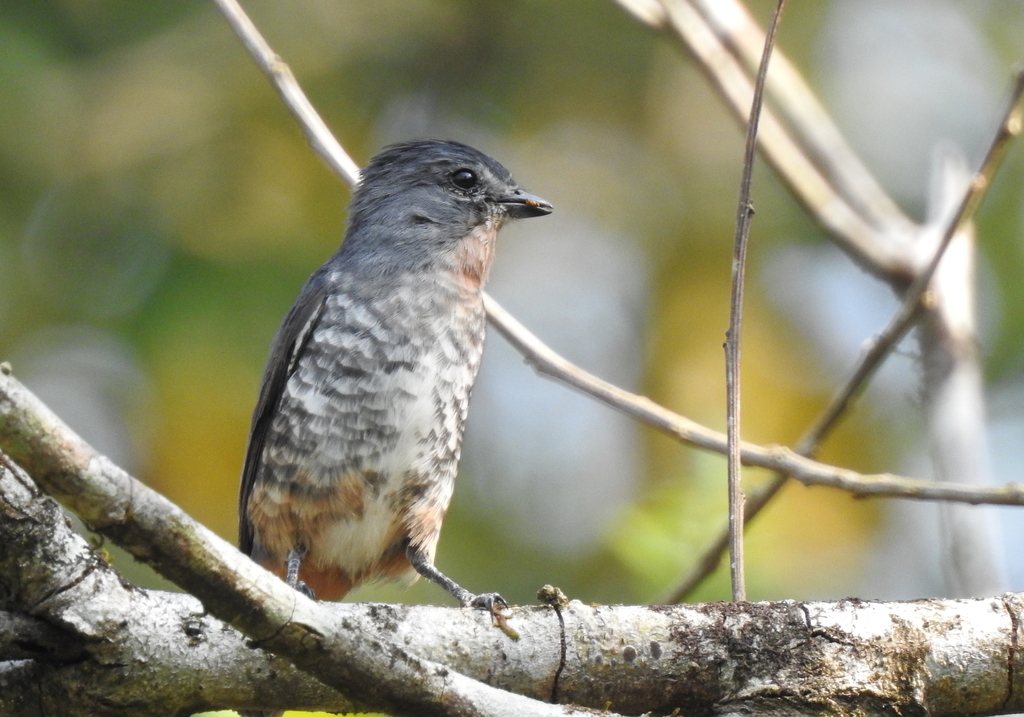
The buff-throated purpletuft is 8.7 to 10.5 cm (3.4 to 4.1 in) long; two individuals weighed 9.6 and 10.5 g (0.34 and 0.37 oz). The sexes have almost the same plumage. They have long wings, a short tail, and a wide bill with a hooked tip. Adults of the nominate subspecies have a pale gray supercilium, a dusky line through the eye, and a broken white eye-ring on an otherwise gray face. Their crown is a darker gray than their face. Their upperparts are mostly gray with a white rump. Their wings are mostly dusky to blackish with dusky coverts. Their tail is dusky to blackish. Their chin has a narrow white band. Their throat and upper breast are cinnamon-buff. They are mottled gray across the breast and along their sides, their belly is white, and their undertail coverts cinnamon-buff. Males have a small tuft of purple feathers on their upper flank; females have no tufts. Subspecies I. p. leucopygia has a larger white rump band and a purer buff throat than the nominate. Both sexes of both subspecies have a dark brown iris, a black bill with a lead-gray base to the mandible, and dark lead-gray legs. Juveniles have white tips on their dark feathers.
Range & habitat
The buff-throated purpletuft has a disjunct distribution on the coast of eastern and southeastern Brazil. Subspecies I. p. leucopygia is the more northerly of the two. It is found intermittently from Paraíba south to northeastern Minas Gerais. The nominate is found somewhat more nearly continuously from Espírito Santo south to Paraná. There are also scattered records outside these core ranges. It is a bird of the Atlantic Forest, where it inhabits primary and secondary forest, cocoa plantations with a forest overcover, and clearings with some trees. "There is some evidence that the species may be associated with a single species of tall, fine-leafed leguminous tree, which is widespread and locally common, and often supports the clumps of mistletoe on which it primarily feeds." In elevation it is almost always found below 1,000 m (3,300 ft).
Wikipedia: “Distribution and habitat”
What it does
The buff-throated purpletuft appears to feed mostly on the berries of mistletoe (Loranthaceae) but also feeds on other fruits and on insects. It forages in the forest canopy and takes insects above it. It plucks fruit both while perched and with a sally from a perch; insects are taken while perched and in mid-air.
Wikipedia: “Feeding”
Listen
Looking for field recordings…
Where it lives
Recorded sightings
—
geo-referenced records in GBIF, from museums, herbaria and field observers.
Drag the globe to turn it. Dots are where records exist, not a range map; darker means more records.
In the stacks
Searching the stacks…
Every page naming Iodopleura pipra in the Biodiversity Heritage Library →
This page is assembled live from iNaturalist, GBIF, Wikipedia, the Source Library and the Internet Archive. It is not yet part of the hand-edited codex. iNaturalist taxon 8869.