On eBird ↗
Nubian Bustard
Live sightings near you, the range map, bar charts of when it is seen, and Macaulay Library photos and recordings.
Nubian Bustard
Neotis nuba
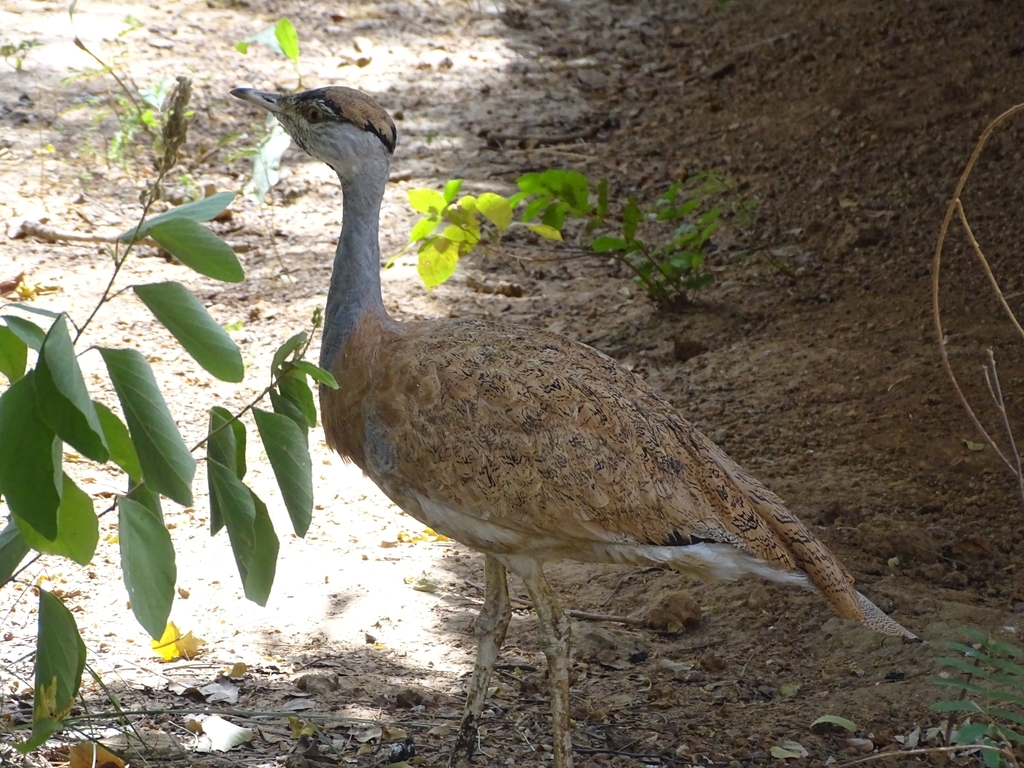
The Nubian bustard (Neotis nuba) is a species of bird in the bustard family. This is a medium-large bustard, found in the sparsely vegetated interface between the southern margins of the Sahara desert and the northern part of the Sahel. It is found in Burkina Faso, Cameroon, Chad, Mali, Mauritania, Niger, Nigeria, and Sudan. Its natural habitats are dry savanna and subtropical or tropical dry shrubland. Formerly common in this region, it is now very rare, with populations declining due to hunting and habitat degradation.
From the article Nubian bustard on Wikipedia (CC BY-SA), quoted section by section
Description
The Nubian bustard is medium-large with pronounced sexual size dimorphism. In this species, males average around 5.4 kg (12 lb) weight and around 70 cm (28 in) length and 180 cm (71 in) wingspan. Females are much smaller at around 50 cm (20 in) in length and 140 cm (55 in) wingspan; their weight is not recorded. It is smaller than the sympatric Arabian bustard, as well as more rufous with a different body shape. Compared to larger bustards, the Nubian bustard has a more rounded body, a relatively long, thin neck, and a rounded head. Mature birds have plumages of rufous and sandy tones, with a long, broad sandy-rufous stripe on the crown unique among bustards. Immature plumage in juveniles are paler and less contrasted than adults. Both sexes are similar in coloration. The tail structure is highly specialized, with the outer rectrices being longer, stiffer, and more sharply pointed than the central tail feathers. This adaptation enables the remarkable forked-tail display that distinguishes this species from all other bustards. Specific information on molting cycles and sequences in the Nubian bustard has not been comprehensively documented. As with other bustards, the species likely undergoes a complete annual molt, though timing and duration remain poorly studied.
Range & habitat
The Nubian bustard occurs in a broad but disjunct range across the Sahel and southern Sahara, with the western subspecies (N. n. agaze) found in Mauritania, Mali, Burkina Faso, Niger, and western Chad, and the eastern subspecies (N. n. nuba) inhabiting eastern Chad and Sudan. Preferred habitats include desert fringes, semi-arid scrub, and dry savannah with scattered vegetation. Populations are patchy and the species is locally rare.
Wikipedia: “Distribution and habitat”
What it does
The Nubian bustard remains one of the least-known bustard species in terms of detailed behavioral ecology due to its remote habitat, low population density, and the extreme difficulty of conducting sustained field observations in its range.
Vocalizations. Audio recordings are extremely scarce in ornithological sound archives. The calls that have been recorded are reported to be relatively quiet compared to the loud vocalizations characteristic of some other bustard species. and consist of low booming or hooting.
Display behavior. The display behavior of the Nubian bustard remained entirely undocumented until 2022. Males perform a unique forked-tail display, walking with tail held vertically and wing-tips resting between the fork. This differs from neck-inflation displays typical of other bustards, as which involve no use of the tail. The Nubian bustard maintains a retracted neck during display. The display is performed solitarily with no nearby conspecifics, suggesting a dispersed territorial or mating system.
Diet. Nubian bustards are omnivorous with a diet consisting of large insects (beetles, grasshoppers), grass seeds, leaves and fruits. The relative proportions of animal versus plant matter in the diet likely vary seasonally depending on prey availability and phenological changes in vegetation. …
Wikipedia: “Behavior and ecology”
In human culture
The Nubian bustard has limited cultural significance compared to some other bustard species, largely due to its occurrence in sparsely populated regions and its relative obscurity even among local communities. However, where the species persists, it is known to local nomadic peoples as a source of meat. The species' extreme rarity and the remoteness of its habitat prevent any significant ecotourism value, though birdwatchers occasionally seek the species in Niger and Chad. The species has gained unfortunate notoriety as a prized quarry for falconers from the Arabian Peninsula, contributing to hunting pressure. Traditional Arab falconry has historically targeted various bustard species, and the Nubian bustard's occurrence in accessible desert regions has made it vulnerable to organized hunting expeditions.
== References ==
Wikipedia: “Cultural significance”
Listen
Looking for field recordings…
Where it lives
Recorded sightings
—
geo-referenced records in GBIF, from museums, herbaria and field observers.
Drag the globe to turn it. Dots are where records exist, not a range map; darker means more records.
In the stacks
Searching the stacks…
Every page naming Neotis nuba in the Biodiversity Heritage Library →
This page is assembled live from iNaturalist, GBIF, Wikipedia, the Source Library and the Internet Archive. It is not yet part of the hand-edited codex. iNaturalist taxon 89.