On eBird ↗
White-tailed Cotinga
Live sightings near you, the range map, bar charts of when it is seen, and Macaulay Library photos and recordings.
White-tailed Cotinga
Xipholena lamellipennis
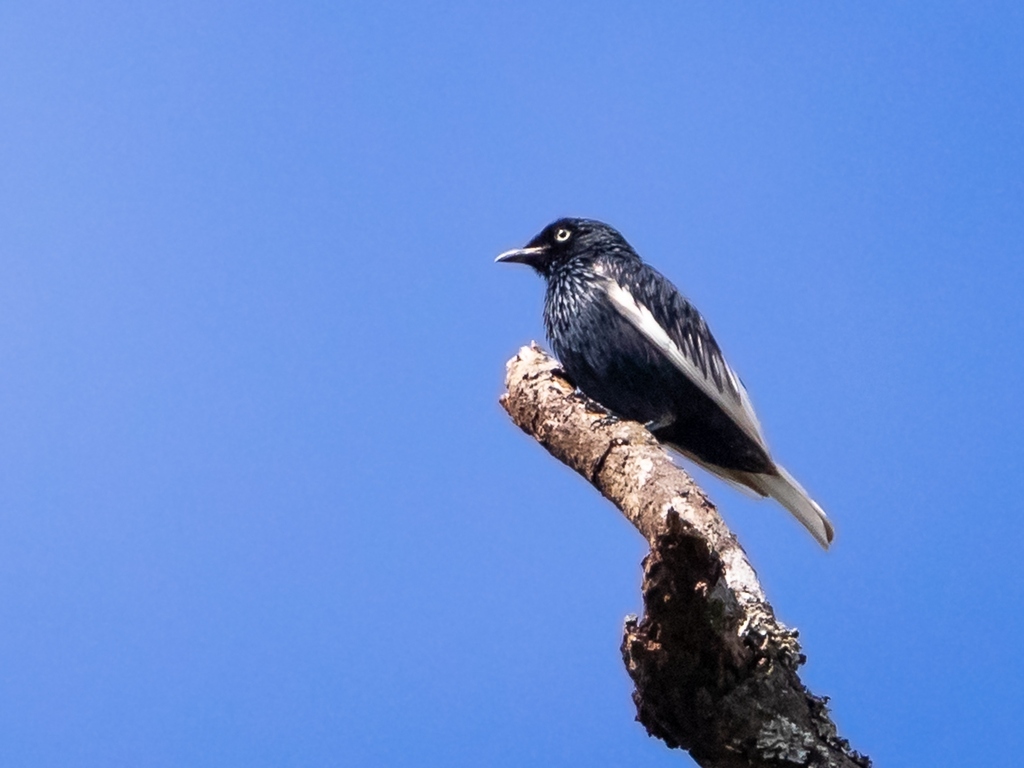
The white-tailed cotinga (Xipholena lamellipennis) is a species of bird in the family Cotingidae. It is endemic to Brazil in the northern portions of the Amazon Basin's southeast quadrant.
From the article White-tailed cotinga on Wikipedia (CC BY-SA), quoted section by section
Description
The white-tailed cotinga is 19 to 20 cm (7.5 to 7.9 in) long. The species is sexually dimorphic. Adult males have a mostly glossy purplish black head and body. Their tail and most wing feathers are white. Adult females have an ash-gray head and upperparts. Their wings and tail are mostly a darker gray with white outer edges on some wing feathers. Their underparts are a paler gray than their back with some darker mottling on the breast. Both sexes have a pale yellow iris and brownish black legs and feet with buff soles. Their dark brownish horn-colored bill has a wide base and a slight hook at the end. Immature males resemble adult females and acquire adult plumage in their second year.
Range & habitat
The white-tailed cotinga is found in the lower Amazon Basin of Brazil south of the Amazon River. Its range extends from the lower Tapajós River in eastern Pará and northern Mato Grosso east through northern Tocantins to the Atlantic in northeastern Maranhão. It inhabits the canopy of humid forest at elevations from sea level to 400 m (1,300 ft). The ranges of the three Xipholena cotingas do not overlap.
Wikipedia: “Distribution and habitat”
What it does
The white-tailed cotinga is believed to feed mainly on fruits. There is one record of an individual feeding on Phytolacca fruit but nothing else is known about the species' diet or foraging behavior.
Wikipedia: “Feeding”
Listen
Looking for field recordings…
Where it lives
Recorded sightings
—
geo-referenced records in GBIF, from museums, herbaria and field observers.
Drag the globe to turn it. Dots are where records exist, not a range map; darker means more records.
In the stacks
Searching the stacks…
Every page naming Xipholena lamellipennis in the Biodiversity Heritage Library →
This page is assembled live from iNaturalist, GBIF, Wikipedia, the Source Library and the Internet Archive. It is not yet part of the hand-edited codex. iNaturalist taxon 8904.