On eBird ↗
Scaled Fruiteater
Live sightings near you, the range map, bar charts of when it is seen, and Macaulay Library photos and recordings.
Scaled Fruiteater
Ampelioides tschudii
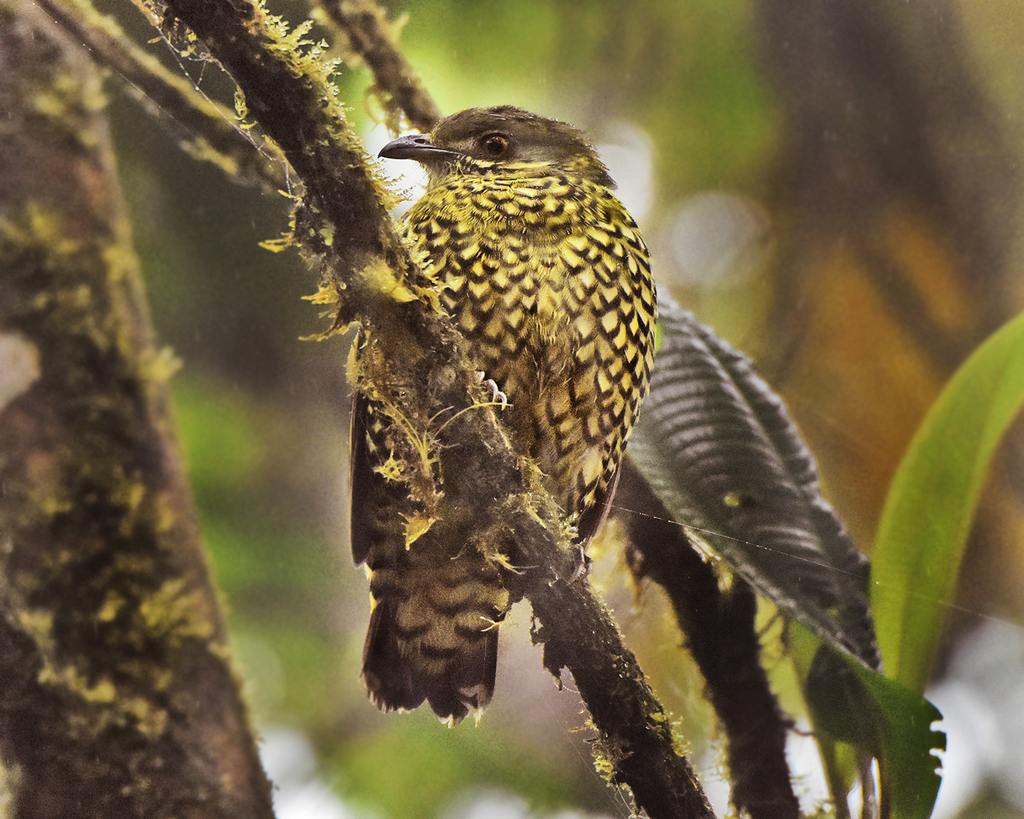
The scaled fruiteater (Ampelioides tschudii) is a species of bird in the family Cotingidae. It is the only member of the genus Ampelioides. This bird is found in Bolivia, Colombia, Ecuador, Peru, and Venezuela, where its natural habitat is the high elevation tropical forests of the Andes mountains. The scaled fruiteater is a chunky, short-tailed, flat-headed bird measuring 19–20 cm (7.5–7.9 in) in length. It uses its green scaled feather pattern to blend in with the dense vegetation of the South American rainforest.
From the article Scaled fruiteater on Wikipedia (CC BY-SA), quoted section by section
Range & habitat
The scaled fruiteater is found in the montane forests of the Andes mountains. They inhabit dense rainforests where they stay below the canopy, often near streams or other water sources. This species is found at high elevations, ranging from 1,000 to 3,500 meters (3,300 to 11,500 ft) above sea level.
Wikipedia: “Distribution and habitat”
What it does
Scaled fruiteaters feed on a variety of fruits and berries that are unique to the South American mountain ranges. They supplement their diet with insects during the breeding season when protein-rich food is essential for raising young. These birds are known for their camouflage ability, utilizing their green scales to remain hidden within the dense vegetation. The Scaled Fruiteater is non-migratory and will stay in the Andes region year-round.
Wikipedia: “Behavior and ecology”
In human culture
Scaled fruiteaters have captured the interest of birdwatchers and ecotourists, attracting visitors to the Andean regions where they are found. Their unique appearance and elusive behavior make them a sought-after sighting for bird enthusiasts. Because of their elusiveness there is a lack of research and knowledge on these birds.
== References ==
Wikipedia: “Cultural Significance”
Listen
Looking for field recordings…
Where it lives
Recorded sightings
—
geo-referenced records in GBIF, from museums, herbaria and field observers.
Drag the globe to turn it. Dots are where records exist, not a range map; darker means more records.
In the stacks
Searching the stacks…
Every page naming Ampelioides tschudii in the Biodiversity Heritage Library →
This page is assembled live from iNaturalist, GBIF, Wikipedia, the Source Library and the Internet Archive. It is not yet part of the hand-edited codex. iNaturalist taxon 8918.