On eBird ↗
Barred Antthrush
Live sightings near you, the range map, bar charts of when it is seen, and Macaulay Library photos and recordings.
Barred Antthrush
Chamaeza mollissima
The barred antthrush (Chamaeza mollissima) is a species of bird in the family Formicariidae. It is found in Bolivia, Colombia, Ecuador and Peru.
From the article Barred antthrush on Wikipedia (CC BY-SA), quoted section by section
Description
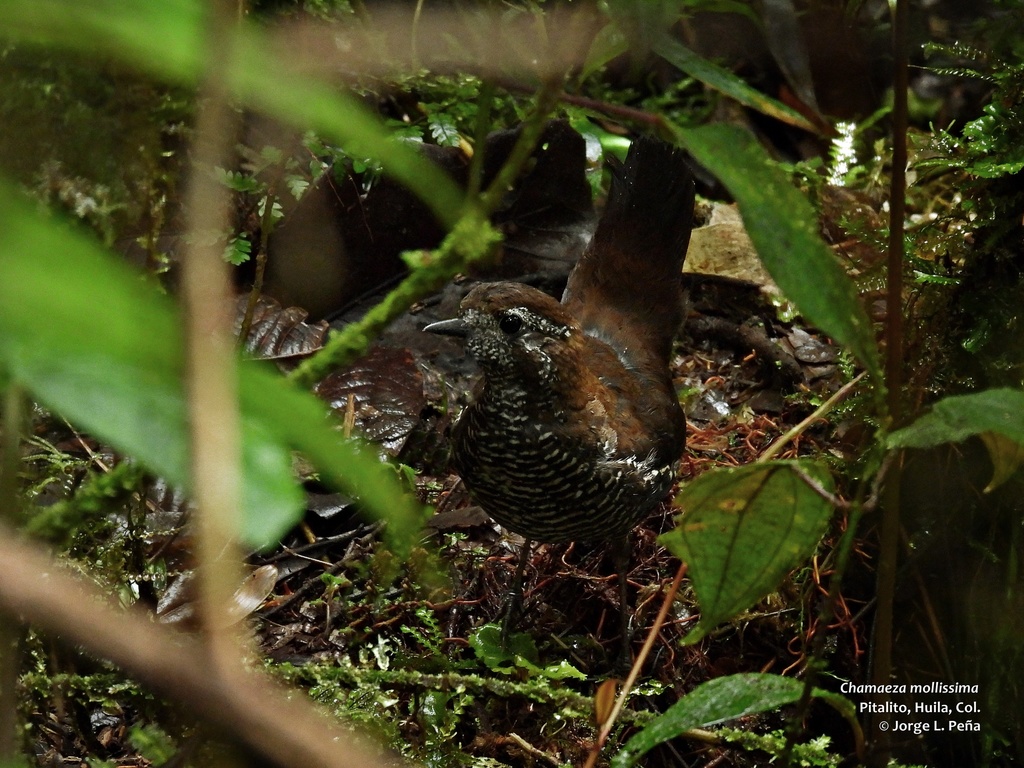
The rufous-tailed antthrush is 19 to 20.5 cm (7.5 to 8.1 in) long and weighs about 69 to 80 g (2.4 to 2.8 oz). The sexes are alike. Adults have a chestnut to dark brown crown. They have whitish lores, a white streak with black bars behind their eye, a chestnut streak below the eye, and black and white barred ear coverts. Their upperparts, wings, and tail are mostly chestnut to dark brown with a slightly more rufescent rump and uppertail coverts. Their throat has narrow black and white bars. Their underparts are mostly dark brown to black with narrow white or buff bars and brown lower flanks. Their iris is dark brown, their bill black with a dark brown base to the mandible, and their legs and feet gray-brown. Subspecies C. m. yungae is darker than the nominate, with broken rather than uniform pale bars on their underparts that give a somewhat spotted look.
Range & habitat
The barred antthrush has a disjunct distribution. The nominate subspecies is found in Colombia's Cauca and Magdalena river valleys and on the east slope of the Andes from Nariño Department in Colombia's southwest south through eastern Ecuador into northern Peru to (or possibly just beyond) the Marañón River. Subspecies C. m. yungae is found from southwestern Ucayali Department in Peru south into Bolivia as far as Cochabamba Department. The species inhabits the floor of humid to wet primary montane forest and cloudforest with dense undergrowth and much moss and lichen on fallen trees. In elevation it ranges between 1,500 and 3,200 m (4,900 and 10,500 ft) in Colombia, mostly between 2,000 and 2,600 m (6,600 and 8,500 ft) in Ecuador, and 1,800 and 3,100 m (5,900 and 10,200 ft) in Peru.
Wikipedia: “Distribution and habitat”
What it does
The barred antthrush's diet and foraging behavior are not known in detail, but one specimen's stomach held small seeds. It is almost entirely terrestrial; it pumps its tail while it walks and runs on the forest floor. Though it is seldom seen, when encountered it is as single birds or pairs.
Wikipedia: “Feeding”
Listen
Looking for field recordings…
Where it lives
Recorded sightings
—
geo-referenced records in GBIF, from museums, herbaria and field observers.
Drag the globe to turn it. Dots are where records exist, not a range map; darker means more records.
In the stacks
Searching the stacks…
Every page naming Chamaeza mollissima in the Biodiversity Heritage Library →
This page is assembled live from iNaturalist, GBIF, Wikipedia, the Source Library and the Internet Archive. It is not yet part of the hand-edited codex. iNaturalist taxon 9022.