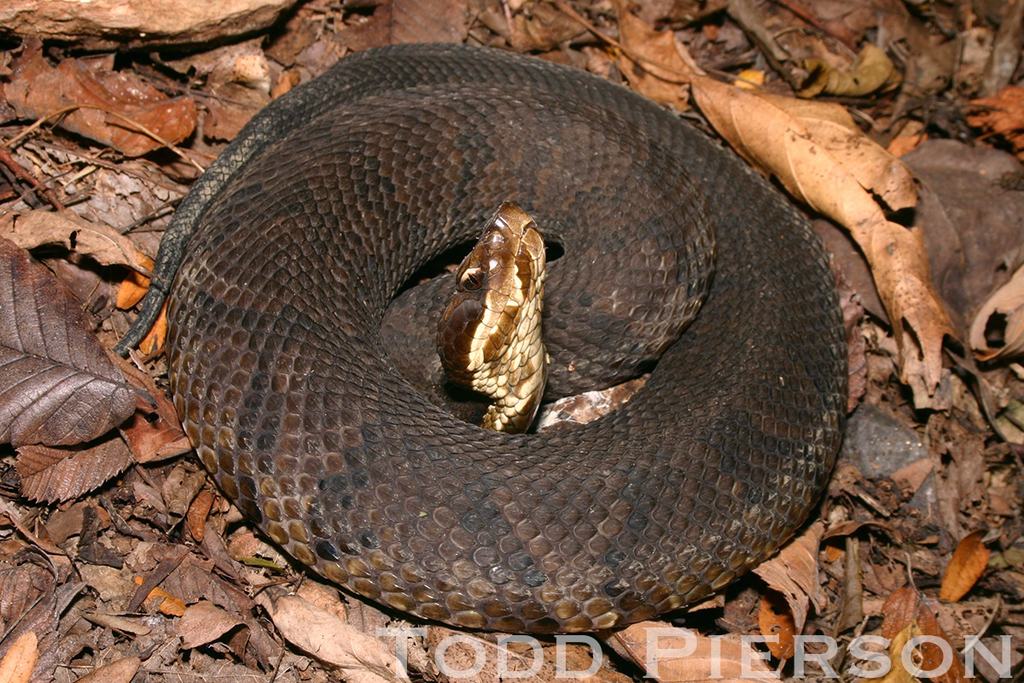
Northern Cottonmouth
Agkistrodon piscivorus
Agkistrodon piscivorus is a species of venomous snake, a pit viper in the subfamily Crotalinae of the family Viperidae. It is one of the world's few semiaquatic vipers (along with the Florida cottonmouth), and is native to the Southeastern United States. As an adult, it is large and capable of delivering a painful and potentially fatal bite. When threatened, it may respond by coiling its body and displaying its fangs. Individuals may bite when feeling threatened or being handled in any way. It tends to be found in or near water, particularly in slow-moving and shallow lakes, streams, and marshes. It is a capable swimmer, and like several species of snakes, is known to occasionally enter bays and estuaries and swim between barrier islands and the mainland.
From the article Agkistrodon piscivorus on Wikipedia (CC BY-SA), quoted section by section
Description
Agkistrodon piscivorus is the largest species of the genus Agkistrodon. Adults commonly exceed 80 cm (31 in) in total length (including tail); females are typically smaller than males. Total length, per one study of adults, was 65 to 90 cm (26 to 35 in). Average body mass has been found to be 292.5 to 579.6 g (10.32 to 20.44 oz) in males and 201.1 to 254.1 g (7.09 to 8.96 oz) in females. Occasionally, individuals may exceed 180 cm (71 in) in total length, especially in the eastern part of the range, with a record specimen of 189.2 cm (74.5 in). Although larger ones have purportedly been seen in the wild, according to Gloyd and Conant (1990), the largest recorded specimen of A. p. piscivorus was 188 cm (74 in) in total length, based on a specimen caught in the Dismal Swamp region and given to the Philadelphia Zoological Garden. This snake had apparently been injured during capture, died several days later, and was measured when straight and relaxed. Large specimens can be extremely bulky, with the mass of a specimen of about 180 cm (71 in) in total length known to weigh 4.6 kg (10 lb). Many would assume that the morphology of an aquatic snake should have a small, narrow head that tapers towards the back to minimize drag in the water, especially when capturing prey. …
Wikipedia: “Anatomy and description”
Range & habitat
A. piscivorus is found in the eastern US from the Great Dismal Swamp in southeast Virginia, south through the Florida peninsula and west to Arkansas, eastern and southern Oklahoma, and western and southern Georgia (excluding Lake Lanier and Lake Allatoona). A few records exist of the species being found along the Rio Grande in Texas, but these are thought to represent disjunct populations, now possibly eradicated. The type locality given is "Carolina", although Schmidt (1953) proposed this be restricted to the area around Charleston, South Carolina. Snakes observed in the northern areas of this range are typically larger older individuals. Campbell and Lamar (2004) mentioned this species as being found in Alabama, Arkansas, Florida, Georgia, Illinois, Indiana, Kentucky, Louisiana, Mississippi, Missouri, North Carolina, Oklahoma, South Carolina, Tennessee, Texas, and Virginia. Maps provided by Campbell and Lamar (2004) and Wright and Wright (1957) also indicate its presence in Western and Middle Tennessee and extreme southeastern Kansas, and limit it to the western part of Kentucky. In Georgia, it is found in the southern half of the state up to a few kilometers north of the Fall Line with few exceptions. Its range also includes the Ohio River Valley as far north as southern Indiana, and it inhabits many barrier islands off the coasts of the states where it is found.
Wikipedia: “Geographic range”
What it does
In the United States, especially in the south, A. piscivorus are often falsely characterized as aggressive. In tests designed to measure the various behavioral responses by wild specimens to encounters with people, 23 of 45 (51%) tried to escape, while 28 of 36 (78%) resorted to threat displays and other defensive tactics. Only when they were picked up with a mechanical hand were they likely to bite. 36% of those picked up attempted to bite. Furthermore, less than 20% attempted to bite when stepped on. None of the snakes attempted to bite when researchers stood next to them. When approached by humans, cottonmouths seek the closest shelter possible. At times this means moving closer to humans, giving the impression that it is seeking to harm them. This behavior is often seen in conjunction with a raising of the head, leading to further misinterpretations. When sufficiently stressed or threatened, this species engages in a characteristic threat display that includes vibrating its tail and throwing its head back with its mouth open to display the startlingly white interior, often making a loud hiss while the neck and front part of the body are pulled into an S-shaped position. …
Wikipedia: “Behavior and ecology”
In human culture
The generic name is derived from the Greek words ἄγκιστρον agkistron "fish-hook, hook" and ὀδών odon "tooth", and the specific name comes from the Latin piscis 'fish' and voro '(I) eat greedily, devour'; thus, the scientific name translates to "hook-toothed fish-eater". Common names include cottonmouth, northern cottonmouth, water moccasin, swamp moccasin, black moccasin, and simply viper. Many of the common names refer to the threat display, in which this species often stands its ground and gapes at an intruder, exposing the white lining of its mouth. Many scientists dislike the use of the term water moccasin since it can lead to confusion between the venomous cottonmouth and nonvenomous water snakes.
Common names. This is a list of common names for A. piscivorus, some of which also refer to other species:
Subspecies and taxonomic history. For many decades, one species with three subspecies were formally recognized: eastern cottonmouth, A. p. piscivorus (Lacépède, 1789); western cottonmouth, A. p. leucostoma (Troost, 1836); and Florida cottonmouth, A. p. conanti Gloyd, 1969. However, a molecular DNA-based study was published in 2014, applying phylogenetic theories (one implication being no subspecies are recognized), changing the long-standing taxonomy. The resulting and current taxonomic arrangement recognizes two species and no subspecies. The western cottonmouth (A. p. …
Wikipedia: “Taxonomy and etymology”
Where it lives
Recorded sightings
—
geo-referenced records in GBIF, from museums, herbaria and field observers.
Drag the globe to turn it. Dots are where records exist, not a range map; darker means more records.
In the stacks
Searching the stacks…
Every page naming Agkistrodon piscivorus in the Biodiversity Heritage Library →
This page is assembled live from iNaturalist, GBIF, Wikipedia, the Source Library and the Internet Archive. It is not yet part of the hand-edited codex. iNaturalist taxon 904170.