On eBird ↗
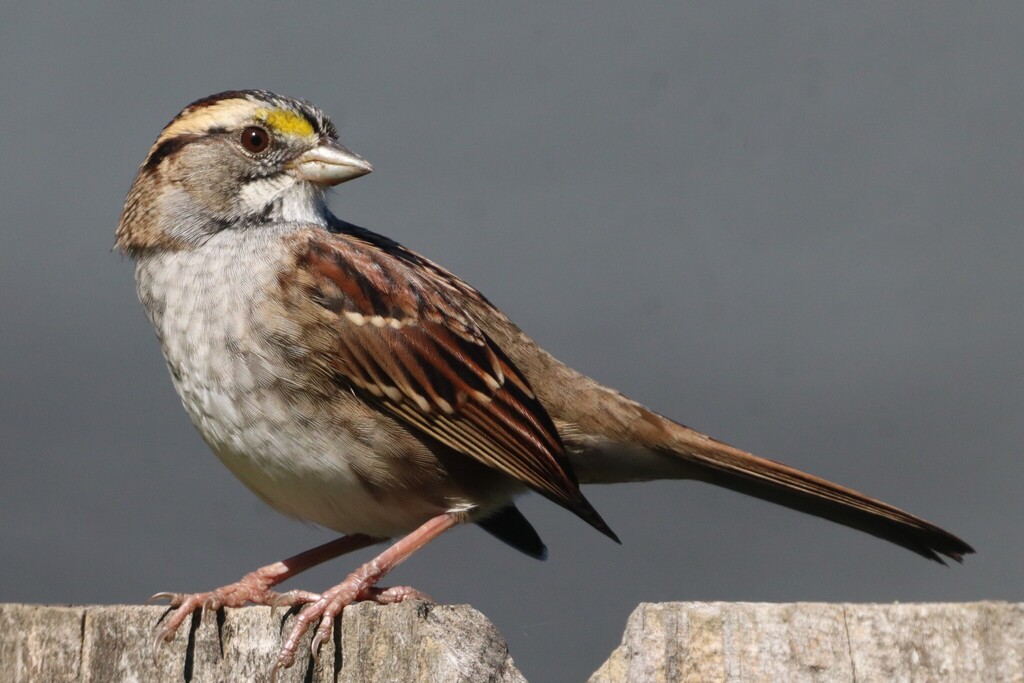
White-throated Sparrow
Live sightings near you, the range map, bar charts of when it is seen, and Macaulay Library photos and recordings.
White-throated Sparrow
Zonotrichia albicollis
The white-throated sparrow (Zonotrichia albicollis) is a passerine bird of the New World sparrow family Passerellidae. It breeds in northern North America and winters in the southern United States.
From the article White-throated sparrow on Wikipedia (CC BY-SA), quoted section by section
Description
The white-throated sparrow is a passerine bird of the New World sparrow family Passerellidae. It measures 15 to 19 cm (5.9 to 7.5 in) in length with a wingspan of 23 cm (9.1 in). Typical weight is 22 to 32 g (0.78 to 1.13 oz), with an average of 26 g (0.92 oz). Among standard measurements, the wing chord is 6.3 to 7.9 cm (2.5 to 3.1 in), the tail is 6.8 to 7.7 cm (2.7 to 3.0 in), the bill is 1 to 1.2 cm (0.39 to 0.47 in) and the tarsus is 2.2 to 2.4 cm (0.87 to 0.94 in). They are similar in appearance to the white-crowned sparrow, but with white throat markings and yellow lores. There are two adult plumage variations known as the tan-striped and white-striped forms. On the white-striped form the crown is black with a white central stripe. The supercilium is white as well. The auriculars are gray with the upper edge forming a black eye line. On the tan form, the crown is dark brown with a tan central stripe. The supercilium is tan as well. The auriculars are gray/light brown with the upper edge forming a brown eye line. Both variations feature dark eyes, a white throat, yellow lores and gray bill. There is variation and some individuals may show dark lateral stripes of each side of the throat. They almost always pair with the opposite color morph for breeding. The two color morphs occur in approximately equal numbers. …
What it does
These birds forage on the ground under or near thickets or in low vegetation by kicking backward with both feet simultaneously. They mainly eat seeds, insects and berries, and are attracted to bird feeders. Blackberries, grapes, and rose hips are some fruits they eat. One of its favorite seeds is millet, but it will also feed on black oil sunflower and different seeds. During the summer, insects and other small invertebrates make up a larger portion of their diet.
Wikipedia: “Diet”
Listen
Looking for field recordings…
Where it lives
Recorded sightings
—
geo-referenced records in GBIF, from museums, herbaria and field observers.
Drag the globe to turn it. Dots are where records exist, not a range map; darker means more records.
In the stacks
Searching the stacks…
Every page naming Zonotrichia albicollis in the Biodiversity Heritage Library →
This page is assembled live from iNaturalist, GBIF, Wikipedia, the Source Library and the Internet Archive. It is not yet part of the hand-edited codex. iNaturalist taxon 9184.