On eBird ↗
Golden-crowned Sparrow
Live sightings near you, the range map, bar charts of when it is seen, and Macaulay Library photos and recordings.
Golden-crowned Sparrow
Zonotrichia atricapilla
The golden-crowned sparrow (Zonotrichia atricapilla) is a large New World sparrow found in the western part of North America.
From the article Golden-crowned sparrow on Wikipedia (CC BY-SA), quoted section by section
Description
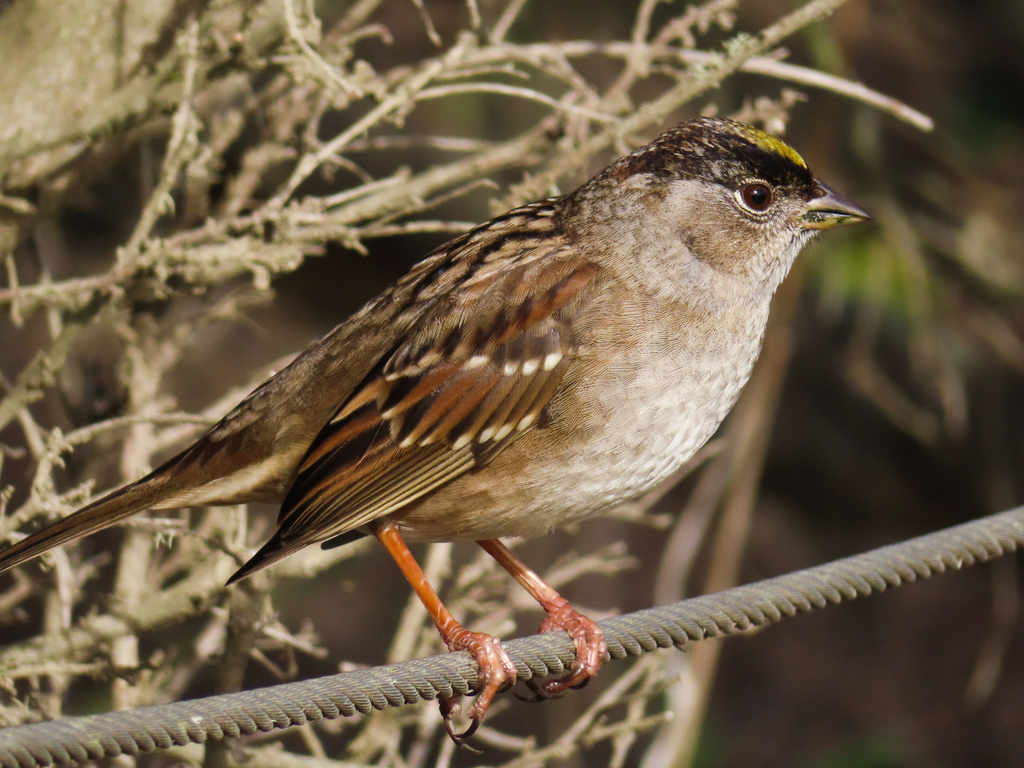
Measuring 15–18 cm (6–7 in) in length with a wingspan of 24.75 cm (9.74 in) and ranging from 19.0 to 35.4 g (0.67 to 1.25 oz) in mass, the adult golden-crowned sparrow is fairly large for an American sparrow. Like all Zonotrichia sparrows, it has a relatively long, square-tipped tail and a slightly peaked crown. Males and females are similarly plumaged, though males average slightly larger than females. Other than a plain gray nape, the adult's upperparts are grayish-brown, with broad brownish-black streaks on the back and scapulars, and an unstreaked rump. Its underparts are gray, slightly paler on the belly and buffier on the flanks. Its wings and tail are brown, and it shows two white wing bars. Its legs are pale brown, and its bill is dark, with the upper mandible darker than the lower. Its iris is brown. In the breeding season, the golden-crowned sparrow has a broad yellow central crown stripe which becomes pale gray towards the back of the head.
Similar species. Although its distinctive crown patches allow for easy identification of the adult golden-crowned sparrow in breeding plumage, an immature or non-breeding bird might be mistaken for a white-crowned or white-throated sparrow. …
Range & habitat
The golden-crowned sparrow is common along the western edge of North America. It is a migratory species, breeding from north-central Alaska (including the Aleutian Islands as far west as Unimak Island) and central Yukon south to the northwestern corner of the US state of Washington, and wintering from southern coastal Alaska to northern Baja California. It has been recorded as a vagrant in Japan and Russia, and occasionally strays as far as the eastern coast of North America, from Nova Scotia to Florida. In the winter, it is generally found in brushy areas, (particularly chaparral), usually in dense shrubs.
Wikipedia: “Distribution and habitat”
What it does
The golden-crowned sparrow spends its winters in flocks with conspecifics, but also often with other sparrow species, especially white-crowned sparrows. Flock territories typically range in size from 15–20 acres (6.1–8.1 ha). Individual birds remain with the same flock for the entire winter and return to the same wintering site each year. Studies show that the golden-crowned sparrow's black and gold head stripes are used to signal social status in wintering flocks. Such signals help to reduce the incidence of confrontation between flock mates, thereby reducing such potential costs as injuries or the unnecessary expenditure of energy. The size and color of a bird's crown patches are better predictors of dominance (indicating which bird will avoid confrontation with another) than are the bird's size or sex. Birds with similarly sized gold crown patches are far more likely to engage in agonistic behavior than are those showing differences, and the outcomes of such confrontations can be predicted based on the color of their black stripes. This suggests that social status in this species involves more complexity than a single signal will allow, and that the multiple color patches allow a gradient of interactions between flock mates.
Feeding. Like other Zonotrichia sparrows, the golden-crowned sparrow feeds on the ground, where it forages by pecking and scratching. …
Wikipedia: “Behavior”
Listen
Looking for field recordings…
Where it lives
Recorded sightings
—
geo-referenced records in GBIF, from museums, herbaria and field observers.
Drag the globe to turn it. Dots are where records exist, not a range map; darker means more records.
In the stacks
Searching the stacks…
Every page naming Zonotrichia atricapilla in the Biodiversity Heritage Library →
This page is assembled live from iNaturalist, GBIF, Wikipedia, the Source Library and the Internet Archive. It is not yet part of the hand-edited codex. iNaturalist taxon 9185.