- Animals
- ›Chordates
- ›Vertebrates
- ›Ray-finned Fishes
- ›Spiny-rayed fishes
- ›Jacks, Flounders, Barracudas, and Allies
- ›Jacks, Remoras, and Allies
- ›Jacks
- ›Trevallies and Kingfishes
Selaroides
The yellowstripe scad (Selaroides leptolepis), also known as the yellowstripe trevally, yellow-banded trevally, smooth-tailed trevally, slender-scaled trevally and slender trevally, is a species of small inshore fish in the jack and horse mackerel family Carangidae, and the only member of the genus Selaroides. The yellowstripe trevally is distributed throughout the tropical waters of the Indo-West Pacific region, ranging from the Persian Gulf in the west to Vanuatu and New Caledonia in the east. The species is distinguished by its prominent lateral yellow band, and differs from the scads of the genus Selar in having a smaller eye and different dentition. Although the yellowstripe scad reaches a maximum recorded length of 22 cm, it is normally encountered at sizes less than 15 cm. Phylogenetic studies indicate the yellowstripe scad is closely related to the scads of the genus Selar, although its exact placement in the family Carangidae is less well agreed upon.
A schooling species that predominantly inhabits inshore waters, the yellowstripe scad is a predatory fish, taking crustaceans, small fish and a variety of other planktonic prey. Feeding occurs at different times of the day and night throughout its range. The species reaches sexual maturity at around 8–13 cm, with spawning in India shown to occur in two peak periods from January to April and July to October. The yellowstripe scad is an important commercial species, with between 113,000 t and 195,000 t reported worldwide between 1990 and 2010.
1 branches of this genus, most-observed first · about 1 known species
See this branch on the Wheel of Life →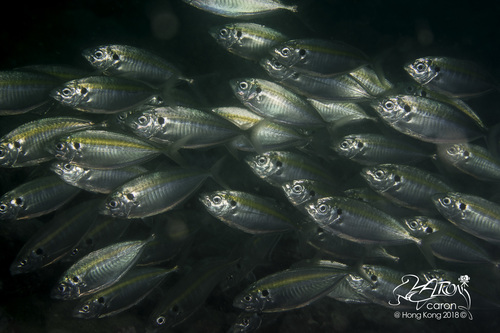
Where it lives
Recorded sightings
—
geo-referenced records in GBIF, from museums, herbaria and field observers.
Drag the globe to turn it. Dots are where records exist, not a range map; darker means more records.
In the stacks
Searching the stacks…
Every page naming Selaroides in the Biodiversity Heritage Library →
This page is assembled live from iNaturalist, GBIF, Wikipedia, the Source Library and the Internet Archive. It is not yet part of the hand-edited codex. iNaturalist taxon 91989.