On eBird ↗
Cretzschmar's Bunting
Live sightings near you, the range map, bar charts of when it is seen, and Macaulay Library photos and recordings.
Cretzschmar's Bunting
Emberiza caesia
The Cretzschmar's bunting (Emberiza caesia) is a passerine bird in the bunting family Emberizidae, a group now separated by most modern authors from the finches, Fringillidae.
From the article Cretzschmar's bunting on Wikipedia (CC BY-SA), quoted section by section
Description
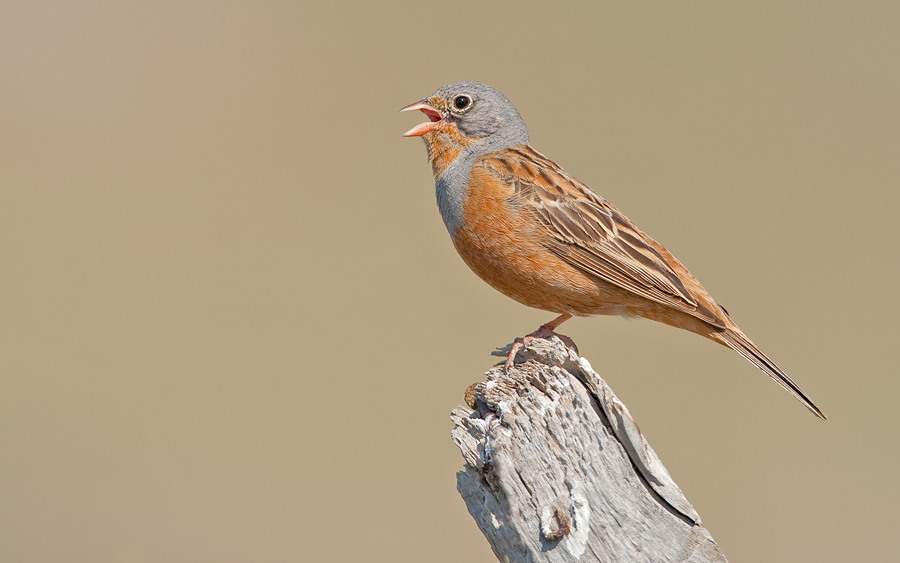
This bird is smaller than ortolan. The breeding male has a grey head with orange moustaches. The upperparts are brown and heavily streaked, except on the rump, and the underparts are rusty orange. The stout bill is pink. Females and young birds have a weaker head pattern, and are more similar to ortolans. They can be distinguished by the warm brown rump and white eye-ring.
Range & habitat
Cretzschmar's bunting breeds on sunny open hillsides with some bushes. It is mainly coastal or insular, and often breeds at lower levels than the closely related ortolan bunting where both occur. It lays four to six eggs in a ground nest. Its natural food consists of seeds and when feeding young, insects.
Wikipedia: “Distribution”
What it does
This species forages almost entirely on the ground, feeding on small seeds, especially from grasses, and supplementing its diet with small invertebrates, particularly ants.
Wikipedia: “Food and feeding”
In human culture
The English common name commemorates the German physician and scientist Philipp Jakob Cretzschmar who founded the Senckenberg Natural History Museum. The genus name Emberiza is from Old German Embritz, a bunting. The specific caesias is from Latin caesius, "bluish-grey". This species is monotypic.
Wikipedia: “Etymology and taxonomy”
Listen
Looking for field recordings…
Where it lives
Recorded sightings
—
geo-referenced records in GBIF, from museums, herbaria and field observers.
Drag the globe to turn it. Dots are where records exist, not a range map; darker means more records.
In the stacks
Searching the stacks…
Every page naming Emberiza caesia in the Biodiversity Heritage Library →
This page is assembled live from iNaturalist, GBIF, Wikipedia, the Source Library and the Internet Archive. It is not yet part of the hand-edited codex. iNaturalist taxon 9211.