On eBird ↗
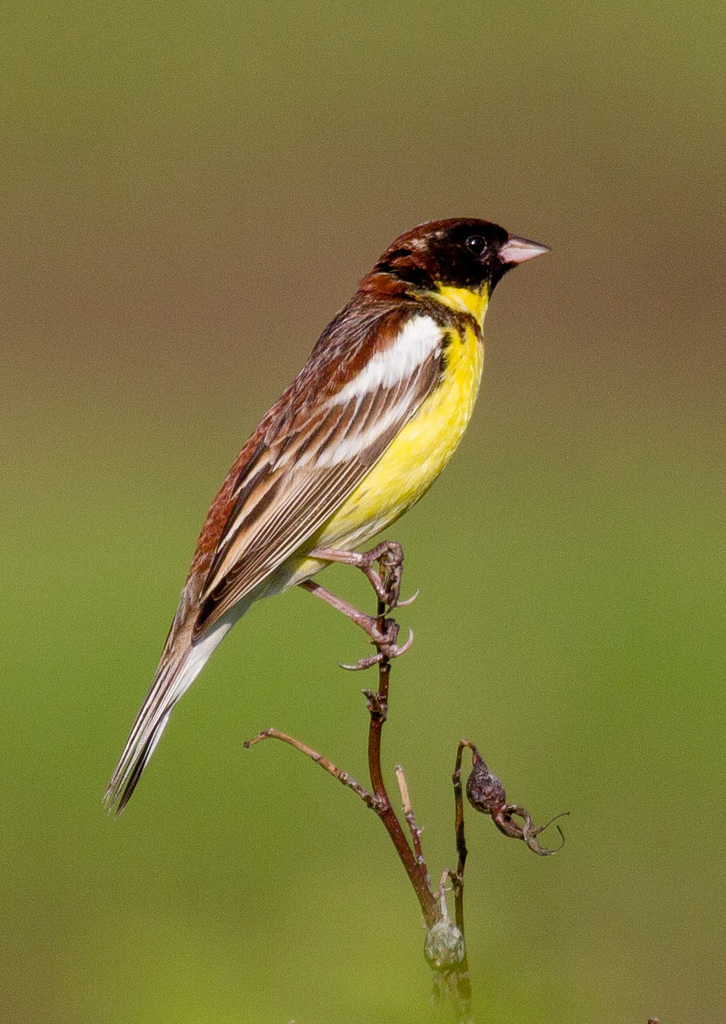
Yellow-breasted Bunting
Live sightings near you, the range map, bar charts of when it is seen, and Macaulay Library photos and recordings.
Yellow-breasted Bunting
Emberiza aureola
The yellow-breasted bunting (Emberiza aureola) is a passerine bird in the bunting family Emberizidae that is found across the Boreal and East Palearctic. The genus name Emberiza is from Old German Embritz, a bunting. The specific aureola is Latin for "golden". The bird's call is a distinctive zick, and the song is a clear tru-tru, tri-tri.
Until 2004, the International Union for Conservation of Nature considered the yellow-breasted bunting to be a species of least concern. Since 2004, it has been gradually upgraded to a status of Critically Endangered due to rapid drops in population sizes. It is subject to heavy hunting pressure in China, through which most specimens pass during migration.
From the article Yellow-breasted bunting on Wikipedia (CC BY-SA), quoted section by section
Description
The yellow-breasted bunting is a small passerine, ranging from 14 to 16 cm (5.5 to 6.3 in) in length, and weighing 17 to 26 g (0.6 to 0.9 oz). For a bunting, it is large and rather stocky. The breeding male has bright white underparts with black flank streaks, brown upperparts, black face and throat bar, and a pink lower mandible. The female has a heavily streaked grey-brown back, and less intensely yellow underparts. She has a whitish face with dark crown, eye and cheek stripes. The juvenile is similar, but the background colour of the underparts and face is buff.
Range & habitat
Emberiza aureola aureola breeds in boreal forests of Finland to Bering Sea migrating to Indochina. Emberiza aureola ornata breeds from the Amur River to Manchuria, N Korea, Kamchatka and Kuril Islands. It is migratory, wintering in south-east Asia, India, and North Korea. It is a rare but regular wanderer to western Europe. There are also ~4 records from the Aleutian Islands of Alaska and a 2017 record from Labrador, Canada. The species winters in large flocks in cultivated areas, rice fields and grasslands, preferring to roost in rice-fields. In the first third of 2023, roosts of up to 6,378 birds were found in reedbeds at Kyon Ka Pyin-Tap Seik Conservation Area, in the Irrawaddy Delta, Myanmar, exceeding previous known maxima for the species in southern Asia.
Wikipedia: “Distribution and habitat”
Listen
Looking for field recordings…
Where it lives
Recorded sightings
—
geo-referenced records in GBIF, from museums, herbaria and field observers.
Drag the globe to turn it. Dots are where records exist, not a range map; darker means more records.
In the stacks
Searching the stacks…
Every page naming Emberiza aureola in the Biodiversity Heritage Library →
This page is assembled live from iNaturalist, GBIF, Wikipedia, the Source Library and the Internet Archive. It is not yet part of the hand-edited codex. iNaturalist taxon 9212.