On eBird ↗
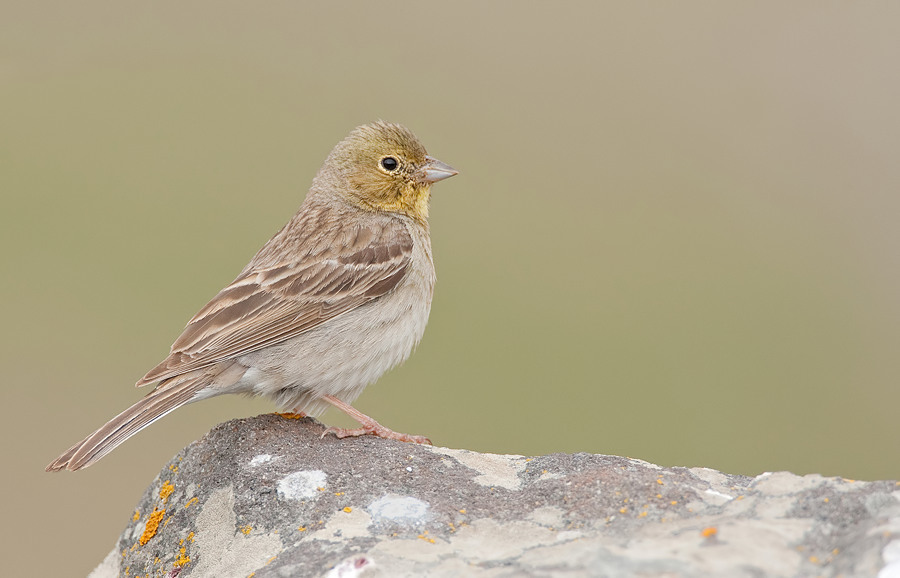
Cinereous Bunting
Live sightings near you, the range map, bar charts of when it is seen, and Macaulay Library photos and recordings.
Cinereous Bunting
Emberiza cineracea
The cinereous bunting (Emberiza cineracea) is a bird in the bunting family Emberizidae, a passerine family now separated by most modern authors from the finches, Fringillidae. This species was first described by Christian Ludwig Brehm.
From the article Cinereous bunting on Wikipedia (CC BY-SA), quoted section by section
Description
The cinereous bunting is a large (16.5–18 cm, 21–29.7 g), slim bunting with a long, white-cornered tail. The term cinereous describes its colouration. It is less streaked than many buntings and has a thick pale bill. It has a greyish back with only subdued dark markings, and a browner tint to the wings. The adult male's head is dull yellow, with a brighter moustachial line and throat. In the nominate race of south-west Turkey, the rest of the underparts are grey, but the eastern form E. c. semenowi has yellow underparts. Females are brownish grey above with a whitish throat and yellow only in the moustachial stripe. Young birds have a plain pale belly and streaking on the breast.
Song. The call is a harsh tschrip, and the song is a hoarse zru- zru-zru-zru.
Range & habitat
It breeds in southern Turkey and southern Iran, and winters around the Red Sea in north-eastern Africa and Yemen. A few isolated populations maintain a foothold within European borders, on Greek islands in the Aegean Sea, especially Lesbos.
Wikipedia: “Distribution”
What it does
Like other buntings, the cinereous bunting feeds principally on seeds. It takes insects especially when feeding its young. Its normal clutch is three eggs.
Wikipedia: “Food and feeding”
Listen
Looking for field recordings…
Where it lives
Recorded sightings
—
geo-referenced records in GBIF, from museums, herbaria and field observers.
Drag the globe to turn it. Dots are where records exist, not a range map; darker means more records.
In the stacks
Searching the stacks…
Every page naming Emberiza cineracea in the Biodiversity Heritage Library →
This page is assembled live from iNaturalist, GBIF, Wikipedia, the Source Library and the Internet Archive. It is not yet part of the hand-edited codex. iNaturalist taxon 9217.