On eBird ↗
Yellow Bunting
Live sightings near you, the range map, bar charts of when it is seen, and Macaulay Library photos and recordings.
Yellow Bunting
Emberiza sulphurata
The name "yellow bunting" can also refer to the yellowhammer (Emberiza citrinella).
The yellow bunting or Japanese yellow bunting (Emberiza sulphurata) is a passerine bird of eastern Asia in the bunting family Emberizidae. It is threatened by habitat loss, the use of pesticides and trapping for the cagebird industry.
From the article Yellow bunting on Wikipedia (CC BY-SA), quoted section by section
Description
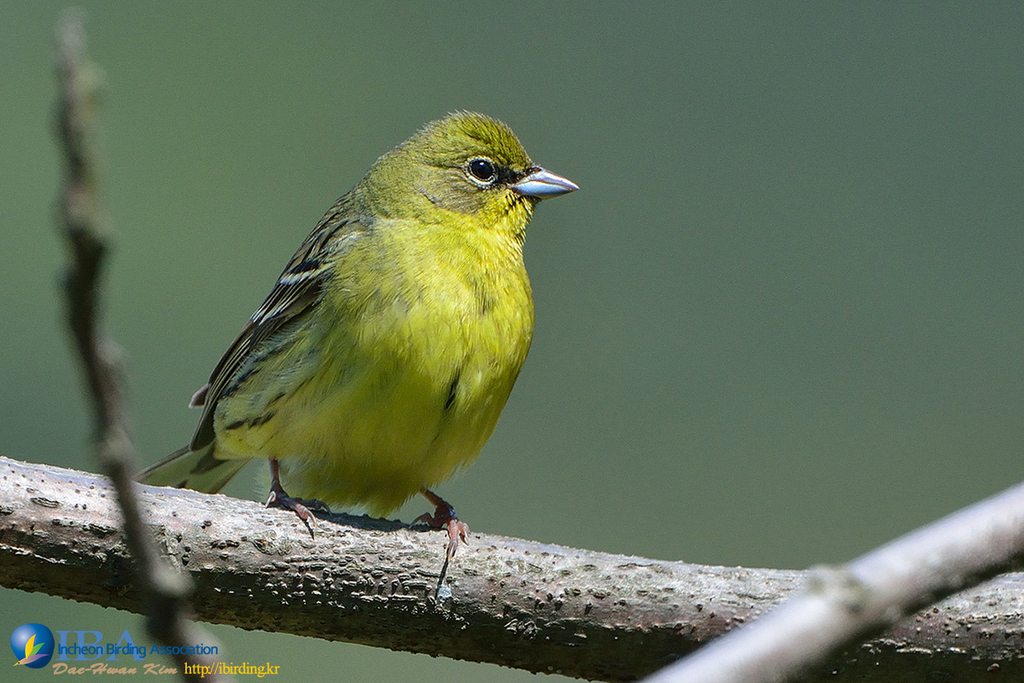
It is 14 cm long and has a conical, grey bill, pinkish-brown feet and brown eyes. The male is grey-green above with black streaks on the back. The underparts are yellow-green (brightest on the throat and belly) with streaks on the flanks. It has black lores, a narrow black chin, a pale eye ring and white outer tail feathers. There are two bars on the wing, formed by pale tips to the median and greater wing coverts. The female is similar to the male but paler without the black on the lores and chin. The species has a twittering song and a soft tsip call. The breeding season lasts from mid-May to early July. The nest is built low in a bush and three to five eggs are laid.
Range & habitat
The yellow bunting breeds only in Japan where it is uncommon. It is found mainly on the largest island Honshu but may also breed on Kyushu and possibly bred on Hokkaido in the past. It occurs in forest and woodland between 600 and 1500 metres above sea level, mainly in the central and northern parts of Honshū. A few birds winter in the warmer regions of Japan but most migrate further south. It has been recorded from the Philippines, Taiwan, Hong Kong and south-east China at this season but is scarce everywhere. It occurs in woodland, scrub, grassland and farmland during winter. Small numbers pass through Korea on spring and autumn migration. As of 2021, the total population of the yellow bunting remains unknown. It is considered stable or possibly increasing, and likely much larger than earlier estimates suggested. The species is classified as least concern by the IUCN. It is threatened by habitat loss, the use of pesticides and trapping for the cagebird industry.
Wikipedia: “Habitat and conservation status”
Listen
Looking for field recordings…
Where it lives
Recorded sightings
—
geo-referenced records in GBIF, from museums, herbaria and field observers.
Drag the globe to turn it. Dots are where records exist, not a range map; darker means more records.
In the old herbals & bestiaries

In the stacks
Searching the stacks…
Every page naming Emberiza sulphurata in the Biodiversity Heritage Library →
This page is assembled live from iNaturalist, GBIF, Wikipedia, the Source Library and the Internet Archive. It is not yet part of the hand-edited codex. iNaturalist taxon 9224.