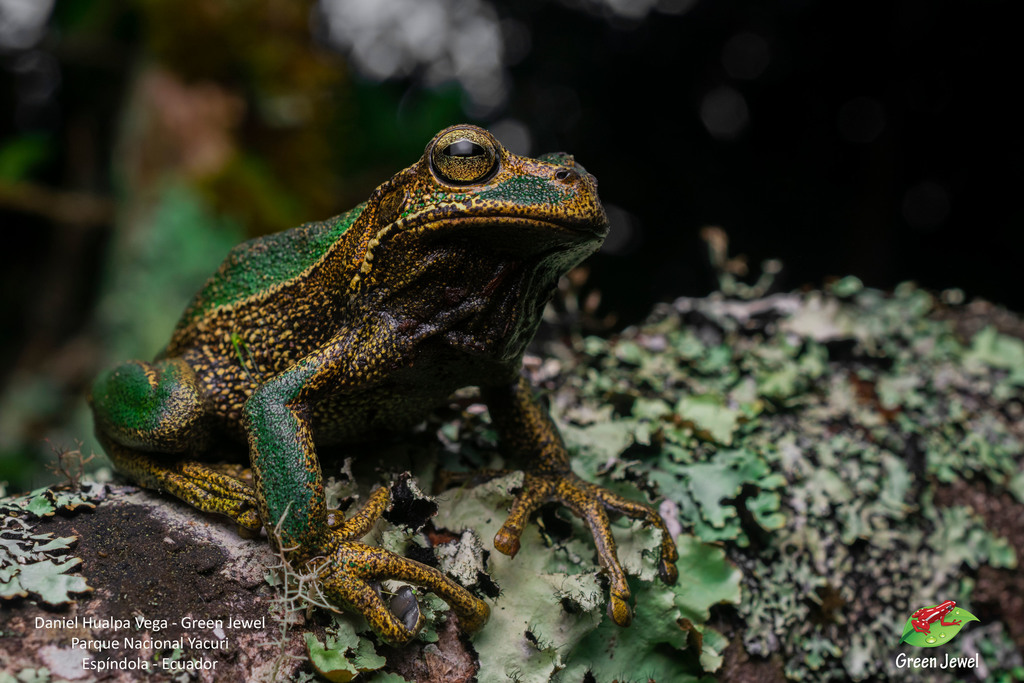
Turner's Marsupial Frog
Gastrotheca turnerorum
Gastrotheca turnerorum, or Turner's marsupial frog, is a frog. Scientists have found it in Ecuador and Peru.
From the article Gastrotheca turnerorum on Wikipedia (CC BY-SA), quoted section by section
Description
The adult male frog measures 50.0–55.6 mm in snout-vent length and the adult female frog 54.0–58.2 mm. The skin of the dorsum can be brown or green in color. The frog is covered with small dots, mostly cream-white or cream-yellow. Some of the lines on the face are made of bronze dots. The flanks are dark brown to bronze in color with tiny cream-white dots. The belly is dark brown in color with cream-white dots. The iris of the eye is cream-yellow in color with dark brown reticulations and a thick dark brown horizontal bar across the whole eye.
Range & habitat
This nocturnal, semi-arboreal frog lives in paramo and sub-paramo. Scientists have reported these frogs between 2,899 m (9,511 ft) and 3,513 m (11,526 ft) above sea level. Scientists have reported this frog in protected areas: Parque Nacional Yacuri, Parque Nacional Podocarpusa, and Reserva Tapichalaca.
Wikipedia: “Habitat”
What it does
The female frog carries her eggs in a pouch on her back. Scientists have found tadpoles in ponds and lagoons.
Wikipedia: “Reproduction”
In human culture
Scientists named this frog turnerorum for the Turner family and their work in conservation, preserving biodiversity, and environmental education.
Wikipedia: “Etymology”
Listen
Looking for field recordings…
Where it lives
Recorded sightings
—
geo-referenced records in GBIF, from museums, herbaria and field observers.
Drag the globe to turn it. Dots are where records exist, not a range map; darker means more records.
In the stacks
Searching the stacks…
Every page naming Gastrotheca turnerorum in the Biodiversity Heritage Library →
This page is assembled live from iNaturalist, GBIF, Wikipedia, the Source Library and the Internet Archive. It is not yet part of the hand-edited codex. iNaturalist taxon 923337.