On eBird ↗
Velvet-fronted Euphonia
Live sightings near you, the range map, bar charts of when it is seen, and Macaulay Library photos and recordings.
Velvet-fronted Euphonia
Euphonia concinna
The velvet-fronted euphonia (Euphonia concinna) is a species of bird in the family Fringillidae, having recently been moved there from the Thraupidae.
From the article Velvet-fronted euphonia on Wikipedia (CC BY-SA), quoted section by section
Description
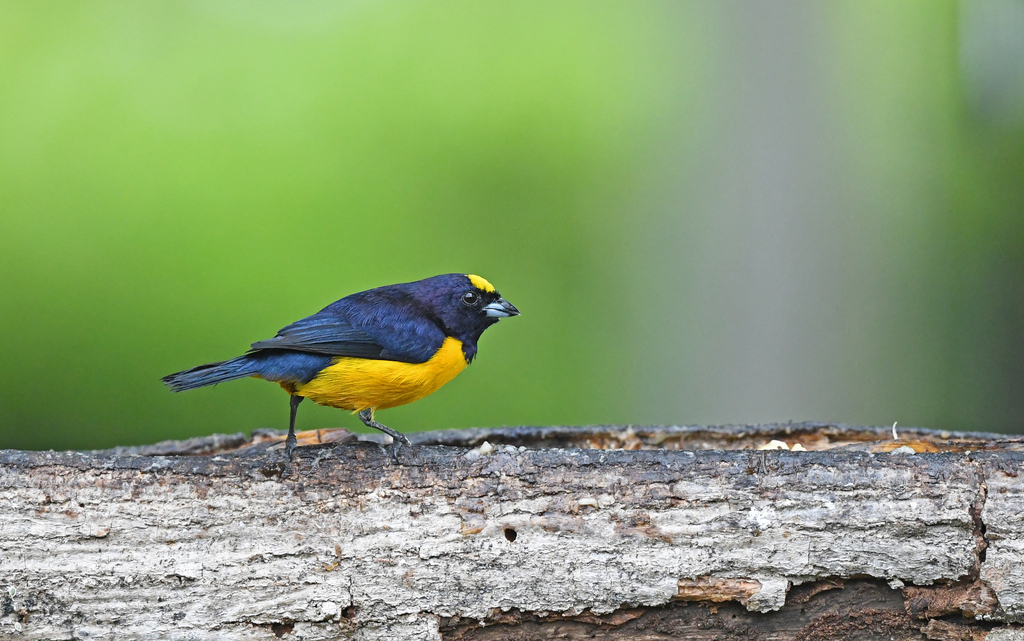
The velvet-fronted euphonia is 9 to 10 cm (3.5 to 3.9 in) long and weighs 9 to 12 g (0.32 to 0.42 oz). The species is sexually dimorphic. Adult males have a small yellow forecrown; the color extends just to the eye and is separated from the bill by a thin black line. The rest of their head and their upperparts are blue-black with a purplish gloss. Their tail is also blue-black. Their flight feathers are black with usually a small white spot at the base of the outer primaries. Their chin and throat are blue-black and the rest of their underparts are rich ochraceous to cinnamon-yellow. Adult females have a mostly light olive-gray head with a short faint olive-yellow supercilium. Their upperparts, wings, and tail are olive. Their throat and underparts are yellowish with an olive tinge. Both sexes have a dark brown iris, a pale bluish gray bill with a blackish tip, and dark gray legs and feet.
Range & habitat
The velvet-fronted euphonia is found only in the upper Magdalena River valley of Colombia between northern Tolima and southwestern Huila departments. It is found primarily along the edges of dry, sometimes patchy, woodlands and also in ranchland with scattered trees and along lightly wooded streams. Sources differ on its elevation range. One says it is 200 to 1,000 m (700 to 3,300 ft) and locally to 1,800 m (5,900 ft). Another says it is 200 to 2,000 m (700 to 6,600 ft).
Wikipedia: “Distribution and habitat”
What it does
The velvet-fronted euphonia feeds primarily on the fruits of mistletoe (Loranthaceae) and other small fruits, and is assumed to include small numbers of insects in its diet. It forages mostly in pairs or family groups. It seldom associates with other euphonias but will share fruiting trees with other birds. It usually forages high in trees.
Wikipedia: “Feeding”
Listen
Looking for field recordings…
Where it lives
Recorded sightings
—
geo-referenced records in GBIF, from museums, herbaria and field observers.
Drag the globe to turn it. Dots are where records exist, not a range map; darker means more records.
In the stacks
Searching the stacks…
Every page naming Euphonia concinna in the Biodiversity Heritage Library →
This page is assembled live from iNaturalist, GBIF, Wikipedia, the Source Library and the Internet Archive. It is not yet part of the hand-edited codex. iNaturalist taxon 9285.