On eBird ↗
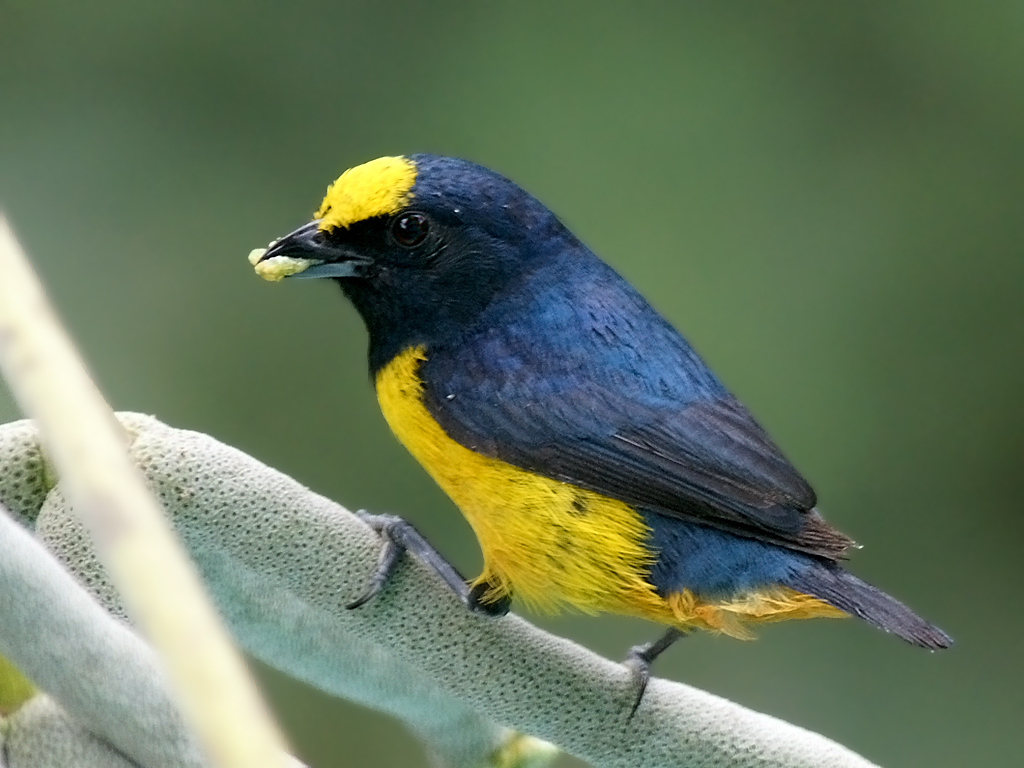
Fulvous-vented Euphonia
Live sightings near you, the range map, bar charts of when it is seen, and Macaulay Library photos and recordings.
Fulvous-vented Euphonia
Euphonia fulvicrissa
The fulvous-vented euphonia (Euphonia fulvicrissa) is a species of bird in the family Fringillidae, the finches and euphonias. It is found in Colombia, Ecuador, and Panama.
From the article Fulvous-vented euphonia on Wikipedia (CC BY-SA), quoted section by section
Description
The fulvous-vented euphonia is 9 to 10 cm (3.5 to 3.9 in) long and weighs about 10 to 13 g (0.35 to 0.46 oz). It is a small euphonia. The species is sexually dimorphic. Adult males of the nominate subspecies have a small lemon-yellow forehead; the patch extends to just above the eye. The rest of their crown and their face, nape, throat, chest, and upperparts are glossy blue-black. Their flight feathers are dusky with a blue-black tinge. The upper side of their tail is blue-black and the underside dark gray with white inner webs on the outer two pairs of feathers. Their breast, sides, and flanks are golden-yellow, their belly cinnamon-yellow, and their vent and undertail coverts yellowish cinnamon. Adult females have a small rufous forehead. Their crown, nape, and upper back are bronzy olive-green with a faint grayish gloss. Their lower back, rump, uppertail coverts, and tail are yellowish olive. Their flight feathers are dusky with olive-yellow edges. The center of their belly and undertail coverts are tawny-rufous and the rest of their underparts are olive-yellow that is brightest on the sides. Males of subspecies E. f. omissa have less white on the underside of their tail than the nominate. E. f. purpurascens males have a purplish gloss on their upperparts and upper side of the tail, and no white on the undertail. …
Range & habitat
The nominate subspecies of the fulvous-vented euphonia is the northernmost of the three. It is found in Panama on the Caribbean slope from Colón Province and the Pacific slope from Panamá Province and from there south into western Colombia's Chocó Department. Subspecies E. f. omissa is found in Colombia at the northern end of the Andes, in the valleys of the Sinú, Cauca, and Magdalena rivers, and south on the Pacific slope of the Andes to Cauca Department. E. f. purpurascens has the smallest range; it is found from southwestern Colombia's Nariño Department south into northwestern Ecuador through Esmeraldas and western Pichincha provinces into northern Manabí Province. The fulvous-vented euphonia primarily inhabits the interior, edges, and clearings of tropical evergreen forest and secondary forest. In elevation it ranges from sea level to about 900 m (3,000 ft) in Panama, to 900 m (3,000 ft) in Coloimbia, and to 500 m (1,600 ft) in Ecuador.
Wikipedia: “Distribution and habitat”
What it does
The fulvous-vented euphonia feeds primarily on small fruits, and also includes smaller amounts of arthropods in its diet. It mostly forages singly, in pairs, and in small groups, and regularly associates with mixed-species feeding flocks. In the forest it forages primarily from the mid-level to the canopy but often down to the shrub layer in clearings and on edges.
Wikipedia: “Feeding”
Listen
Looking for field recordings…
Where it lives
Recorded sightings
—
geo-referenced records in GBIF, from museums, herbaria and field observers.
Drag the globe to turn it. Dots are where records exist, not a range map; darker means more records.
In the stacks
Searching the stacks…
Every page naming Euphonia fulvicrissa in the Biodiversity Heritage Library →
This page is assembled live from iNaturalist, GBIF, Wikipedia, the Source Library and the Internet Archive. It is not yet part of the hand-edited codex. iNaturalist taxon 9286.