On eBird ↗
Jamaican Euphonia
Live sightings near you, the range map, bar charts of when it is seen, and Macaulay Library photos and recordings.
Jamaican Euphonia
Euphonia jamaica
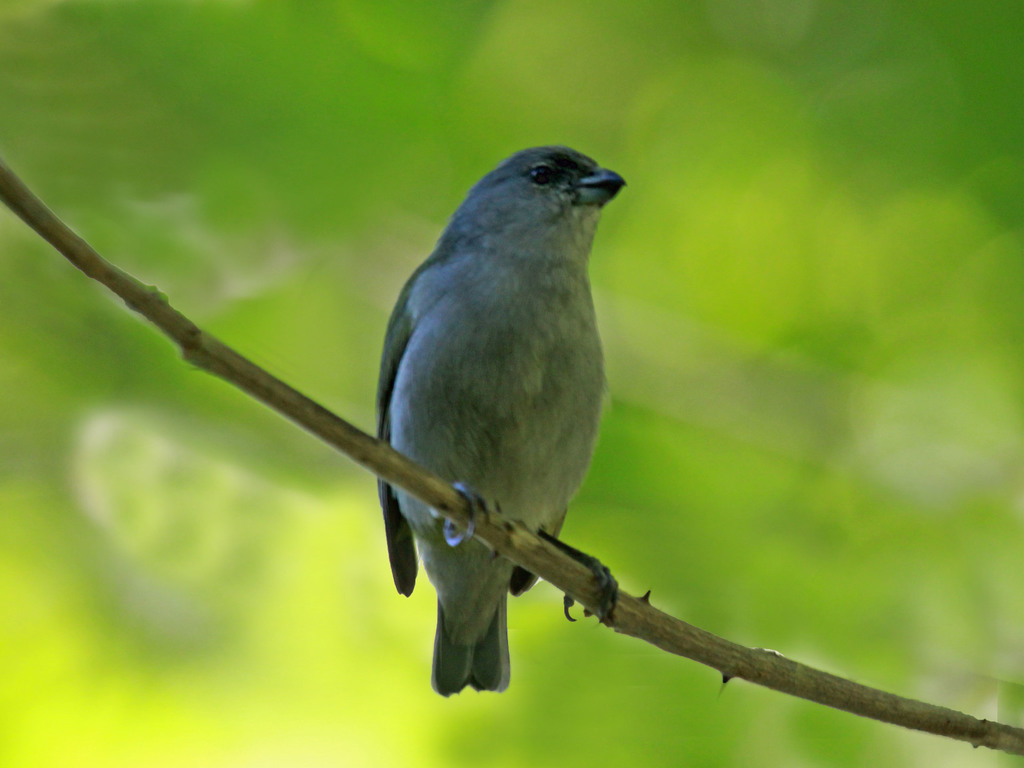
The Jamaican euphonia (Euphonia Jamaica) is a species of bird in the family Fringillidae. Jamaican euphonias are small and have a varying appearance depending on their sex and age. They are the only species of Euphonia that reside in Jamaica and have received the nickname of "Short-Mouth Bluequit" from Jamaican locals. These birds do not migrate anywhere and can be found throughout the island in wooded areas, shrublands, gardens, orchards, and hilly lowlands.
From the article Jamaican euphonia on Wikipedia (CC BY-SA), quoted section by section
Description
The appearance of the Jamaican Euphonia is different for males and females. Males are a bluish-grey color with a yellow belly and pale undertail coverts, females are bicolored and have grey foreparts and olive backs and tails. Both males and females have short, thick bills. The appearance of a Jamaican Euphonia between the juvenile and adult stages are similar to the appearance of the female, although the coloration of a bird in this stage is not as bright. The average Jamaican Euphonia is 11 centimeters (about 4.33 in) in length and weighs 17 grams.
Wikipedia: “Appearance”
Range & habitat
Jamaican Euphonias do not migrate anywhere and only live on the island of Jamaica. These birds live in various topographical regions on the island including wooded areas, shrublands, gardens, and orchards. Of the various locations the Jamaican Euphonia lives, it is found most often in hilly lowlands. They can be found anywhere from altitudes of 0 meters at sea level to 2250 meters (about 1.4 mi) at the height of the tallest mountain in Jamaica, Blue Mountain Peak.While they are not migratory, Jamaican euphonias have been reported to undertake seasonal movements around the island.
Wikipedia: “Habitat”
What it does
The diet of the Jamaican Euphonia consists mostly of fruits and berries. Mistletoe berries, also known as Loranthaceae, compose a major portion of their diet. Fruit of figs (Ficus, Cecropia, Dunalia), fruit of cho-cho vines (Sechium), and guava (Psidium) are also part of their diet. To find food, they may forage in a small flock or gather with other birds at feeding sights. In a study done on the winter fat storage of migrant and resident birds in Jamaica, researchers found that the Jamaican Euphonia has greater fat storage than other species. Due to their fruit-based diet, flocks of Jamaican Euphonias can damage cultivated fruit crops in gardens and orchards.
Wikipedia: “Diet and Foraging”
Listen
Looking for field recordings…
Where it lives
Recorded sightings
—
geo-referenced records in GBIF, from museums, herbaria and field observers.
Drag the globe to turn it. Dots are where records exist, not a range map; darker means more records.
In the stacks
Searching the stacks…
Every page naming Euphonia jamaica in the Biodiversity Heritage Library →
This page is assembled live from iNaturalist, GBIF, Wikipedia, the Source Library and the Internet Archive. It is not yet part of the hand-edited codex. iNaturalist taxon 9288.