On eBird ↗
Plumbeous Euphonia
Live sightings near you, the range map, bar charts of when it is seen, and Macaulay Library photos and recordings.
Plumbeous Euphonia
Euphonia plumbea
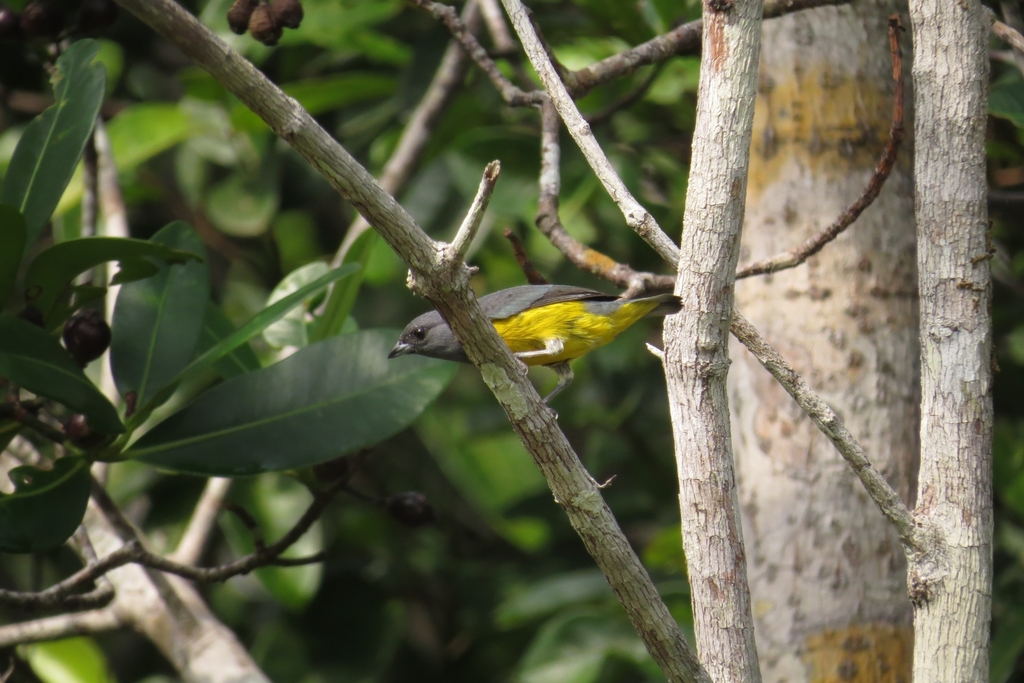
The plumbeous euphonia (Euphonia plumbea) is a species of bird in the Fringillidae family. It is found in Brazil, Colombia, French Guiana, Guyana, Peru, Suriname, and Venezuela. Its natural habitats are subtropical or tropical moist lowland forests and heavily degraded former forest.
From the article Plumbeous euphonia on Wikipedia (CC BY-SA), quoted section by section
Description
The plumbeous euphonia is about 9 cm (3.5 in) long and weighs about 9 g (0.32 oz). The species is sexually dimorphic. Adult males have a glossy dark gray head, upper breast, and upperparts. Their tail is dusky with a wash of olivaceous gray. Their upperwing coverts and flight feathers are dusky with wide olivaceous gray edges. Their underparts from their breast to the undertail coverts are bright yellow with some gray mottling on the sides and flanks. Adult females have an overall pattern similar to the male's though duller. Their crown and nape are gray and the rest of their head and their back are yellowish gray. Their rump and uppertail coverts are paler and more yellowish than the back. Their tail, upperwing coverts, and flight feathers are dark olive. Their throat and chest are pale gray with a slight yellow tinge. Their breast and belly are olive-yellow and their undertail coverts pale olive with a yellow wash. Both sexes have a dark brown iris, a blackish bill with a grayish base, and dark gray legs and feet.
Range & habitat
The plumbeous euphonia has one large contiguous range and a few isolated populations. The contiguous range is from extreme eastern Colombia east through most of southern Venezuela and Guiana into Suriname and also across far northwestern Brazil. Though some sources include French Guiana in this range, the South American Classification Committee (SACC) treats it as a vagrant in that country. There is a small population in northern Peru's Department of San Martín and possibly another in the Department of Loreto. There are records in several sites in Brazil that are distant from the contiguous range. The plumbeous euphonia inhabits a variety of somewhat open landscapes such as scrubby open woodlands, scattered trees and bushy areas in savannah, the edges of larger savanna wooded areas, and rock outcrops in scrubby areas. Most of these landscapes are on nutrient-poor white-sand soil. In Colombia it is found below about 200 m (700 ft) of elevation and in Venezuela and Brazil below 1,000 m (3,300 ft).
Wikipedia: “Distribution and habitat”
What it does
The plumbeous euphonia feeds primarily on small berries and other small fruits. It typically forages in pairs or family groups and usually in the upper parts of trees.
Wikipedia: “Feeding”
Listen
Looking for field recordings…
Where it lives
Recorded sightings
—
geo-referenced records in GBIF, from museums, herbaria and field observers.
Drag the globe to turn it. Dots are where records exist, not a range map; darker means more records.
In the stacks
Searching the stacks…
Every page naming Euphonia plumbea in the Biodiversity Heritage Library →
This page is assembled live from iNaturalist, GBIF, Wikipedia, the Source Library and the Internet Archive. It is not yet part of the hand-edited codex. iNaturalist taxon 9294.