- Animals
- ›Chordates
- ›Vertebrates
- ›Ray-finned Fishes
- ›Carps, Characins, Catfishes and Allies
- ›Minnows, Suckers, Carps, and Loaches
- ›Carps and Minnows
- ›True Minnows
- ›Old World Minnows
- ›Abramis
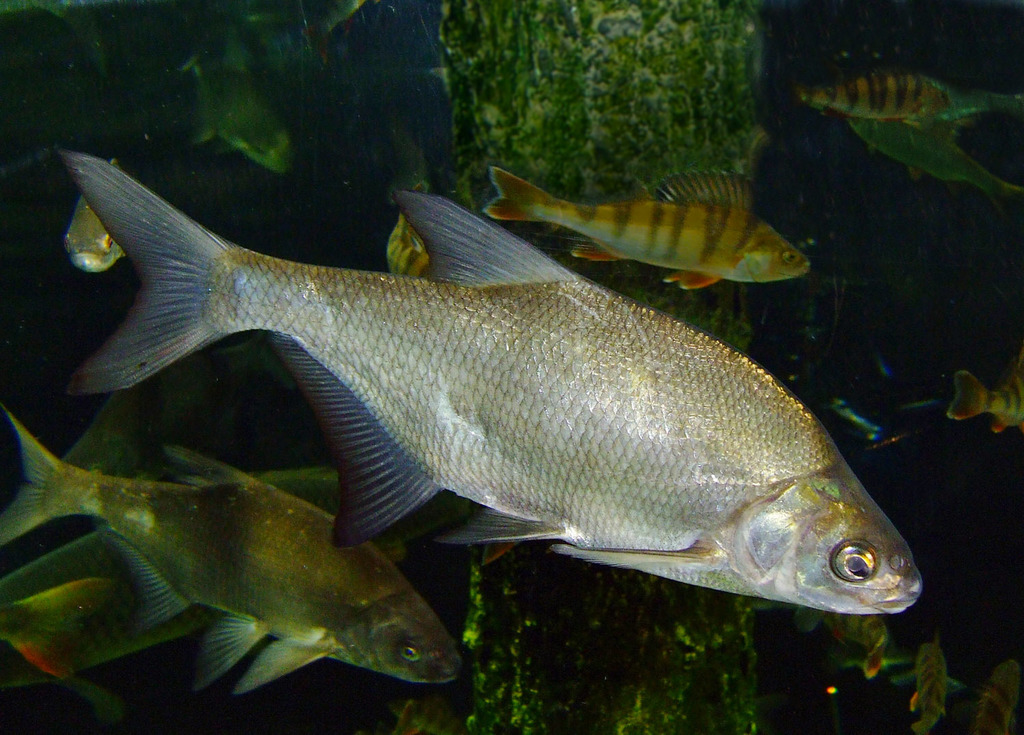
Common Bream
Abramis brama
The common bream (Abramis brama), also known as the freshwater bream, bream, bronze bream, carp bream or sweaty bream, is a European species of freshwater fish in the family Leuciscidae. It is now considered to be the only species in the genus Abramis.
From the article Common bream on Wikipedia (CC BY-SA), quoted section by section
Description
The bream is usually 30 to 55 cm (12 to 22 in) long, though some specimens of 75 cm (30 in) have been recorded; it usually weighs 2 to 4 kg (4.4 to 8.8 lb). Its maximum length is 90 cm (35 in), the record weight exceeds 9 kg (20 lb). The common bream has a laterally flattened and high-backed body and a slightly undershot mouth. It has a bright silver colouration, though older fish can be bronze-coloured, especially in clear waters. The fins are greyish to black, but never reddish.
Similar-looking fish. The common bream can easily be confused with the silver or white bream (Blicca bjoerkna), in particular at the younger stages (see picture). The most reliable method of distinguishing these species is by counting the scales in a straight line downwards from the first ray of the dorsal fin to the lateral line. Silver bream have fewer than 10 rows of scales, while common bream have 11 or more. At the adult stage the reddish tint of the fin of the silver bream is diagnostic. Like other Cyprinidae, common bream can easily hybridise with other species, and hybrids with roach (Rutilus rutilus) can be very difficult to distinguish from pure-bred bream.
Immature specimens could also be confused with other European breams, such as the two Ballerus species or Vimba vimba.
Range & habitat
The common bream's home range is Europe north of the Alps and Pyrenees, as well as the Balkans. They are found as far east as the Caspian Sea, the Black Sea, and the Aral Sea. The common bream lives in ponds, lakes, canals, and slow-flowing rivers. The common bream generally lives in rivers (especially in the lower reaches) and in nutrient-rich lakes and ponds with muddy bottoms and plenty of algae. It can also be found in brackish sea waters.
Wikipedia: “Range and habitat”
What it does
The common bream lives in schools near the bottom. At night, common bream can feed close to the shore, and in clear waters with sandy bottoms, feeding pits can be seen during daytime. The fish's protractile mouth helps it dig for chironomid larvae, Tubifex worms, bivalves, and gastropods. The bream eats water plants and plankton, as well. In very turbid waters, common bream can occur in large numbers, which may result in a shortage of bottom-living prey such as chironomids. The bream are then forced to live by filter feeding with their gill rakers, Daphnia water fleas being the main prey. As the fish grows, the gill rakers become too far apart to catch small prey and the bream will not then grow bigger than 40 cm (16 in). If a common bream is malnourished, it can develop a so-called "knife back", a sharp edge along its back.
Wikipedia: “Feeding habits”
In human culture
The common bream is the only species in the genus Abramis, this name is an Ancient Greek name for a bream or mullet. The specific name is derived from Abramis.
Wikipedia: “Etymology”
Where it lives
Recorded sightings
—
geo-referenced records in GBIF, from museums, herbaria and field observers.
Drag the globe to turn it. Dots are where records exist, not a range map; darker means more records.
In the stacks
Searching the stacks…
Every page naming Abramis brama in the Biodiversity Heritage Library →
This page is assembled live from iNaturalist, GBIF, Wikipedia, the Source Library and the Internet Archive. It is not yet part of the hand-edited codex. iNaturalist taxon 92984.