On eBird ↗
Olive Warbler
Live sightings near you, the range map, bar charts of when it is seen, and Macaulay Library photos and recordings.
Olive Warbler
Peucedramus taeniatus
The olive warbler (Peucedramus taeniatus) is a small passerine bird. It is the only member of the genus Peucedramus and the family Peucedramidae.
This species breeds from southern Arizona and New Mexico, USA, south through Mexico to Nicaragua. It is one of the only bird families endemic to North America (including Central America). It was in the past classed with the Parulidae (New World warblers), but DNA studies suggest that it split early from the other related passerines, prior to the differentiation of the entire New World warbler/American sparrow/Icterid group. It is therefore now given a family of its own.
From the article Olive warbler on Wikipedia (CC BY-SA), quoted section by section
Description
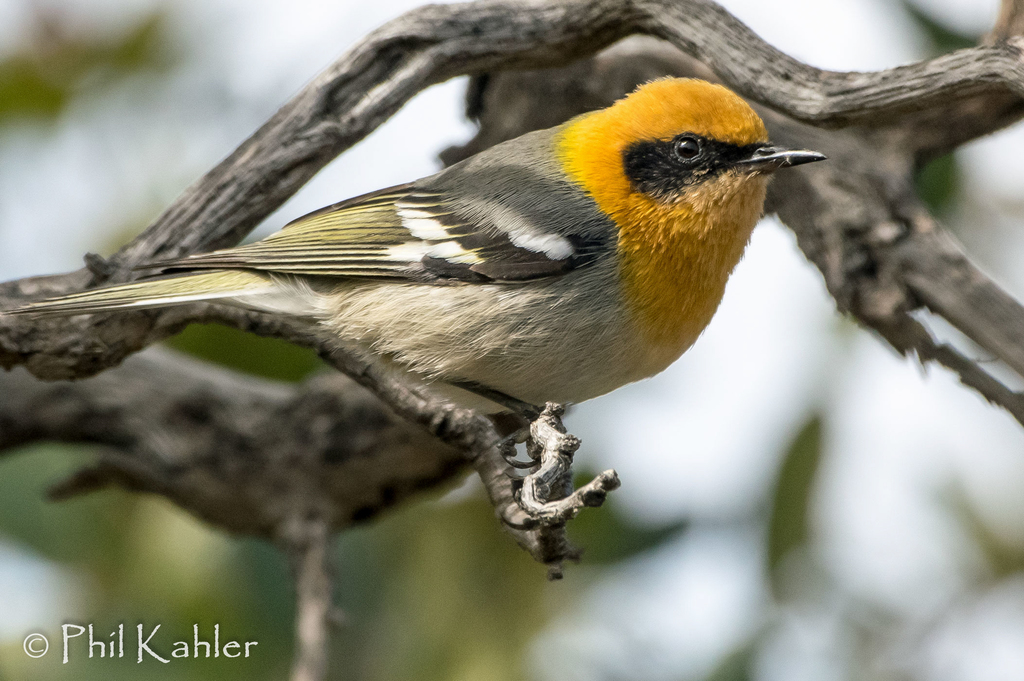
The olive warbler is a medium-sized warbler, 13 to 14 cm (5.1–5.5 in) in length and weighing 9.5 to 12 g (0.34–0.42 oz). It shows clinal variation in size, with more northern populations being larger than southern ones, a phenomenon known as Bergmann's rule. The olive warbler is a long-winged bird. The plumage of the male is mostly grey body with some olive-green on the wings and two white wing bars. The male's head and breast are "tawny-orange", and there is a black patch through the eye. In the female and juvenile, the orange is replaced by yellow, and the black mask is more diffuse. In addition to differences in size, plumage varies geographically as well, with southern birds having more brightly coloured plumage. The song consists of clear whistles rendered as hirrJI hirrJI hirrJI, plida plida plida chir chir, etc. The male sings throughout the year, with the frequency of the singing increasing in late winter and reaching a peak in early spring. During the year the male sings the most during the midmorning, but during spring the male sings constantly during mornings and late afternoon. Song is usually delivered from the canopy or other tall trees.
Range & habitat
The olive warbler is distributed from the southwestern United States to Nicaragua, making it the only bird family endemic to North America. In the northern part of its range it has a continuous distribution from Yavapai County, Arizona and the southwestern tip of New Mexico along central Mexico to southern Mexico. It has a disjunct distribution across the rest of its range, with populations in Tamaulipas, Coahuila and Sonora and Chihuahua in Mexico, and further south in southwest Guatemala and from northern El Salvador and central Honduras to northern Nicaragua. The olive warbler is a bird of mountains and highlands. In northern areas of its range it occurs from 2,600 m (8,500 ft) above sea level or more, in some parts of its range it may not occur below 3,500 m (11,500 ft). In Oaxaca in Mexico it occupies a range of between 1,700–3,000 m (5,600–9,800 ft) further south in Guatemala it ranges down to 1,850 m (6,070 ft) and at the southern end of its range it can be found as low as 1,000 m (3,300 ft) in Honduras and in Nicaragua it occupies a belt of forest from 1,070–1,370 m (3,510–4,490 ft) . They typically inhabit conifer forests, such as ponderosa and sugar pine forests in Arizona, Abies common fir forests, oak, and pine forests in central Mexico, Guatemala, and Honduras. These forests range from humid to semi-arid. …
Wikipedia: “Distribution and habitat”
What it does
The olive warbler is an insectivore, taking insects and other arthropods. No specific information exists about the actual prey species taken, except that they will take the larvae of Tortricidae moths. It forages in forests in the canopy and subcanopy. In feeds in the outer branches and twigs. It mostly feeds in the branches of ponderosa pines, but also feeds in the branches of grey and silverleaf oaks.
Wikipedia: “Diet and feeding”
Listen
Looking for field recordings…
Where it lives
Recorded sightings
—
geo-referenced records in GBIF, from museums, herbaria and field observers.
Drag the globe to turn it. Dots are where records exist, not a range map; darker means more records.
In the stacks
Searching the stacks…
Every page naming Peucedramus taeniatus in the Biodiversity Heritage Library →
This page is assembled live from iNaturalist, GBIF, Wikipedia, the Source Library and the Internet Archive. It is not yet part of the hand-edited codex. iNaturalist taxon 9312.