On eBird ↗
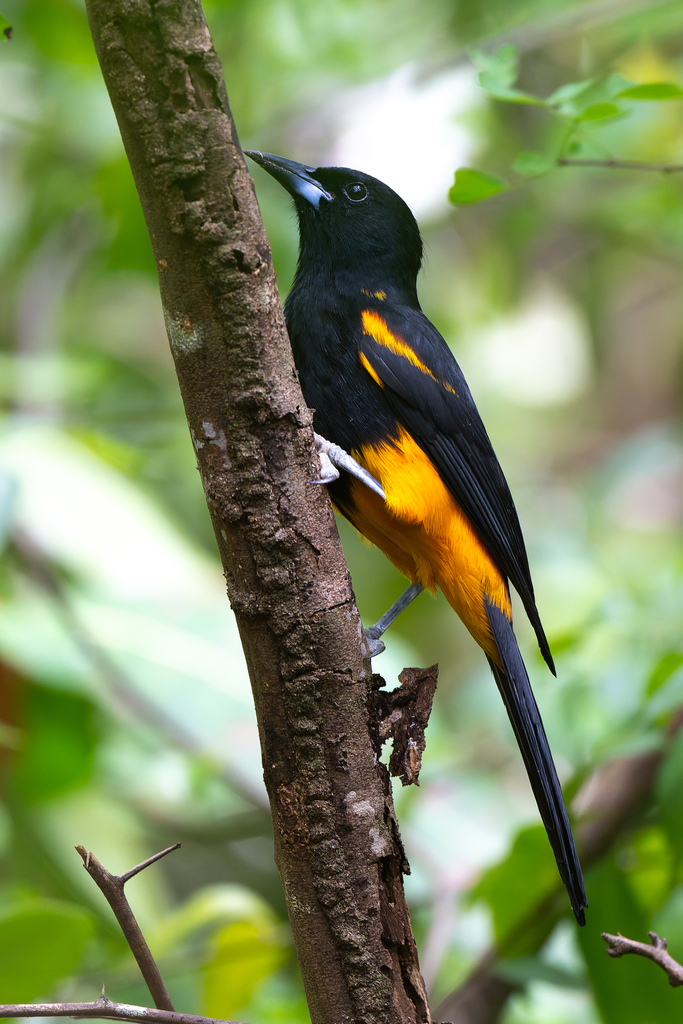
St. Lucia Oriole
Live sightings near you, the range map, bar charts of when it is seen, and Macaulay Library photos and recordings.
St. Lucia Oriole
Icterus laudabilis
The Saint Lucia oriole (Icterus laudablis) is a species of songbird endemic to Saint Lucia. Locally known as the Corouge, it is in the family Icteridae and the genus Icterus (or New World orioles). Due to human development, this species of Oriole (a long with many others in the Caribbean) has seen significant population decline due to invasive species and habitat loss.
From the article Saint Lucia oriole on Wikipedia (CC BY-SA), quoted section by section
Range & habitat
St. Lucia orioles are endemic to, and exclusively found on the main island of St. Lucia located in the Lesser Antilles. The Saint Lucia Oriole does not migrate. They are the only resident orioles on the island, however, Baltimore and Orchard orioles may be found in the region as vagrants. St. Lucia orioles are known to inhabit mountain rainforests, dry coastal scrub forests, primary and secondary forests, the edges of certain plantations (such as banana citrus and coconut) and mangroves (particularly those that adjoin coastal scrub). They appear to prefer humid mountain forests over the dry coastal scrub forests. The regions which are inhabited by St. Lucia orioles range from sea level up to 700m in elevation.
Wikipedia: “Geography & Habitat”
What it does
Typical of the Icterid family, St. Lucia orioles exhibit wide range of foraging adaptations. They feed on both fruits and insects. St. Lucia orioles are often found in pairs foraging in trees. However, small groups (of up to ten individuals) have been observed. They have also been observed stripping oak bark to that of a similar manner to their relatives the Jamaican oriole. They produce a typical hanging oriole nest, which is basket shaped, and woven from plant fibers. The St. Lucia oriole nests under large fronds of banana plants and in coconut palms. Females lay 2–3 eggs at a time. Males do not feed the female during nesting, but they may aid in provisioning the young. Nesting occurs through April to early June. Between late June – August, juveniles (some being fed by adults) have been observed.
== References ==
Wikipedia: “Behavior”
Listen
Looking for field recordings…
Where it lives
Recorded sightings
—
geo-referenced records in GBIF, from museums, herbaria and field observers.
Drag the globe to turn it. Dots are where records exist, not a range map; darker means more records.
In the stacks
Searching the stacks…
Every page naming Icterus laudabilis in the Biodiversity Heritage Library →
This page is assembled live from iNaturalist, GBIF, Wikipedia, the Source Library and the Internet Archive. It is not yet part of the hand-edited codex. iNaturalist taxon 9331.