On eBird ↗
Venezuelan Troupial
Live sightings near you, the range map, bar charts of when it is seen, and Macaulay Library photos and recordings.
Venezuelan Troupial
Icterus icterus
The Venezuelan troupial (Icterus icterus) is the national bird of Venezuela and one of about 25 or so species of New World orioles. It is found in Colombia, Venezuela, and the Caribbean islands of Aruba, Curaçao, Bonaire, and Puerto Rico. Previously forming a superspecies simply named Turpial, it was recently split together with the orange-backed troupial and Campo troupial.
From the article Venezuelan troupial on Wikipedia (CC BY-SA), quoted section by section
Description
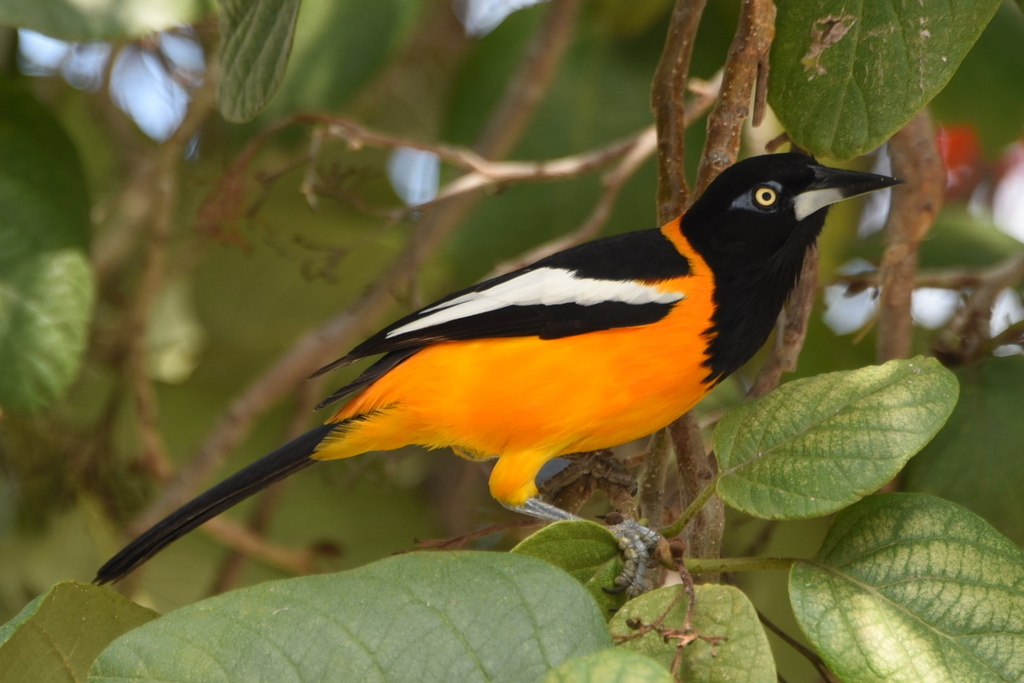
Venezuelan troupials are fairly large in size, with a long tail and a bulky bill. It has a black head and upper breast. The feathers on the front of the neck and upper breast stick outward, making an uneven boundary between the black and the orange of the bird's lower breast and underside. The rest of the orange color is found on the upper and lower back, separated by the black shoulders. The wings are mostly black except for a white streak that runs the length of the wing when in a closed position. The eyes are yellow, and surrounding each one, there is a patch of bright, blue, naked skin.
Subspecies. There are three subspecies: I. i. icterus, I. i. ridgwayi, and I. i. metai. Individuals of I. i. metae have more orange on the back and a black line that divides the lengthwise white wing-stripe in half. Individuals of I. i. ridgwayi are generally stronger and larger in proportion to the other subspecies.
Range & habitat
Venezuelan troupial inhabit dry areas like woodlands, gallery forest, dry scrub, plains, and open savanna, where they mainly forage for fruits of the giant cactus, which make up their entire diet while in season. However, they also consume other fruits, such as mangoes, sapodillas, papaya, soursop, dates and malpighia cherries. They have also been known to eat the juvenile birds and unhatched eggs of the nests they attack.
Wikipedia: “Habitat”
What it does
Their mating behavior can be expressed as defensive in both males and females. Although males usually sing as a sign of attracting females or defending themselves from unwanted/competing troupials. Duetting behavior in these particular birds is meant to defend their territories and maintain contact (communication). Males also approach this behavior during paternity guarding contexts, as this species' behavior is consistent in breeding and nonbreeding seasons. Their defending behavior was exclusively related to troupials having couples, as their partners usually elicit stronger vocals and physical responses.
Wikipedia: “Behavior”
In human culture
The Venezuelan troupial, as the national bird of Venezuela, appears on the reverse side of the Venezuelan Bs.S 500 banknote. Former Miss International Edymar Martínez wore the image as a national costume in 2015 in Tokyo, Japan.
Wikipedia: “In culture”
Listen
Looking for field recordings…
Where it lives
Recorded sightings
—
geo-referenced records in GBIF, from museums, herbaria and field observers.
Drag the globe to turn it. Dots are where records exist, not a range map; darker means more records.
In the stacks
Searching the stacks…
Every page naming Icterus icterus in the Biodiversity Heritage Library →
This page is assembled live from iNaturalist, GBIF, Wikipedia, the Source Library and the Internet Archive. It is not yet part of the hand-edited codex. iNaturalist taxon 9345.