- Animals
- ›Chordates
- ›Vertebrates
- ›Ray-finned Fishes
- ›Carps, Characins, Catfishes and Allies
- ›Minnows, Suckers, Carps, and Loaches
- ›Carps and Minnows
- ›True Minnows
- ›Old World Minnows
- ›Alburnus
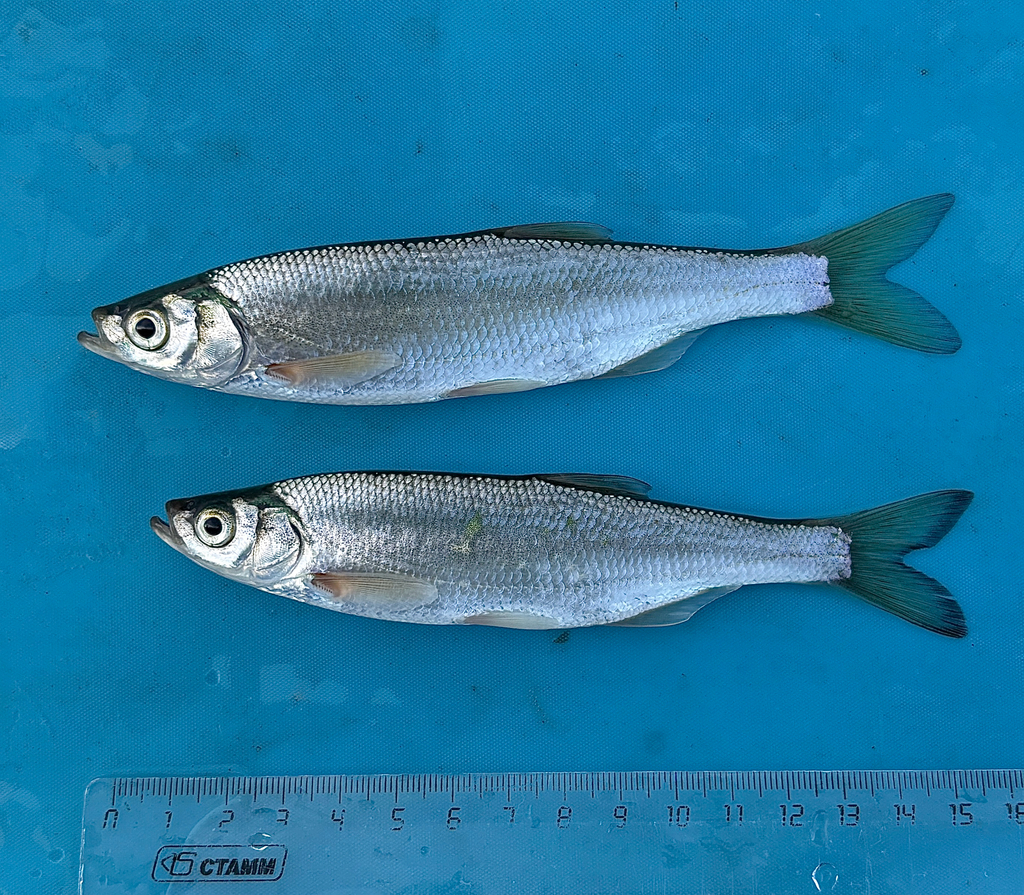
Crimea shemaya
Alburnus mentoides
Alburnus mentoides is a species of ray-finned fish in the genus Alburnus that is endemic to Crimea (Black and Azov Sea basins) in Ukraine. This freshwater fish grows up to a length of 13 centimetres (5.1 in) (SL).
From the article Alburnus mentoides on Wikipedia (CC BY-SA), quoted section by section
Description
The Crimean shemaya grows to a standard length of up to 13 centimetres (5.1 in). It can be distinguished from other Alburnus species that occur in the Black Sea by the following characteristics: the body has a faint dark line along the middle of the sides; the anal fin has 13–14.5 branched rays and originates 0.5 to 1.5 scales behind the last branched dorsal ray; there are 58–69 + 4 scales on the lateral line; there are 18–25 gill rakes; the ventral keel is exposed for 8 to 10 scales in front of the anus; the depth of the caudal peduncle is 1.7–1.9 times its length; and nuptial males have a limited number of large tubercles.
Range & habitat
The Crimean shemaya is endemic to southern Crimea, where it is found in middle and lower portions of the Bel'bek and Al'ma rivers, and two man-made impoundments on the Chornaya River. Its preferred habitats are the lower portions of rivers, alongside artificial habitats like reservoirs and canals. Crimean shemayas feed on zooplankton, invertebrates, and arthropods that fall into the water, hunting near the surface of the water. Foraging takes place in small streams. Adults begin breeding after three years and can live as long as five years. The breeding season lasts from June to July. Adults migrate to the upper reaches of the river to lay eggs in riffles in gravel beds with heavy currents. The Crimean shemaya is known to hybridise with the European chub.
Wikipedia: “Distribution and ecology”
Where it lives
Recorded sightings
—
geo-referenced records in GBIF, from museums, herbaria and field observers.
Drag the globe to turn it. Dots are where records exist, not a range map; darker means more records.
In the stacks
Searching the stacks…
Every page naming Alburnus mentoides in the Biodiversity Heritage Library →
This page is assembled live from iNaturalist, GBIF, Wikipedia, the Source Library and the Internet Archive. It is not yet part of the hand-edited codex. iNaturalist taxon 93622.